
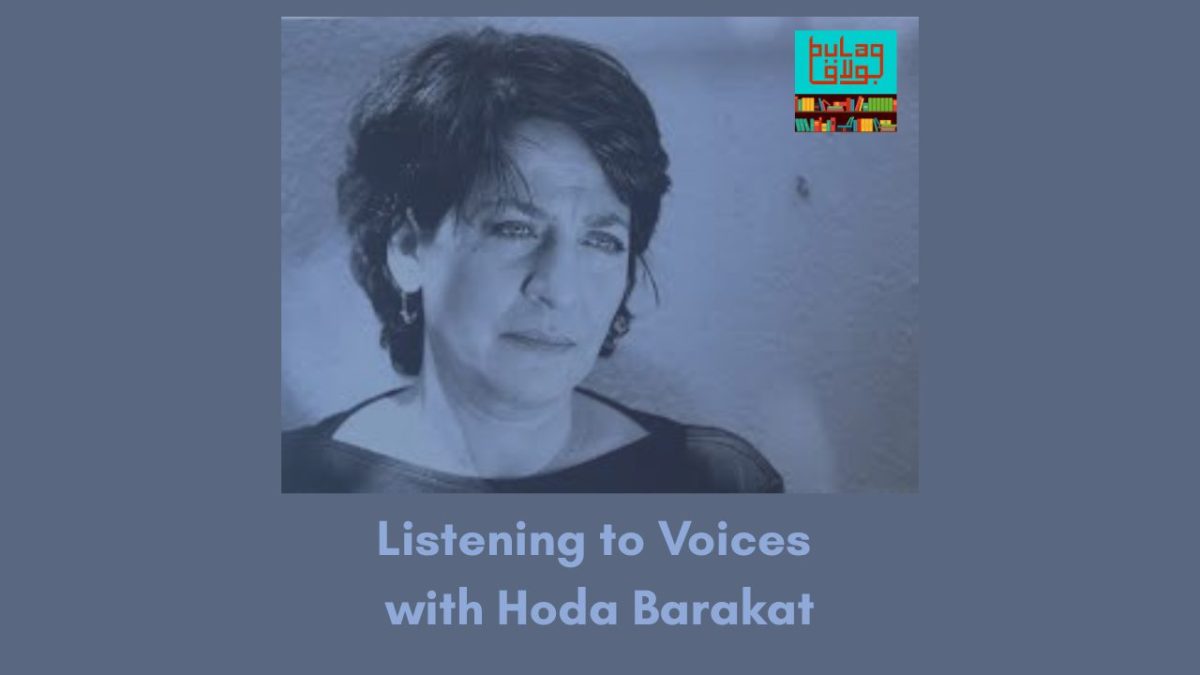

This is part of an interview with the Lebanese author Hoda Barakat that took place on September 30 2025. It has been translated from French and edited for clarity and length. You can also listen to the BULAQ episode based on this interview, in which we also discuss Barakat’s unique life journey and works. Barakat is the 2025 winner of the Sheikh Zayed Book Award for Literature.
UL: In your book Voices of the Lost there are stories of lonely people, lost people, people who are sometimes in danger. It made me wonder if you are someone who likes hearing other people’s stories, who collects stories? Was the starting point [for some of these characters] something you once heard?
HB: The word “hear” is fitting. They aren’t people I met in reality. But as with most of my novels, I had the impression that I was starting to hear voices. They are voices that don’t exist in reality. My characters aren’t people I’ve met or who have told me their story.
But what I was seeing in the world around me, what I found very exceptional in human history, was so many millions of people on the move, without even a real hope of arriving anywhere. Who want to leave their countries at any price. It really astounded me. […] We writers, artists or journalists assume that people love where they are from, love their countries, that they leave for economic reasons, that they want return and build something their country. But it seemed to me that this notion has been tainted. There are people who take unimaginable risks, who jump with their babies into the ocean, on makeshift boats, and when they arrive they tear up their papers, because they don’t want to go back. This kind of migration is astounding. These people know that they are not loved or appreciated or wanted where they are going. […] I don’t have any answers, but all of this intrigued me. From afar, I saw migrants moving from one camp to another, being hunted down by police and even by residents of some neighborhoods. At some of the borders of Europe they were threatened and even shot at…and still they kept going. I wanted, just between myself and I, to figure out who these people were. Without saying – you may have noticed this – that they are victims or angels, or that others are devils.
Many of these migrants come from my region, the one that I left. Some of them are fleeing their countries because they are wanted by the authorities, they aren’t all angels and I don’t defend them. That’s why when they write their letters, they lie. Even as they are confessing, as we have the impression that they want to confess, to tell the truth, it’s not always the truth. Because when you’re raised in corrupt and unjust systems, and you’re forced to cope with these regimes, somehow you also come to resemble them, even as you try to escape their injustices. It’s a long story, a story told by millions and millions, who continue to walk and to die without arriving. Because they don’t have a clear goal of arriving somewhere, of establishing something, they are simply in flight, they continue to flee. That’s why the letters don’t have destinations, addresses, they have no end point, they aren’t of interest to hardly anyone. It’s this kind of solitude that I tried, let’s say, to listen to.
UL: The individual voices are very strong and different but you don’t mention what country or city they are from… the individuals are vivid but the background is ambiguous, fluid.
HB: So as not to give the impression that it’s all because of where they come from. It’s their personal story, not the story of their countries, that interests me. But the whole region – we can see it every day – is suffering the destiny of being pushed out of history. […] As if people are being physically pushed out. There are regions of the world that the strong, powerful parts of the world don’t need at all anymore. Values are changing. We see it every day. […]
UL: We’ve certainly reached terribly low points in recent years.
HB: What’s terrible is that you can start to lose your curiosity about the world. You don’t want to know more. Knowledge doesn’t help you act. It’s a knowledge that ends in despair, you tell yourself: there’s nothing to be done. These are the times we live in. This is dangerous, dangerous for the younger generation, for people who want to live in today’s world.
UL: All that you write is in the context of Lebanon, the Arab world. It’s a context that feels very hopeless. How does this affect you as a writer?
You know, ever since my first novel, which had a considerable impact in the Arab world, because I wrote and write in Arabic…people were surprised, they found it a bit original, a bit bizarre…But as you say I always start from individual cases, individuals that I have imagined, I don’t write about facts or real events or my memories, it’s all really made up in my head.
And most of the time, there are questions. Even when you are down in the dark bottom of a well, what remains – if you don’t have ideas you want to preach, if you don’t have convictions – is an anguish that takes the form of questions. I pose questions, let’s say existential enigmas, but the reader is also invited to ask: What does this woman, this writer want to say? The reader will try to understand, will find that they are themselves concerned, and if they like they themselves can ask questions. Because I myself, for a long time now, I confess that I don’t have the answers. But the important thing is to pose the right questions. In each of my novels, there are people who are unbalanced, who are lost, who don’t have the strength to struggle against fate. Because they try to struggle but they find themselves in conditions, in a situation – local, general or international – such that their struggle is vain.
UL: The form of Voices of the Lost is the epistolary form, this old form that goes back to the earliest novels, that has been reinvented many times. But what’s striking is that in your book there are no exchanges..
HB: That’s why it’s a fake epistolary novel. Because there is no exchange.
UL: There is a chain.
HB: There is a chain. And in the second part of the novel, the answers come from elsewhere, [those answering] aren’t really concerned with the ones who wrote [the original letters]. There is a disconnect between the person who wanted to send the letter that didn’t arrive, and the one who didn’t receive the letter. There is a complete disconnect. It’s a deep misunderstanding. It’s non-communication.
UL: And yet there is a great communication with us readers..
HB: It’s the readers who receive the letters, not the characters.
UL: We receive them and you have sent them. With each letter, we’re sucked in by the story and the character, but afterwards when we think about it, we say: that’s not a real letter, it’s not realistic that anyone would write such a letter, no one sits down at an airport and writes a letter like that. We are caught up in the story-telling but after we tell ourselves: these are dream-letters, imagined ones that could never exist. There’s this real-unreal quality that is very beautiful.
HB: Thank you. Because you know, the reader re-writes what he or she reads with you. There are those you can’t communicate this to. Or who read you poorly. This doesn’t hurt me. Ever since my first novel — I was very incensed, for the wrong reasons. Then I told myself: It’s all right. A later generation will read it and understand it better. [21]
UL: What was misunderstood in your first novel (The Stone of Laughter)?
HB: You know the central character, Khalil, is a homosexual. Sometimes society, your readers – they are pre-programmed. So some readers adore what you write because of your style, but they understand you poorly. If you say something new, that doesn’t fit their mentality, there is misunderstanding. They love it, but they don’t know why. Some eminent critics said that the novel was a masterpiece but they said that [the character of Khalil] was effeminate, that the civil war took away his dignity, that he was emasculated […] that the civil war deformed people, made them unhealthy, engaging in unhealthy behavior. But for me it was the opposite. I defended [Khalil] until he tried to renounce his homosexuality. For me his fall, the fall of his morality, was when he acted like all the others, like all men.
UL: In your forthcoming book Hind or the Most Beautiful Woman in the World, what led you to become interested in the disease of acromegaly, to decide to make it a feature of your narrator?
HB: I had this impression that, if you will, the world is expanding and deforming. Cities, people’s homes, men and women. It’s as if there is an excrescence, things growing so fast and not in a pretty way. And when I started to hear the voice of this character, I wasn’t headed towards this idea, of acromegaly. I started by a question around beauty and ugliness. I started asking myself: what is beautiful and not beautiful in what I live, in what I see, in my memories of my country –how I don’t find it beautiful now, how it was beautiful once, was it really so beautiful, or were we just kidding ourselves? Because there are always legends, around Lebanon and other Arab countries. […] In Arab countries and other developing countries there is not history in the scientific sense of the word. There are only legends. This is why identity in these countries is so problematic and crumbles so quickly – in civil wars..[…] These are big questions. I didn’t start with this. I started with a mother who has lost a child, a very pretty little girl. This is my personal story. My mother lost a little girl before me. She was eight months old. And my mother always talks about her extraordinary beauty. Because she lost her. This is loss, which she couldn’t accept. And I saw.. they had put away the picture of this sister who was born before my birth. When I saw her photograph, it was incredible how much I resembled her.
And so I asked myself: Did my mother love me because I looked..? It started like that, with some questions that are a bit stupid. Did my mother love me so much because I looked like this sister, or for myself? And then I asked myself: Why do we always exaggerate the beauty of the people we love? They’re the most beautiful people in the world. And they can also be the most ugly people in the world, because they don’t respond to our desires. I started from there. And then I realized as I wrote that everything around me was like a legend. We are never sure of being fully loved, being fully Christian, Muslim, Lebanese, Arab. All this confusion – I always start from confusion..I
I arrived a bit by chance at acromegaly. When I was preparing this novel in my head, I saw an article in a newspaper and I saw how a woman had become. I thought, my God […] How beauty can be threatened by nothing at all…can we remain loved if we catch the disease of ugliness? And what is ugly, finally? Maybe it is a lie. When you read the whole novel, you may believe it’s a lie. Hanadi and her sister Hind might be the same person. One can imagine that.
I took pleasure in writing it. For me, you have to love the text, not write to follow a well-traced-out line. These is no clear plan. It’s as I write that I discover what I want to say.