
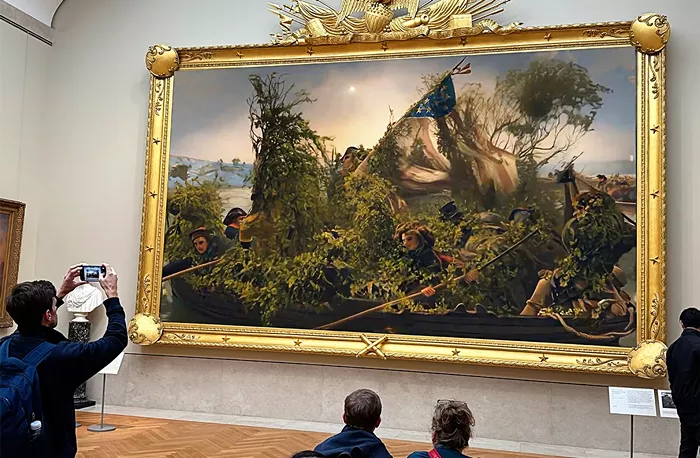
“Did you see Washington Crossing the Delaware?” a security officer asked as I scrutinized the labyrinthine floor plan of the Metropolitan Museum of Art. “It’s the largest painting in the American Wing. Nearly 22 feet across!”
I had indeed seen it, in all its largeness. It dominated the gallery packed with a crowd that collectively craned its neck to take in the larger-than-life future president, his stony stoicism radiating bombastically amid turbulent waters. But that’s where my experience of the art diverged from the rest of the tourists in the room.
I held my phone up to the painting, and then, as though a hit of psilocybin had just kicked in, the details of the painting began to move. The floating ice atop the river currents jostled, oars churned, and the chests of men heaved. Words materialized: “Rights Of Nature” seared white against the overcast sky, only to dissipate just as quickly into a scattering flock of white birds. The image of Washington and his men soon melted, water giving way to effervescent vegetation that coalesced into shifting forest, which dissipated into a radiant night sky with the words “landback” stamped into the black. I’d never seen anything like this before—not in a museum, or anywhere.
Nearby visitors did a double take at the image dancing across my phone. This visual sorcery was happening on my screen, augmented reality unfolding in real time. Other people were witnessing a frozen moment painted by Emanuel Leutze in 1851. I was watching an artwork called LANDBACK by an artist called Flechas. Twenty-six artworks like this one are currently being activated at the Met, available to view through the end of the year.
Titled ENCODED, this guerrilla art exhibit is an attempt to address the erasure of Indigenous presence throughout American art history. The absence of Indigenous bodies—or Indigenous anything—is a glaring omission among the 20,000 artworks on view in the American Wing. Instead, galleries are filled with pristine, unpeopled landscapes, there for the (re)claiming. The romanticized paintings of Albert Bierstadt and his Hudson River School colleagues set the tone early on, and as colonizers decimated the lives, fortunes, and lands of some 1,000 Indigenous tribes across Turtle Island (the Indigenous name for North America), the genre was cemented into art history. Paintings served as postcards for westward expansion, offering a thinly veiled (if veiled at all) gospel of manifest destiny.
To access ENCODED (on view through the end of the year), visitors at the Met can launch an AR viewer accessible via QR code on the exhibit’s website, encodedatthemet.com. The site also offers a gallery of videos that capture what the experience looks like firsthand, as well as a link to an Amplifier app that allows folks at home to activate the static target images through their phone.
While it features work made by 17 Indigenous artists from across the continent, ENCODED has tendrils deep through the Pacific Northwest. It is also, simply put, unprecedented, both for the technology it employs and because it is unsanctioned. Not illegal, per se, but executed without permission.
Hacking the Met was something Cleo Barnett had been thinking about for years. It was the kind of thing her nonprofit, Amplifier, was made for. Founded by Barnett and Aaron Huey nearly 10 years ago in Seattle, the media lab works with artists and technologists to create unforgettable multimedia campaigns focused on disrupting, educating, and amplifying voices. With under 10 employees, the team is small and limber—they can work fast in response to political and cultural events. “We have always been interested in how we can bring the voices of artists from our community into different public spaces, in order to tap into collective consciousness and shift it,” says Barnett. “The American Wing of the Met is the pulse point of the propaganda that we’ve all been told about the founding story of this country in its current form.”
Technology provided a way to address these omissions through AR interventions by Indigenous artists. But the timing and the funding (or lack thereof) was never quite right until this past summer, when Barnett pitched the idea to an anonymous Indigenous funder who agreed to take on the project immediately. With only a three-month runway to Indigenous Peoples’ Day (the second Monday of October), Barnett brought on Tracy Renée Rector to curate the group of artists. “I wanted to show the breadth of Indigenous technologies, ranging from millennium-old pottery to digital art—a span of Indigenous creativity,” says Rector, a filmmaker and curator who splits her time between Portland and Tacoma. For the past decade, Rector has served as the executive director of Longhouse Media, which she cofounded and which produces the youth media program Native Lens. “In the two months before the launch, the technology itself changed so much,” says Rector. “The tech is so incredibly new that even a week before the show, there were major adjustments.”
Many of the pieces in ENCODED push the limits of what AR can currently do, like rendering 3D images that are anchored to 3D objects. Katsitsionni Fox’s Gifts From the Ancestors appears tethered to neither earth nor air. The target artwork in the Met’s collection is Indian Vase, a marble amphora by Ames Van Wart, the well-to-do descendant of colonizers (his grandmother was Washington Irving’s sister) and European playboy. The ornate vase, which was created on the occasion of America’s centennial, features two Indigenous warriors perched on the rim, hunched in resignation. The scene of a buffalo hunt—a wistful memory—plays out in relief carved around the base. Seen through the lens of ENCODED, the marble is eclipsed by a huge clay Haudenosaunee vessel painted blue and decorated with meteor showers. As the viewer circles around the plinth, tails of shooting stars spiral through the air, raining down.
Nearby is Cass Gardiner’s transformation of Jerome B. Thompson’s The Belated Party on Mansfield Mountain. It’s a saccharine painting featuring a group of rosy-cheeked picnickers in gowns and ascots gathered on a mountaintop. One figure—a shabbier, less dandified iteration of Caspar David Friedrich’s Wanderer Above the Sea of Fog—stands gazing into the expanse of the unfolding mountain range. Gardiner’s activation turns the bucolic landscape into a pixelated image displayed on an old Windows screen—a scene from the Oregon Trail computer game. Two 8-bit Indigenous figures pop up in frame, accompanied by a text block that says: “Look at these guys, acting like they discovered the place.”
Mexican Girl Dying is another piece in the Met’s collection—a woman wounded in battle, rendered in marble, recumbent on the floor of the bustling Charles Engelhard Court. The fortress-like neoclassical façade of the Branch Bank of the United States (originally located on Wall Street) serves as backdrop to the spectacle. Her back is arched as she clutches a naked breast in one hand, a rosary in the other. The sculptor, Thomas Crawford, carved the piece in Rome in 1848, inspired by William H. Prescott’s sensationalized History of the Conquest of Mexico, published just a few years earlier.
Priscilla Dobler Dzul’s augmentation of Mexican Girl Dying is a literal and figurative redressing. The nakedness has been covered with a heavily embroidered pelt of a puma—the digital rendering of a piece Dobler Dzul created for an exhibit at MadArt in Seattle in 2023. The original was made using the pelt of a cougar that died in captivity at a local zoo. The AR component proved one of the most ambitious in the exhibit; both the pelt and the marble sculpture were photographed thousands of times from every angle, in every type of light. (For each piece in ENCODED, the Amplifier team visited and photographed target objects at the Met continually throughout the full breadth of daylight hours in order to seamlessly recreate the image in AR.)
For Dobler Dzul, the intervention is a celebration of her Yucatán Maya ancestry, an attempt to undo the colonial flattening of the cultural identities of nearly 70 Indigenous tribes that populated the region currently known as Mexico. It is also an act of defiance: interrupting a gaze that is endemic to the colonial exploitation of bodies.
In another room in the wing, Jarrette Werk reimagines Seymour Joseph Guy’s Story of Golden Locks—a shadowy depiction of a little white girl regaling her siblings with the British fairy tale—into a portrait of his niece, Harmony. Werk is a journalist and photographer who works for Underscore Native News in Portland, an organization that covers Indigenous communities in the Northwest. For his piece, Werk interviewed and filmed his young niece Harmony (or Bííín íθeih in Aaniiih). In The Story of Bííín íθeih, what emerges from the shadows of Golden Locks is a portrait of exuberance. Trembling rainbows burst into fields of flowers as Harmony describes the joys of being Native.
”So much of the photography of our Native youth has served as propaganda,” Werk says. “Photographers came through Indian boarding schools with a mission to document children being ‘civilized.’ So many of those children look so sad. In the work I do, the youth I encounter are beautiful, vibrant little spirits. They’re having fun. There are many lasting impacts of colonization, but we’re beginning to see intergenerational healing. That’s what I wanted to showcase.”
Portland-based ENCODED artist, writer, and activist Demian DinéYazhi´, from the Navajo Nation (Diné), doesn’t mince words: “Western art history is colonial propaganda.” It’s one of many letterpress statements DinéYazhi´ created for the series Protect the Sacred Voice, made during a residency at Mullowney Printing.
DinéYazhi´ has never stepped foot in the Met. “When I first got the call from Tracy, I was nervous because the Met is one space that I refused to enter,” says DinéYazhi´. “I refused to allow my ancestral philosophies or symbols to be in conversation with the space through my own practice.”
DinéYazhi´s work is frequently rooted in language, text used directly and subversively to critique the institutional structures and powers at play in the art world—powers that dictate who gets to make work, who gets paid, who gets seen. The work of dismantling and rebuilding these structures goes hand in hand with decolonizing work. Violence, power, and genocide are all intertwined, encoded within art history.
Upon entering the American Wing, DinéYazhi´s piece is one of the first interventions activated through the exhibit’s AR filter, with text superimposed over a lavish mosaic fountain mural designed by Louis Comfort Tiffany. The augmented view reveals a neon sign that flashes across the iridescent Favrile glass swans. It says: we deserve dignity over solidarity / we desire survival over statements / we demand resources over acknowledgements.
ENCODED is not DinéYazhi´s first time hacking a museum. Their piece in the 2024 Whitney Biennial served as a Trojan horse of a poem; stanzas of red neon letters mounted to a steel framework made headlines because of a hidden message revealed only after the piece was installed at the museum. As the neon letters intermittently flickered, they spelled out the words “free Palestine.”
“At the end of the day it’s not a priority of mine to tell people to go to the Met to experience this exhibition,” DinéYazhi´ says. “I think the major takeaway is that we become aware of ways we maintain our power as artists and as individuals in this shared time in our history. As artists, we need to continue to dream new ways of strategizing in these spaces, of challenging these spaces, of maintaining our voice.”
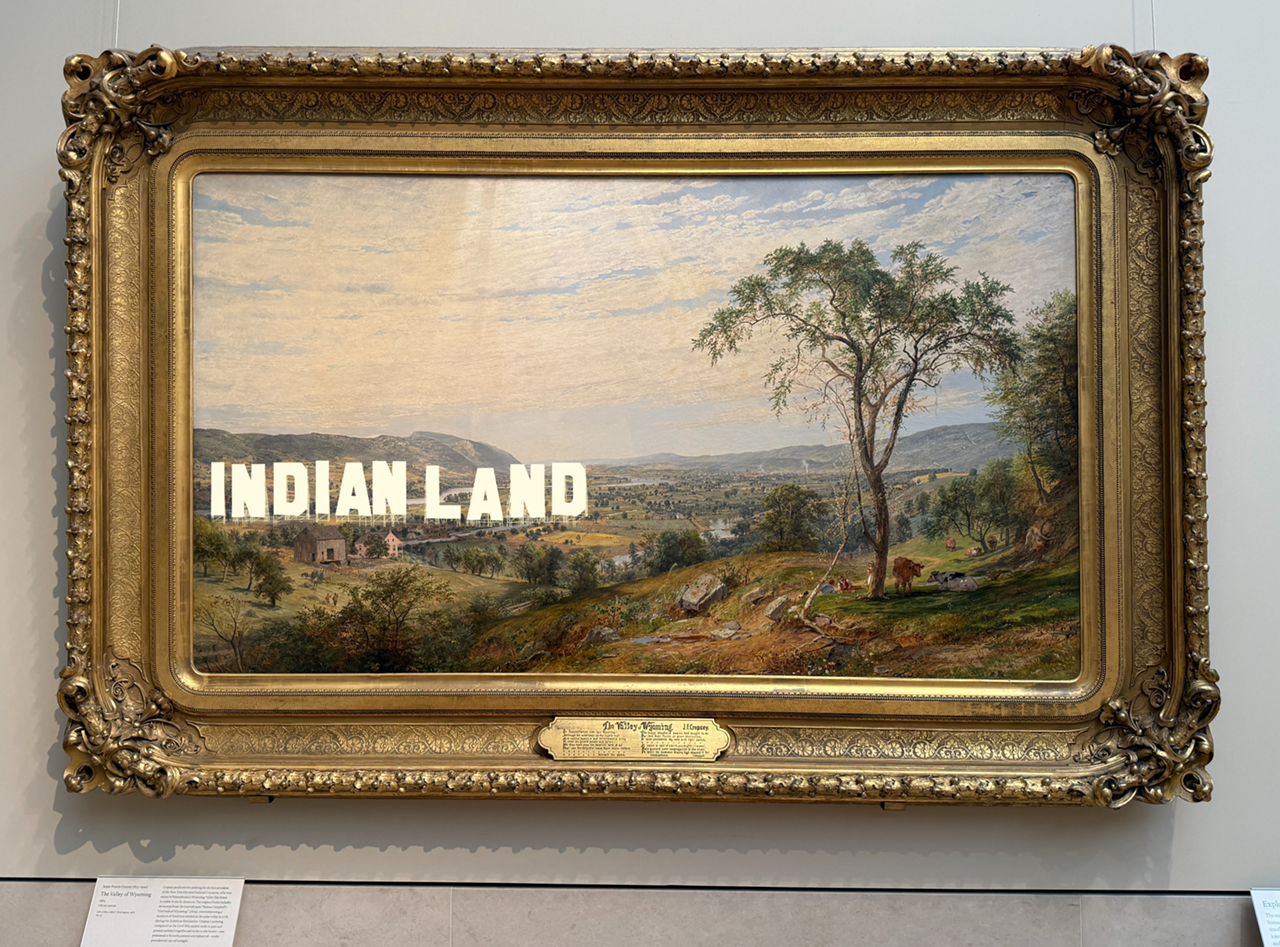
Unlocking the art in ENCODED feels like a scavenger hunt after a while. Nicholas Galanin’s iconic Never Forget (featuring the words “INDIAN LAND” in the style of the old Hollywood sign, originally erected outside Palm Springs for the 2021 iteration of Desert X) appears nestled along the horizon of Jasper Francis Cropsey’s 1865 painting Valley of Wyoming. In other paintings still, Cannupa Hanska Luger’s Midéegaadi figures dance across hollow landscapes, or emerge through the tangled flourishes of 19th-century wallpaper covering gallery walls—dances to summon the bison back to the land. At times the dancers’ toes balance on the precipitous edge of the painting’s gilt frame. In such moments the seamless integration of the augmented image is pure thrill.
As of now, the Met has yet to issue an official statement about ENCODED and its interventions (though it seems it would behoove the institution to acquire the exhibition works and offer them as a permanent extension of their collection).
Regardless, the strategy behind ENCODED is a success on many levels. It navigates defiance with delicacy: No art was harmed in the making of the exhibit. Perhaps most importantly, it feels like a breakthrough in the way art can be experienced on the most fundamental level. I won’t lie: Once you’ve begun to unlock the artworks in ENCODED, it’s hard to go back to viewing the static, one-dimensional relics. And I don’t think that’s a bad thing. At a time in human history when technology seems to be threatening our collective intelligence and livelihoods, the breakthroughs produced by Amplifier and the artists of ENCODED prove that we are still only just beginning to discover the potential of the new tools at hand. And (as is often the case), it is artists who lead the way in dreaming that potential to life.