
Japanese Beetle–Resistant Roses for Your Garden


Growing roses in the Rocky Mountain region has never been easy. We gardeners are familiar with the periods of drought, sudden cold snaps, and dry winters that zap rose vigor and leave plants resprouting from their bases. Many of us have shifted to shopping for own-root (rather than grafted) plants whenever possible; have taken up winter watering—dragging hoses to and fro as if participating in some sort of monthly, slow-motion ritual; and modified our pruning practices to account for greater and later cold damage. Often, I don’t prune substantially until mid to late May, to avoid encouraging plants to break dormancy or opening their vasculature in the event of a late hard freeze.
Still, we’ve been blessed, until recently, to have enjoyed gardens free of Japanese beetles, which prefer roses above almost all other plants (of which they eat a dizzying spread in the first place). Since their arrival in Denver over 10 years ago and Fort Collins more recently, growing tidy-looking roses has become even more difficult. And, because they are gradually spreading west, other vicinities in the Rocky Mountain region will soon have to tackle this challenge head-on.

It’s worth noting that this piece won’t cover Japanese beetle management by active control measures; it will focus on plant selection as a means of minimizing beetle damage in the rose garden. For general information on Japanese beetles and an introduction to their management, check out this resource from CSU Extension: Japanese Beetle.
Learn more: How to Get Rid of Japanese Beetles
Early Flowering Roses Get a Jump on the Competition
Roses that bloom prior to the emergence of adult Japanese beetles are among those least bothered by their presence in regional gardens. These would include many species roses (the original genetic building blocks for much of the roses we cultivate in gardens today) as well as several old garden roses (sometimes referred to as OGRs). Old garden roses emerged less through active breeding programs and more through observation and selection of superior roses in cultivation prior to the year 1867, which, not by coincidence, is the year the first hybrid tea rose was introduced.
These older roses, in many cases, also benefit from greater innate tolerance for extreme weather than newer rose groups and tend to be especially vigorous. In some native roses, like thornless wild rose (Rosa blanda, Zones 3–7) and Woods’ rose (Rosa woodsii, Zones 3–8), which some now lump with blanda, suckering can be extensive. These plants are best kept to the back forty. Most others in this early flowering group don’t sucker, or sucker modestly, developing into what looks like a shrub. Regardless of their habit, many roses in this group make superb wildlife plants, providing good cover thanks to their dense and thorny stems, plentiful foliage, and hips. Below is a list of suggested species and OGR roses for “beating the beetle”; these plants will complete most of their bloom before adult beetles emerge or after they die off for the year, and so are less susceptible to beetle feeding.

Thornless wild rose and Woods’ rose
Rosa blanda and Rosa woodsii
- Native, wild roses by various names
- Single, fragrant, soft pink flowers with yellow centers
- R. blanda reaches 3 to 6 feet tall and R. woodsii grows half as high; both grow into wide-forming, loose colonies in favorable sites
White rose of York
Rosa × alba ‘Semi-Plena’
- Zones 4–9
- 6 to 9 feet high and half as wide; irregular to vase shape
- Semi-double white flowers
Autumn Damask rose
Rosa × damascena nothovar. semperflorens
- Zones 4–9
- 4 to 6 feet tall and tend to be narrower
- Double pink flowers with strong fragrance
- The only rose in this list that routinely flowers in the spring and fall, conveniently taking a pause during the midsummer beetle onslaught)
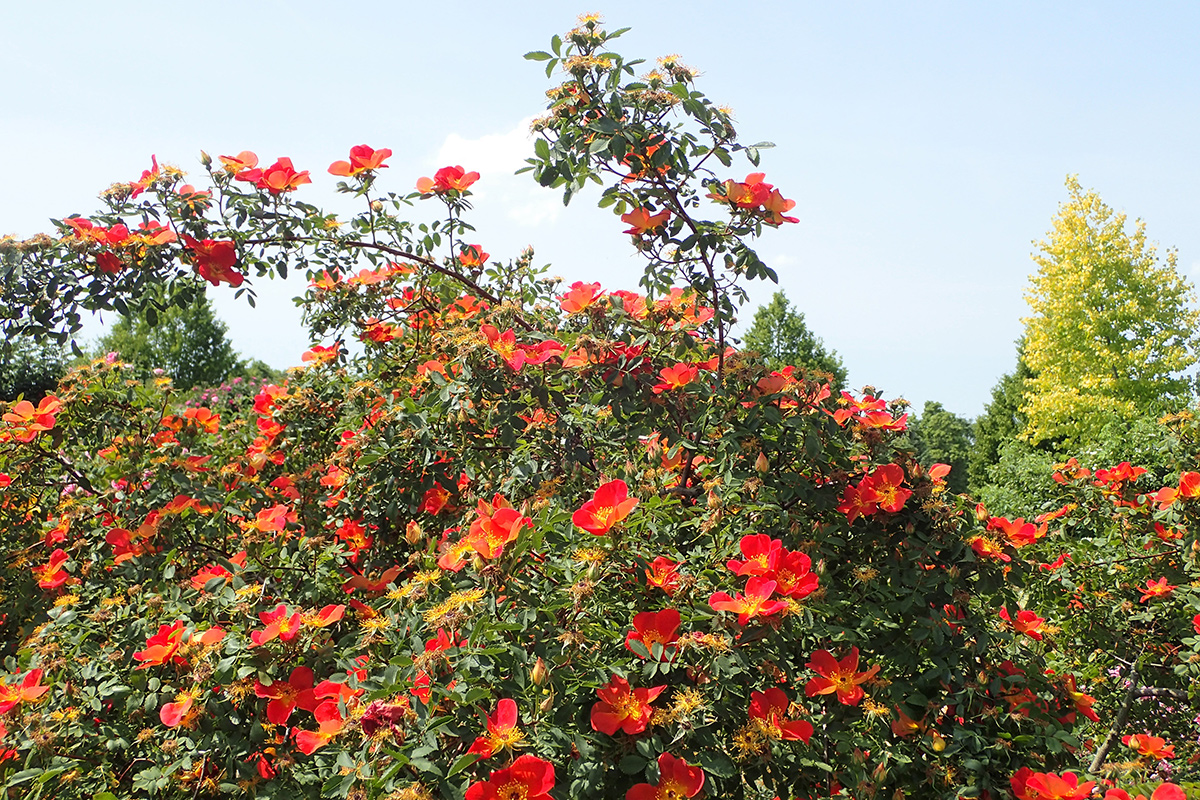
Foetida rose varieties:
Austrian copper (Rosa foetida ‘Bicolor’)
- Zones 3–9
- Up to 6 feet high and wide, some suckering
- Unique combination of mostly rusty orange/copper, single blooms with branches of all yellow flowers intermingled, both colors lightly fragrant
Persian Yellow (Rosa foetida persiana)
- Zones 4–9
- Up to 6 feet high and wide; upright to arching form with some suckering
- Double, lightly fragrant, bright yellow flowers
- Especially drought tolerant
Harison’s Yellow (Rosa x harisonii ‘Harison’s Yellow’)
- Zones 3–9
- Up to 6 feet high and wide; upright to arching form with some suckering
- Semi-double, lightly fragrant, bright yellow flowers
- Especially drought tolerant

French roses
Rosa gallica
- Zones 4–9
- 3 to 4 feet tall and wide, suckering slightly
- Semi-double to double, extra-fragrant, white to pink flowers
- The cultivar ‘Officinalis’ is known as the apothecary rose, which is among the easiest to find, bearing extra-fragrant, semi-double pink flowers
Redleaf rose
Rosa glauca (formerly R. rubrifolia)
- Zones 3–9
- 4 to 8 feet high and wide; elegant but substantial plants with an arching vase shape
- Single, bicolor flowers with pink petal edges and white centers, though no fragrance
- Striking blue-purple foliage and persistent orange hips make this shrub a superb garden accent or contrast piece, though it can self-sow on some sites

Burnet rose
Rosa spinosissima (formerly R. pimpinellifolia)
- Zones 3–9
- 4 to 6 feet tall and wide; upright or arching form with moderate suckering
- Single, pure white, lightly fragrant flowers; unusual glossy black hips; and distinctive, petite leaves
Long-blooming options with resistance

Still, not everybody’s satisfied to have most of their roses bloomed out by the end of June. Experts suspect a degree of susceptibility to Japanese beetle feeding in roses is genetic, and so preliminary work has been done by entomologists in Colorado to assess beetle-feeding preference by rose cultivar. A 2016/2017 study by Schreiner et. al of Colorado State University’s Cranshaw Lab resulted in recommended cultivar lists, including perpetual roses, that can be found here: Cranshaw Rose Study.
To compile information for this piece, I also spoke with a few rose-growing horticulturists in my network, including Mike Kintgen of Denver Botanic Gardens, and Derek von Drehle, horticulturist responsible for the Longmont Memorial Rose Garden. The latter garden represents a collection of over 700 individual rose plants made up of 130 taxa in northern Colorado, making it a great place to get a quick read on beetle susceptibility by cultivar for many different roses.
Derek mentioned that, interestingly, ‘Lady Elsie May’ (Rosa ‘ANGelsie’, Zones 5–9), listed as a plant most heavily fed on in the Schreiner study, is among the plants most lightly fed on in Longmont’s Rose Garden, highlighting the impact of environment and year in influencing beetle feeding pressures year-to-year and site-to-site. Still, Derek also indicated that two of the roses listed as least fed-upon in the Schreiner study are also least fed upon in the Longmont collection: Rainbow Sorbet™ (Rosa ‘Baiprez’, Zones 5–9), a shrubby floribunda with an ombré, color-changing bloom, and French Lace™ (Rosa ‘JAClace’, Zones 6–10), a cream-flowered floribunda. Both are perpetuals, blooming in flushes all season long with much-less-than-average beetle interest, so might be “best bets” if you are looking for long-blooming roses with less appeal to beetles.

Rose maintenance makes a difference
Maintaining vigorous plants through best practices like deep waterings, proper pruning and soil care, and thoughtful site selection is advisable too. Appropriate plant maintenance minimizes stress that predisposes plants to insect feeding of all kinds in the first place.
Finally, as far as actively controlling the beetles, you can also pick or knock adults off your plants first thing in the morning before temperatures warm up. Do so into a bucket of soapy water; as seems obnoxiously appropriate for such a pest, Japanese beetles float on plain water. Once the day has warmed, the beetles will fly off before you can get them into the bucket.
Regardless of whether you choose to hand-remove beetles or not, they will likely continue to show up from mid-June to late August, assuming they’ve reached your area. While they will feed lightly on most roses out of bloom, the damage is nothing compared to what can happen to a blooming plant. So planting early flowering OGRs and species roses is the most surefire way to minimize beetle feeding in your rose garden.
Learn more about growing roses:
Discuss this article or ask gardening questions with a regional gardening expert on the Gardening Answers forum.
And for more Mountain West regional reports, click here.
Bryan Fischer lives and gardens at the intersection of the Great Plains and the Rockies. He is a horticulturist and the curator of plant collections for a local botanic garden.
Fine Gardening Recommended Products

Gardena 3103 Combisystem 12-Inch To 20-Inch Adjustable Metal Fan Rake Head
Fine Gardening receives a commission for items purchased through links on this site, including Amazon Associates and other affiliate advertising programs.
With adjustable tine spacing: suitable for raking coarse and fine material. Flexible, zinc-plated spring-steel prongs. Working width adjustable from 12-20 inches. Sold as head only, handle sold separately.

Lee Valley Mini Garden Shear Set
Fine Gardening receives a commission for items purchased through links on this site, including Amazon Associates and other affiliate advertising programs.
These shears have a distinctive finger rest that not only aids grip but allows greater freedom of movement than a conventional handle design. They have a durable powder-coat finish to resist rust and wear, and a simple clasp that locks the spring-action stainless-steel blades closed. The set includes one pair of round-nose shears measuring 5 1/2″ overall with 1″ blades for cutting stems up to 3/8″ in diameter, and one pair of 6 1/2″ needle-nose shears with 2″ fine-tip blades for precise work.