
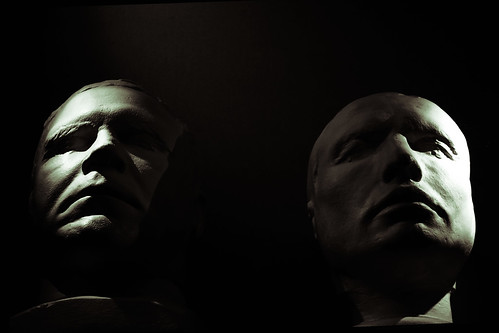
These spooky Life Casts of the notorious murderers Williams Burke and Hare can be found in the fascinating Scottish National Portrait Gallery in Edinburgh.
The Burke and Hare murders, or West Port murders, were a series of murders committed in Edinburgh, Scotland, over a period of about ten months in 1828. The killings were attributed to Irish immigrants William Burke and William Hare, who sold the corpses of their 16 victims to Doctor Robert Knox as dissection material for his well-attended anatomy lectures.
Before 1832, there were insufficient cadavers legitimately available for the study and teaching of anatomy in Britain’s medical schools. As medical science began to flourish in the early nineteenth century, the demand for cadavers rose sharply, but at the same time the legal supply failed to keep pace. One of the main sources—the bodies of executed criminals—had begun to dry up owing to a reduction in the number of executions being carried out in the early nineteenth century.[3] The situation of too few corpses being available to doctors for demonstrating anatomical dissection to growing numbers of students attracted criminal elements willing to obtain specimens by any means. As at similar institutions, doctors teaching at the Edinburgh Medical School, which was universally renowned for medical sciences, relied increasingly on body-snatchers for a steady supply of "anatomical subjects". The activities of these so-called "resurrectionists" gave rise to particular public fear and revulsion,[4] but, such were the financial inducements, the illegal trade continued to grow. It was a short step from grave-robbing to anatomy murder.
Burke and Hare’s first murder victim was a sick tenant named Joseph, a miller by trade, whom they plied with whisky and then suffocated. When there were no other sickly tenants, they decided to lure a victim from the street. In February 1828, they invited pensioner Abigail Simpson to spend the night before her return home to the village of Gilmerton. The following morning they employed the same modus operandi, serving her with alcohol to intoxicate her, and then smothering her.
Two further undated murders took place that Spring. One victim was invited into the house by Mrs Hare and plied with drink until Hare’s arrival; the other was despatched in similar circumstances by Burke acting on his own. Next, Burke encountered two women, Mary Paterson and Janet Brown, in the part of Edinburgh known as the Canongate. He invited them to breakfast at his brother’s house in Gibb’s Close, but Brown left when an argument broke out between McDougal and Burke. When she returned, she was told that Paterson had left with Burke; in fact, she, too, had been taken to Dr. Knox’s rooms in a tea-chest. The two women were described as prostitutes in contemporary accounts, but there is no evidence that this was true. The story later arose that one of Knox’s students had recognized the dead Paterson, whose acquaintance he had made a few days earlier.
One victim was an acquaintance of Burke, a woman called Effie who scavenged for a living and was in the habit of selling him scraps of leather she found which he could use for his cobbling. They were paid £10 for her body. Then Burke "saved" an inebriated woman from being held by a policeman and his assisting neighbour by claiming that he knew her and could take her back to her lodging. He delivered her body to the medical school just hours later. The next two victims were an old woman and her mute son or grandson, aged about 12. While the woman died from an overdose on painkillers, Hare took the young boy and stretched him over his knee, then proceeded to break his back. He later said that this was the murder that disturbed him the most, as he was haunted by his recollection of the boy’s expression. The customary tea-chest being found inadequate, both bodies were forced into a herring barrel and conveyed to Surgeons’ Square, where they fetched £8 each.According to Burke, the barrel was loaded onto a cart which Hare’s horse refused to pull uphill from the Cowgate, so that Hare had to call a porter to help him drag it the rest of the way on a sled. Once back in Tanner’s Close, Hare took his anger out on the horse by shooting it dead in the yard.[19]
Two more victims were Burke’s acquaintance, Mrs. Hostler, and one of McDougal’s relatives, Ann Dougal, a cousin from Falkirk. Burke later claimed that about this time Mrs Hare suggested converting Helen McDougal into merchandise on the grounds that "they could not trust her, as she was a Scotch woman"; but he refused.
Another victim was Mary Haldane, a former lodger who, down on her luck, asked to sleep in Hare’s stable. Burke and Hare also murdered her daughter Peggy Haldane when she called a few days later to inquire after her mother’s whereabouts.
Burke and Hare’s next victim was a familiar figure in the streets of Edinburgh, a mentally disabled young man with a limp, named James Wilson. "Daft Jamie", as he was known locally, was 18 at the time of his murder. The boy resisted, and the pair had to kill him together, though later each blamed the other for taking the main part in the crime. His mother began searching and asking for him. When Dr. Knox uncovered the body the next morning, several students recognized Jamie. Knox denied that it was the missing boy, and was reported to have dissected the body ahead of others to render the remains unrecognisable. While Hare was in the habit of disposing of victims’ clothing in the Union Canal, Burke passed Jamie’s clothes to his nephews, leaving behind material evidence which was recovered before the trial.
Burke stated later that he and Hare were "generally in a state of intoxication" when the murders were carried out, and that he "could not sleep at night without a bottle of whisky by his bedside, and a twopenny candle to burn all night beside him; when he awoke he would take a draught of the bottle—sometimes half a bottle at a draught—and that would make him sleep".
The last victim was Mrs Mary Docherty, also known by her maiden name as Margery Campbell. Burke lured her into the lodging house by claiming that his mother was also a Docherty.
The novelist Sir Walter Scott commented:
"Our Irish importation have made a great discovery of Oeconomicks, namely, that a wretch who is not worth a farthing while alive, becomes a valuable article when knockd on the head & carried to an anatomist; and acting on this principle, have cleard the streets of some of those miserable offcasts of society, whom nobody missed because nobody wishd to see them again."
Posted by Bobbex on 2015-06-29 20:29:14
Tagged: , scottish history , works of art , scottish art