

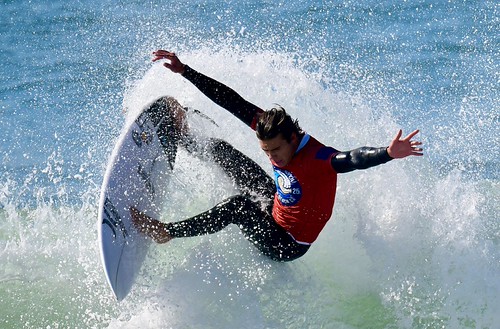
SLO CAL Surf Open, Pismo Beach California, Surfing for Hope
Wikipedia, This glossary of surfing includes some of the extensive vocabulary used to describe various aspects of the sport of surfing as described in literature on the subject.[a][b] In some cases terms have spread to a wider cultural use. These terms were originally coined by people who were directly involved in the sport of surfing.
About the water
Breaking swell waves at Hermosa Beach, California
See also: surf break
A-Frame: Wave with a peak that resembles an A and allows surfers to go either left or right, with both sides having a clean shoulder to work with.[1]
Barrel: (also tube, cave, keg, green room) The effect when a big wave rolls over, enclosing a temporary horizontal tunnel of air with the surfer inside[c]
Beach break: An area with waves that are good enough to surf break just off a beach, or breaking on a sandbar farther out from the shore[c]
Big sea: Large, unbreaking surf[2]
Blown out: When waves that would otherwise be good have been rendered too choppy by wind[c]
Bomb: An exceptionally large set wave[d]
Bottom: Refers to the ocean floor, or to the lowest part of the wave ridden by a surfer[2]
Channel: A deep spot in the shoreline where waves generally don’t break, can be created by a riptide pulling water back to the sea and used by surfers to paddle out to the waves[2]
Chop or choppy: Waves that are subjected to cross winds, have a rough surface (chop) and do not break cleanly [d]
Close-out: A wave is said to be "closed-out" when it breaks at every position along the face at once, and therefore cannot be surfed[3]
Crest: The top section of the wave, or peak, just before the wave begins to break [4]
Curl: The actual portion of the wave that is falling or curling over when the wave is breaking[4]
Face: The forward-facing surface of a breaking wave [c]
Flat: No waves[c]
Glassy: When the waves (and general surface of the water) are extremely smooth, not disturbed by wind [c]
Gnarly: Large, difficult, and dangerous (usually applied to waves) [c]
Green: The unbroken portion of the wave, sometimes referred to as the wave shoulder[2]
Inshore: The direction towards the beach from the surf, can also be referring to the wind direction direction traveling from the ocean onto the shore[2]
Line-up: The queue area where most of the waves are starting to break and where most surfers are positioned in order to catch a wave[a]
Mushy: A wave with very little push[3]
Off the hook: An adjective phrase meaning the waves are performing extraordinarily well [c]
Outside: Any point seaward of the normal breaking waves[3]
Peak: The highest point on a wave[2]
Pocket: The area of the wave that’s closest to the curl or whitewash. Where you should surf if you want to generate the most speed. The steepest part of a wave, also known as the energy zone.
Pounder: An unusually hard breaking wave[3]
Point break: Area where an underwater rocky point creates waves that are suitable for surfing[c]
Riptide: A strong offshore current that is caused by the tide pulling water through an inlet along a barrier beach, at a lagoon or inland marina where tide water flows steadily out to sea during ebb tide
Sections: The parts of a breaking wave that are rideable[c]
Sectioning: A wave that does not break evenly, breaks ahead of itself[2]
Set waves: A group of waves of larger size within a swell[c]
Shoulder: The unbroken part of a breaking wave[c]
Surf’s up: A phrase used when there are waves worth surfing[2]
Swell: A series of waves that have traveled from their source in a distant storm, and that will start to break once the swell reaches shallow enough water
Trough: The bottom portion of the unbroken wave and below the peak, low portion between waves[2][4]
Undertow: An under-current that is moving offshore when waves are approaching the shore[2]
Wall: The section of the wave face that extends from the shoulder to the breaking portion, where the wave has not broken and where the surfer maneuvers to ride the wave[4]
Wedge: Two waves traveling from slightly different direction angles that converge to form a wedge when they merge, where the wedge part of the two waves usually breaks a great deal harder than the individual waves themselves[2]
Whitecaps: The sea foam crest over the waves[2]
Whitewater: In a breaking wave, the water continues on as a ridge of turbulence and foam called "whitewater"[d] or also called "soup"[4]
Techniques and maneuvers
Tandem surfing
Tube riding at Teahupo’o (Tahiti)
Air/Aerial: Riding the board briefly into the air above the wave, landing back upon the wave, and continuing to ride[d]
Backing out: pulling back rather than continuing into a wave that could have been caught[2]
Bail: To step off the board in order to avoid being knocked off (a wipe out)[d]
Bottom turn: The first turn at the bottom of the wave[d]
Carve: Turns (often accentuated)
Caught inside: When a surfer is paddling out and cannot get past the breaking surf to the safer part of the ocean (the outside) in order to find a wave to ride[d]
Cheater five: See Hang-five/hang ten
Cross-step: Crossing one foot over the other to walk down the board
Drop in: Dropping into (engaging) the wave, most often as part of standing up[d]
"To drop in on someone": To take off on a wave that is already being ridden. Not a legitimate technique or maneuver. It is a serious breach of surfing etiquette.[5]
Drop-knee: A type of turn where both knees are bent where the trail or back leg is bent closer to the board than the lead or front leg knee[2]
Duck dive: Pushing the board underwater, nose first, and diving under an oncoming wave instead of riding it[d]
Fade: On take-off, aiming toward the breaking part of the wave, before turning sharply and surfing in the direction the wave is breaking, a maneuver to stay in the hottest or best part of the wave[2]
Fins-free snap (or "fins out"): A sharp turn where the surfboard’s fins slide off the top of the wave[f]
Floater: Riding up on the top of the breaking part of the wave, and coming down with it[c]
Goofy foot: Surfing with the left foot on the back of board (less common than regular foot)[d]
Grab the rail: When a surfer grabs the board rail away from the wave[3]
Hang Heels: Facing backwards and putting the surfers’ heels out over the edge of a longboard[6]
Hang-five/hang ten: Putting five or ten toes respectively over the nose of a longboard
Kick-out: Surfer throwing their body weight to the back of the board and forcing the surfboard nose straight up over the face of the wave, which allows the surfer to propel the board to kick out the back of the wave[4]
Head dip: The surfer tries to stick their head into a wave to get their hair wet[3]
Nose ride: the art of maneuvering a surfboard from the front end
Off the Top: A turn on the top of a wave, either sharp or carving[6]
Pop-up: Going from lying on the board to standing, all in one jump[d]
Pump: An up/down carving movement that generates speed along a wave[d]
Re-entry: Hitting the lip vertically and re-reentering the wave in quick succession.[d]
Regular/Natural foot: Surfing with the right foot on the back of the board[d]
Rolling, Turtle Roll: Flipping a longboard up-side-down, nose first and pulling through a breaking or broken wave when paddling out to the line-up (a turtle roll is an alternative to a duck dive)[d]
Smack the Lip /Hit the Lip: After performing a bottom turn, moving upwards to hit the peak of the wave, or area above the face of the wave.[7]
Snaking, drop in on, cut off, or "burn": When a surfer who doesn’t have the right of way steals a wave from another surfer by taking off in front of someone who is closer to the peak (this is considered inappropriate)[d]
Snaking/Back-Paddling: Stealing a wave from another surfer by paddling around the person’s back to get into the best position[d]
Snap: A quick, sharp turn off the top of a wave[6]
Soul arch: Arching the back to demonstrate casual confidence when riding a wave
Stall: Slowing down by shifting weight to the tail of the board or putting a hand in the water. Often used to stay in the tube during a tube ride[c]
Side-slip: travelling down a wave sideways to the direction of the board[8]
Switchfoot: Ambidextrous, having equal ability to surf regular foot or goofy foot (i.e. left foot forward or right foot forward)
Take-off: The start of a ride[9]
Tandem surfing: Two people riding one board. Usually the smaller person is balanced above (often held up above) the other person[f]
Tube riding/Getting barreled: Riding inside the hollow curl of a wave
Accidental
"Over the falls" redirects here. For other uses, see Over the falls (disambiguation).
Wipeout
Over the falls: When a surfer falls off the board and the wave sucks them up in a circular motion along with the lip of the wave. Also referred to as the "wash cycle", being "pitched over" and being "sucked over"[e]
Wipe out: Falling off, or being knocked off, the surfboard when riding a wave[e]
Rag dolled: When underwater, the power of the wave can shake the surfer around as if they were a rag doll[10]
Tombstone: When a surfer is held underwater and tries to climb up their leash, which positions the board straight up and down[e]
Pearl: Accidentally driving the nose of the board underwater, generally ending the ride[d]
About people and behavior
Grommet on a board with his dad watching.
Dilla: A surfer who is low maintenance, without concern, worry or fuss. One who is confidently secure in being different or unique.[11]
Grom/Grommet/Gremmie: A young surfer[a]
Hang loose: Generally means "chill", "relax" or "be laid back". This message can be sent by raising a hand with the thumb and pinkie fingers up while the index, middle and ring fingers remain folded over the palm, then twisting the wrist back and forth as if waving goodbye, see shaka sign
Hodad: A nonsurfer who pretends to surf and frequents beaches with good surfing[12]
Kook: A wanna-be surfer of limited skill[13][14]
Waxhead: Someone who surfs every day[e]
About the board
Further information on surfboards: Surfboard
Waxing a surfboard
Blank: The block from which a surfboard is created
Deck: The upper surface of the board
Ding: A dent or hole in the surface of the board resulting from accidental damage[a]
Fin or Fins: Fin-shaped inserts on the underside of the back of the board that enable the board to be steered
Leash: A cord that is attached to the back of the board, the other end of which wraps around the surfer’s ankle
Nose : The forward tip of the board
Quiver: A surfer’s collection of boards for different kinds of waves[15]
Rails: The side edges of the surfboard
Rocker: How concave the surface of the board is from nose to tail
Stringer: The line of wood that runs down the center of a board to hold its rigidity and add strength
Tail: The back end of the board
Wax: Specially formulated surf wax that is applied to upper surface of the board to increase the friction so the surfer’s feet do not slip off the board
Leggie: A legrope or leash. The cord that connects your ankle to the tail of surfboard so it isn’t washed away when you wipe out. Made of lightweight urethane and available in varying sizes. With thicker ones for big waves and thinner ones for small waves.
Thruster: A three-finned surfboard originally invented back in 1980 by Australian surfer Simon Anderson. It is nowadays the most popular fin design for modern surfboards.
The riding of waves has likely existed since humans began swimming in the ocean. In this sense, bodysurfing is the oldest type of wave-catching. Undoubtedly ancient sailors learned how to ride wave energy on many styles of early boats. Archaeological evidence even suggests that ancient cultures of Peru surfed on reed watercraft for fishing and recreation up to five thousand years ago. However, standing up on what is now called a surfboard is a relatively recent innovation developed by the Polynesians. The influences for modern surfing can be directly traced to the surfers of pre-contact Hawaii.
Peru
Caballito de totora
Chimú vessel representing a fisherman on a caballito de totora (1100–1400 CE)
Archaeologists have found that the practice of riding a vessel with a wave was utilized since the pre-Inca cultures around three to five thousand years ago.[1][2] The Moche culture used the caballito de totora (little horse of totora), with archaeological evidence showing its use around 200 CE.[3]
An early description of the Inca surfing was documented by Jesuit missionary José de Acosta in his 1590 publication Historia natural y moral de las Indias, writing:[4]
It is true to see them go fishing in Callao de Lima, was for me a thing of great recreation, because there were many and each one in a balsilla caballero, or sitting stubbornly cutting the waves of the sea, which is rough where they fish, they looked like the Tritons, or Neptunes, who paint upon the water.
To this day Caballitos de Totora are still used by local fishermen and can also be ridden by tourists for recreational purposes.
West Africa
West Africans (e.g., Ghana, Ivory Coast, Liberia, Senegal) and western Central Africans (e.g., Cameroon) independently developed the skill of surfing.[5] Amid the 1640s CE, Michael Hemmersam provided an account of surfing in the Gold Coast: “the parents ‘tie their children to boards and throw them into the water.’”[5] In 1679 CE, Barbot provided an account of surfing among Elmina children in Ghana: “children at Elmina learned “to swim, on bits of boards, or small bundles of rushes, fasten’d under their stomachs, which is a good diversion to the spectators.”[5] James Alexander provided an account of surfing in Accra, Ghana in 1834 CE: “From the beach, meanwhile, might be seen boys swimming into the sea, with light boards under their stomachs. They waited for a surf; and came rolling like a cloud on top of it. But I was told that sharks occasionally dart in behind the rocks and ‘yam’ them.”[5] Thomas Hutchinson provided an account of surfing in southern Cameroon in 1861: “Fishermen rode small dugouts ‘no more than six feet in length, fourteen to sixteen inches in width, and from four to six inches in depth.’”[5]
Polynesia
The art of surfing, known as heʻe nalu (literally, wave sliding)[6] in the Hawaiian language, was recorded in his journal by Joseph Banks aboard HMS Endeavour during the first voyage of James Cook, during the ship’s stay in Tahiti in 1769:
…their cheif [sic] amusement was carried on by the stern of an old canoe, with this before them they swam out as far as the outermost breach, then one or two would get into it and opposing the blunt end to the breaking wave were hurried in with incredible swiftness. Sometimes they were carried almost ashore…[7]
Kahaluʻu Bay was the site of an ancient surfing temple.
Surfing was a central part of ancient Polynesian culture and predates European contact. The chief (Ali’i) was traditionally the most skilled wave rider in the community with the best board made from the best wood. The ruling class had the best beaches and the best boards, and the commoners were not allowed on the same beaches, but they could gain prestige by their ability to ride the surf on their boards.
In Tahiti and Samoa, surfing was a popular pastime that was often used as part of warriors’ training. Warriors often paddled to surf breaks and were recorded in print by early European historians as spending many hours bravely paddling head-on into large surf and riding waves. Canoes often accompanied surfing parties and the men would often swap between canoeing and paddling boards, and then catch fish after their recreational activities. In Hawai’i, surfing became ingrained into the very fabric of Hawaii’an religion and culture.
The sport was also recorded in print by other European residents and visitors who wrote about and photographed Samoans surfing on planks and single canoe hulls; Samoans referred to surf riding as fa’ase’e or se’egalu. Edward Treager also confirmed Samoan terminology for surfing and surfboards in Samoa. Oral tradition confirms that surfing was also practiced in Tonga, where the late king Taufa’ahau Tupou IV became an expert surfer in his youth.[8] Matt Warshaw, however, says the King began to surf in the 1960s on a board given him by Duke Kahanamoku.[9]
Ancient Hawaii
Hawaiians referred to this art as heʻe nalu which translates into English as "wave sliding." The art began before entering the mysterious ocean as the Hawaiians prayed to the gods for protection and strength to undertake the powerful mystifying ocean. If the ocean was tamed, frustrated surfers would call upon the kahuna (priest), who would aid them in a surfing prayer asking the gods to deliver great surf. Prior to entering the ocean, the priest would also aid the surfers (mainly of the upper class) in undertaking the spiritual ceremony of constructing a surfboard.
Hawaiians would carefully select one of three types of trees. The trees included the koa (Acacia koa), ʻulu (Artocarpus altilis), and wiliwili (Erythrina sandwicensis) trees. Once selected, the surfer would dig the tree out and place fish in the hole as an offering to the gods. Selected craftsmen of the community were then hired to shape, stain, and prepare the board for the surfer. There were three primary shapes: the ʻolo, kikoʻo, and the alaia. The ʻolo is thick in the middle and gradually gets thinner towards the edges. The kikoʻo ranges in length from 370 to 550 cm (12 to 18 ft) and requires great skill to maneuver. The alaia board is around 275 cm (9 ft) long and requires great skill to ride and master. Aside from the preparatory stages prior to entering the water, the most skilled surfers were often of the upper class including chiefs and warriors that surfed amongst the best waves on the island. These upper-class Hawaiians gained respect through their enduring ability to master the waves and this art the Hawaiians referred to as surfing.[10] Some ancient sites still popular today include Kahaluʻu Bay and Holualoa Bay.[11]
Post-contact Hawaii
After contact with the Western World Hawaiian culture was forced to change. While Europeans were preoccupied with exploring and later colonizing the Pacific, they defined the islands as specks of land in a faraway sea.[12] Western diseases spread and colonization began, plantations were built, and immigration started. Local Hawaiians, mixed with imported workers from Asia, were put to work on sugar plantations and Protestant missionaries attempted to turn the population from their traditional beliefs into Christians. Along with the suppression of traditional culture was the suppression of surfing, often viewed as frivolous.
It was not until Waikiki became a tourist destination that surfing began a resurgence in popularity.[when?] Particularly wealthy Americans came to the beach and saw the locals occasionally surfing what had long been an established surf break, Waikiki, and wanted to try it. Mark Twain attempted it but failed in 1866. Jack London tried it while visiting, then chronicled it enthusiastically in an essay entitled "A Royal Sport" published in October 1907. In 1908 Alexander Hume Ford founded the Outrigger Canoe and Surfing Club the first modern organization developed to promote surfing broadly, although it was de facto whites-only and women weren’t admitted until 1926. Local Hawaiians started their own club in 1911 called Hui Nalu, meaning "Club of the Waves". But the first surf icons who gained widespread recognition, George Freeth and Duke Kahanamoku, became famous for practicing their traditional sport and helped spread it from Waikiki to around the world.
As the news of this new sport began to spread, locals in Waikiki began giving lessons and demonstrations for tourists. This was the basis of the Waikiki Beach Boys, a loose group of mostly native Hawaiians who hung out at the beach, surfed daily, and taught wealthy haole tourists how to ride waves. This was also known as the Hawaiian boarder-land, where white hegemony was uncertain and Natives inverted dominant social categories.[12] A borderland is a place where differences converge and social norms are often fluid. Because state-sanctioned authority is often absent from the borderlands, unique social and cultural identities are formed there. This was the foundation of a continual element of surf culture, repeated around the globe innumerable times and continuing to this day: people who, for at least a time, dedicate most of their daily lives to living on or around the beach and surfing as much as they can. These groups in Hawaii, and following in Australia, California, laid the foundation for modern surf culture around the world.[12]
North America
See also: Surfing in the United States
In July 1885, three teenage Hawaiian princes took a break from their boarding school, St. Mathew’s Hall in San Mateo, and came to cool off in Santa Cruz, California. There, David Kawananakoa, Edward Keliʻiahonui, and Jonah Kūhiō Kalaniana’ole surfed the mouth of the San Lorenzo River on custom-shaped redwood boards, according to surf historians Kim Stoner and Geoff Dunn.[13] In 1907 George Freeth traveled to California from Hawaii to demonstrate surfboard riding as a publicity stunt to promote Abbot Kinney’s resort in Venice, Venice of America. Later that year, Henry Huntington, who gave his name to Huntington Beach, hired Freeth as a lifeguard and to give surfing demonstrations to promote the city of Redondo Beach. Freeth surfed at the Huntington Beach pier for its rededication in 1914. In 1917 Freeth moved to San Diego to work as a swimming instructor at the San Diego Rowing Club. He later worked as a lifeguard at Coronado and Ocean Beach where he also gave surfing exhibitions.[14]
Surfing on the East Coast of the United States began in Wrightsville Beach, North Carolina in 1909 when Burke Haywood Bridgers and a colony of surfers introduced surfing to the East Coast.[15] The State of North Carolina honored Burke Haywood Bridgers and the colony of surfers by placing a North Carolina Highway Marker for PIONEER EAST COAST SURFING on Wrightsville Beach and designated Wrightsville Beach as the birthplace of surfing in North Carolina in 2015.[16] North Carolina has the greater weight of published verifiable accurate evidence and impacts a broader geographical area when compared to other east coast states.[17] Burke Haywood Bridgers and the colony of surfers activities are among the earliest appearances of surfboards in the Atlantic Ocean.[18] The early twentieth-century surfers proved that surfing migrated from Hawaii to California and North Carolina about the same time, then Florida. The Wrightsville Beach Museum Waterman Hall of Fame honors, recognizes, and inducts community members for their contributions to the island’s watersport culture.
Surf Culture Epicenters
For over a century now intrepid North American surfers have explored and ridden innumerable rugged and unnamed waves all over the vast North American coastline, yet distinct surf cultures tend to form around special small areas of particularly consistent good surf. The most archetypal and original of these is Malibu (both before and after Gidget). Not only is Malibu a rare world-class wave, but being adjacent to Hollywood it became the stereotype of Southern Californian surfing culture for the rest of the United States and the world. As Waikiki represented Hawaii, so Malibu represented California in the popular mindset. Both wave’s quality remains intact to this day, but their local culture has gone through many shifts. Great surf epicenters often find their original surf culture quickly overrun by outside popularity, sometimes repeatedly.
Generally there are nine broadly defined continental regions, based on similar conditions: Alaskan, Cascadian, Northern California, Southern California, the Great Lakes, the Gulf Coast, East Coast of Florida, Georgia and the Carolinas, the North East, and Puerto Rico. Usually Hawaii is considered a separate entity from North America, subdivided by island and region. In professional surfing US mainlanders often use the American flag whereas Hawaiians (of any race) use the Hawaiian state flag.
Australian surfing
See also: Surfing in Australia
In 1910, Tommy Walker returned to Manly Beach, Sydney, with a 300 cm (10 ft) surfboard "bought at Waikiki Beach, Hawaii, for two dollars."[19] Walker became an expert rider and in 1912 gave several exhibitions in Sydney.[20]
Surfboard riding received national exposure with the exhibitions by Hawaiian Duke Kahanamoku in the summer of 1914-1915 at several Sydney beaches. As a current Olympic sprint champion, Kahanamoku was invited to tour the Eastern states for an extensive series of swimming carnivals and at his first appearance in the Domain Pool, Sydney, smashed his previous world record for 100 yards by a full second.[21] Following the first exhibition at Freshwater on 24 December 1914,[22] in the New Year Kahanamoku demonstrated his skill at Freshwater and Manly,[23] followed by appearances at Dee Why[24] and Cronulla.[25]
Duke Kahanamoku’s board is now on display in the Freshwater Surf Life Saving Club, Sydney, Australia.[26]
Great Britain
Main article: Surfing in the United Kingdom
In 1890, the pioneer in agricultural education John Wrightson reputedly became the first British surfer at Bridlington in Yorkshire when instructed by two Hawaiian students, Princes David Kahalepouli Kawanaankoa Piikoi and Jonah Kuhio Kalanianaole Pikkoi, studying at his college.[27][28][29]
Modern surfing
Around the start of the 20th century, Hawaiians living close to Waikiki began to revive surfing, and soon re-established surfing as a sport. The revival is linked to real estate development and efforts to boost tourism.[30] The beach was historically a place where haole and Hawaiian worlds collided and violence was sometimes a substitute for mutual understanding.[12] Duke Kahanamoku, "Ambassador of Aloha," Olympic medalist, and avid waterman, helped expose surfing to the world. Kahanamoku’s role was later memorialized by a 2002 first class letter rate postage stamp of the United States Postal Service.[31] Author Jack London wrote about the sport after having attempted surfing on his visit to the islands. Surfing progressed tremendously in the 20th century, through innovations in board design and ever-increasing public exposure.
Surfing’s development and culture was centered primarily in three locations: Hawaii, Australia, and California, although the first footage of surfing in the UK was in 1929 by Louis Rosenberg and a number of friends after being fascinated by watching some Australian surfers. In 1959 the release of the film Gidget, based on the life of surfer Kathy Kohner-Zuckerman, boosted the sport’s popularity immensely, moving surfing from an underground culture into a national fad and packing many surf breaks with sudden and previously unheard of crowds. B-movies and surf music such as the Beach Boys and Surfaris based on surfing and Southern California beach culture (Beach Party films) as it exploded, formed most of the world’s first ideas of surfing and surfers.[citation needed] This conception was revised again in the 1980s, with newer mainstream portrayals of surfers represented by characters like Jeff Spicoli from Fast Times at Ridgemont High.
Surfing at Ormond Beach in Oxnard, California, in 1975
The anonymous sleeve notes on the 1962 album Surfin’ Safari, the first album to be released on the Capitol label by The Beach Boys, include a rather tongue-in-cheek description of the sport of surfing thus:
"For those not familiar with the latest craze to invade the sun-drenched Pacific coast of Southern California, here is a definition of "surfing" – a water sport in which the participant stands on a floating slab of wood, resembling an ironing board in both size and shape, and attempts to remain perpendicular while being hurtled toward the shore at a rather frightening rate of speed on the crest of a huge wave (especially recommended for teen-agers and all others without the slightest regard for either life or limb)."
Regardless of its usually erroneous portrayal in the media, true surfing culture continued to evolve quietly by itself, changing decade by decade. From the 1960s fad years to the creation and evolution of the short board in the late 60s and early 70s to the performance hotdogging of the neon-drenched 1980s and the epic professional surfing of the 1990s (typified by Kelly Slater, the "Michael Jordan of Surfing"). In 1975, professional contests started.[32] That year Margo Oberg became the first female professional surfer.[32]
Surfing documentaries have been one of the main ways in which surfing culture grows and replenishes itself, not just as a sport but as an art form, the style and quality of surf films have often tracked well the evolution of the sport.
Professional surfing
Defining the scope of professional surfing is difficult, because like in many extreme sports, there is more than one model for what constitutes a professional. There are three main contemporary modes of making money purely as an active surfer: sponsorship, surf contests, and social media influence. Most often all three go together, but sometimes well-known professionals excel in only one.
If a professional surfer is someone who makes money from surfing (not including teaching), then the history of professional surfing dates to perhaps 1959 when the first West Coast Surfing Championships was held in Huntington Beach, California. Previously there had been innumerable amateur competitions, from the ancient Hawaiians themselves who were known to wager on the outcomes, to multiple iterations of surf competition as some form of race (commonly starting from shore, paddling to a buoy, then catching a wave back to shore).
In 1961 the United States Surfing Association (USSA) was founded, arguably the first proto-professional surfing contest organization. This was also about the time when surfing switched from core action: simply riding a quality wave, to a more style-oriented endeavor where turns, tricks, style, and artistry began to be important. Dynamic moves, such as nose-riding, top turns, and cut-backs were becoming even more important than catching the best wave and riding it for the longest possible time, which had previously been the primary goal, and seemed self-evident to earlier surfers.
Through numerous iterations of the surf contest and small sponsorships, very few people ever made a living from surfing alone (by not teaching or producing signature model boards or clothing) until the 1970s. As described in the documentary Bustin’ Down the Door much of the prestige and money to be made from contest surfing resided in Hawaii, specifically, the increasingly important epicenter of worldwide performance-surfing: the North Shore of Oahu. But when Australians and South Africans showed up to join the Californians who had been migrating there in waves for nearly 20 years, multiple tensions arose between not only the Americans vs international surfers, but even more powerfully between the local Hawaiians and the haoles generally.
Into the 1980s surfing saw its second boost of wider popular recognition (the first being from Gidget) with new neon colors, increasing shortboard performance, more professional surfers, and a number of surf brands becoming trendy beyond surfing, such as Town & Country Surf Designs and Body Glove. The pro surfers of the 1980s were able to make more money, get more exposure, and generally survive longer with no job other than contest surfing and sponsorship.
In the last few decades there are generally less than 60 men and 30 women who qualify for the highest level of the surf league each year in its modern form, the WSL. There are thousands more surfers competing in various smaller surf contests held continually around the world, the majority of them being for groms (young participants). In the last half century of competitive surfing, nearly all professionals have learned to surf as children and were essentially prodigies, as in most modern professional sports.
In 1920, Duke Kahanamoku, the "Father of Modern Surfing", proposed that the sport be included in the Olympics. Surfing was to be a part of the Olympics for the first time ever in the 2020 Tokyo Olympics, allowing athletes from around the world to show their skills in the sport. Before surfing could make its Olympic debut, the COVID-19 pandemic caused the 2020 Tokyo Olympic Games to be cancelled and then rescheduled for the year 2021. Surfing is set to appear in the 2021 Olympics with several members of the WSL as well as other amateur surfers for the first time ever at Tsurigasaki Beach in Chiba Japan.[33]
A surfer dropping in
Technological innovations in surfing
Surfing has been an internationally co-developed sport since its early spread beyond Hawaii, and has been highly influenced by (and generally welcoming of) new technology. There are no standards or committees to rule surfboard design or progression. Change has been rampant. Surfers generally pick styles and materials based on performance, feeling, and price. Surfboard shapers can be global name-brand professionals, local artisans, or even backyard amateurs. Unlike many other sports, the high variability and subtle performance differences in the main apparatus, the surfboard, is fundamental to both the experience and history. While many other sports standardize their equipment, in surfing, diversity in craft-design played a huge part in its history and still ongoing culture.
Much of the last century of surf history has been defined by new eras of technology which often fundamentally changed the experience. Surfers themselves have often developed, altered, or anticipated new technology to grant increased access to previously unsurfed waves and places. And unlike many other sports, the secondary equipment became almost as important as the core surfboard, a prime example being the wetsuit. The worldwide history of surfing could easily be divided between pre-wetsuit and post-wetsuit, because it expanded the potential to surf places previously far too cold, which comprised a vast amount of un-surfed worldwide coastline. On a similar basis, surfing history could justifiably be divided between pre-polystyrene and post-polystyrene surfboards, or pre-fin and post-fin as the original Hawaiian boards did not have fins until Tom Blake added one in 1935. Technology has changed surfing repeatedly and dramatically throughout its modern development, generally making the sport more accessible, cheaper, easier, and raising the level of performance.
Much of this change has also come from the fact that surfing was originally, and for many decades into the modern era, primarily a tropical or summertime only warm water sport, and a developed-world sport, making its early range quite limited. But after the arrival of mass-produced fiberglass boards, quality wetsuits, offroad vehicles, and inexpensive international travel, surfing became accessible along many parts of the world’s coasts which were previously unthinkable or unknown as surf spots. Travelers thereby introduced the sport and equipment to the local coastal peoples of even very remote places. By the 21st century, much of the worldwide coastline has been explored and local peoples surf in nearly every country with access to waves. Yet unlike many other aspects of human expansion, there remain surf breaks as yet never ridden by humans, often in remote or treacherous corners of the globe, politically unstable areas, or around uninhabited islands, many which might yet reveal great surf spots in the future.
A quiver of surfboards
The Short Board Revolution
The ancient Hawaiians had mainly three types of board: Olo, Alaia, and Paipo. The Olo was 4.5 to 6.096 meters (15 to 20 ft) long and solid wood. They were very difficult to make and reserved for the upper classes. The Alai was only 1.82 or 2.13 meters (6 or 7 ft) long and usually much thinner. The Paipo was even smaller and similar to a modern bodyboard. None of these had a fin.
Throughout the first half of the 20th century nearly all modern surfboards were longboards, generally 2.74 meters (9 ft) or longer, although after the 1930s they began to shift away from being solid dense wood and towards lighter materials like balsa wood, and eventually various forms of polystyrene, which still dominate to this day.
Throughout the decades, shapers had occasionally made smaller boards, often as novelties, experiments, or specifically designed for small-statured people, but the popularity of those designs was slow to rise. During the surfboard production boom of the 1960s, the predominantly male shapers would sometimes construct specifically smaller boards for girls (who are often lighter and shorter, affecting weight/length requirements for paddling). Yet often they ended up surfing those small boards themselves because the style of surfing was different and mid-wave turns were growing in popularity, more easily done on shorter boards.
A fundamental reason for longer, thicker, more buoyant surfboards generally is they paddle faster, and paddle-speed is crucial to wave catching. But in the 1960s faster waves were becoming more popular, waves with narrower take off zones, requiring more skill to drop in. If the surfer could catch a fast wave, then a shorter board was inherently more maneuverable (and by extension more fun).
By the early 1970s, shorter boards began to rise dramatically in popularity, not just as novelties but as fulltime craft, so design innovation was not far behind. The number of fins and their location was experimented with. Various nose and tail shapes were tried. Then, by the 1980s, the styles were refined and coalescing into the modern shortboard just as the second large burst of broader surf-culture popularity within the mainstream was occurring. The 3-fin, 1.82 meters (6-ft-tall)"thruster" shortboard began to take over as the most popular design. A generally narrow board with rather small variance in design was being mass-produced. It nearly always has three fins, a pointed nose, a squash tail, and was approximately the height of the rider.
This basic style of board, with many small modifications, has been the dominant craft since the 1980s and is still the approximation of the modern professional surfboard. In 21st century professional surfing the common boards have slowly become shorter and wider, with a more rounded nose and sometimes 4-fins (very rarely 2-fins and never 1-fin), although non-professionals still regularly mix and match all those options based on personal taste.
Big wave surfing
Main article: Big wave surfing
Although the original Hawaiian surfers would ride large unbreaking ocean swells on their Olo boards, surfing a breaking wave larger than 4.5 to 6.1 meters (15–20 ft) was extremely challenging with pre-modern equipment, if it was attempted at all. But once board design began advancing rapidly in the 1950s and 1960s these larger and faster waves became more accessible. The first truly renowned big wave spot was Oahu’s Waimea Bay. As the North Shore of Oahu was being explored for all its various breaks, Waimea was seen as too fast, brutal, and difficult. As detailed in the movie Riding Giants the first documented successful attempt was in October 1957. Once Waimea was finally surfed, it spawned the search for other giant waves around the world, and a devotional subset of surfers who specifically desired to surf very large waves. By the 1990s there were numerous giant waves being surfed all over the world, some regularly reaching the 12.2, 15.2, even 18.3 meters (40-, 50-, 60-ft) range. Big wave surfing bifurcated into two main branches: paddle-in and tow-in. Some waves are so big and quick it is nearly impossible to paddle fast enough to catch them, so surfers started towing behind boats and PWCs in order to catch the wave.
Style versus performance
"What is the purpose of surfing?" has long been philosophically debated in and out of surf culture. Often the entire endeavor has been viewed in the popular media as a waste of time, or the occupation of slackers. For the most part, surfing is agreed to be purely recreational, as it did not develop from, or turn into, a useful mode of daily transportation (as opposed to skiing or skateboarding, which can be both). Therefore in judging and appreciating surfing there has always been varying opinions about what is necessary, stylish, extravagant, and/or functional.
The variety and size of waves varies tremendously, as does surf craft, and to some degree even the medium. Harnessing the momentum of a wave for travel is the loosest definition of surfing, so in popular culture, the term is often applied to many forms of expanded "surfing". Particularly "surfing the web" and "couch surfing" common examples. But also characters like The Silver Surfer have taken the notion of surfing into science fiction.
There are also those who view surfing in a religious context. Certainly for the ancient Hawaiians, this component was important because the ocean was viewed as a deity. Yet also in modern surfing it is common for surfing to refer to it as some form of church or mass.
Surfing’s impact on popular culture
Comparatively small and localized surfing cultures have repeatedly generated surprisingly large influence upon popular culture, particularly in the United States of America and Australia, as well as upon the global consciousness of surfing as a form of recreation. Since the expansion of surfing in the mid-20th century, there have been numerous coastal towns that were situated near good surf breaks, whose citizens did not yet know about modern surfing, and so did not even realize it was a rare commodity.
In America and Australia, the culture of surfing has influenced popular culture in periodic fads, starting with novels, movies, and the early-1960s TV show, Gidget. Gidget is often given credit for popularizing surfing as a "slightly strange and hedonistic lifestyle".[34] In film specifically, the surfing image has been so popular that it inspired an entire “beach party/surf film genre”.[35] The attention that surfing has received in popular culture has waxed and waned, much like other niche sports.
Another area of popular culture where surfing has had significant influence is popular music. As many scholars recognize, a large part of surfing’s popularity is from the positively connoted image of “beach parties, rich tans, loose clothing, and surf-ready cars"; in other words, there is "more to surfing than the sea”.[34] This image is very well suited to be represented in popular music, which is why so many popular teen anthems are based on the surfing craze.[34] The Beach Boys, a group whose songs frequently involved “an endless summer filled with surfing, cruising, and beachcombing,” is only one such example.[34] In the first half of the 1960s especially, popular music was dominated by exuberant music featuring the surf craze ("surf rock").[36] Another example is Katy Perry’s Billboard #1 hit song “California Gurls,” featuring Snoop Dogg[37] released in 2010, which highlights the same beachside lifestyle first popularized in the 1960s.
Fashions developed within surf culture have had a large worldwide impact numerous times from the 1960s to the present. A number of large clothing brands began as surfing brands, including but not limited to: OP, Stussy, Billabong, Quicksilver, Roxy, Hurley, O’Neill, Ripcurl, RVCA, Vans, Volcom, Reef, and Da Kine. One of the largest influences is probably the worldwide adoption of boardshorts as swim gear for men.
Alternatives to wind-generated waves
Since their invention, surfers have sometimes used wave pools to attempt surfing, but generally, the waves were too small and not well-formed enough for an enjoyable experience. The 1987 movie North Shore started the protagonist in an Arizona wave pool, then going on to Hawaii to try his luck. Both in and out of the movie this was considered basically a joke. But more recently, multiple attempts have been made to construct wave pools specifically designed for surfing. As of 2023 there are only a few around the world open to the public, but there are numerous in development. 2018 was the first year a professional surfing contest was held at a wave pool, specifically: Kelly Slater’s Surf Ranch.[38]
Wakeboarding is a popular type of surfing done behind a boat’s wake. There are also sometimes standing waves in rivers at high flow which can be surfable. At certain times of year on large rivers, tidal bores are surfable. People have also surfed alongside large cargo ships as their wakes roll into shallower water, and a few people have even surfed the waves caused by calving glaciers. The Wave Bristol opened in The UK as an inland artificial surf site.[39]
Surfing is a surface water sport in which an individual, a surfer (or two in tandem surfing), uses a board to ride on the forward section, or face, of a moving wave of water, which usually carries the surfer towards the shore. Waves suitable for surfing are primarily found on ocean shores, but can also be found as standing waves in the open ocean, in lakes, in rivers in the form of a tidal bore, or wave pools.
The term surfing refers to a person riding a wave using a board, regardless of the stance. There are several types of boards. The Moche of Peru would often surf on reed craft, while the native peoples of the Pacific surfed waves on alaia, paipo, and other such water craft. Ancient cultures often surfed on their belly and knees, while the modern-day definition of surfing most often refers to a surfer riding a wave standing on a surfboard; this is also referred to as stand-up surfing.
Another prominent form of surfing is body boarding, where a surfer rides the wave on a bodyboard, either lying on their belly, drop knee (one foot and one knee on the board), or sometimes even standing up on a body board. Other types of surfing include knee boarding, surf matting (riding inflatable mats) and using foils. Body surfing, in which the wave is caught and ridden using the surfer’s own body rather than a board, is very common and is considered by some surfers to be the purest form of surfing. The closest form of body surfing using a board is a handboard which normally has one strap over it to fit on one hand. Surfers who body board, body surf, or handboard feel more drag as they move through the water than stand up surfers do. This holds body surfers into a more turbulent part of the wave (often completely submerged by whitewater). In contrast, surfers who instead ride a hydrofoil feel substantially less drag and may ride unbroken waves in the open ocean.
Three major subdivisions within stand-up surfing are stand-up paddling, long boarding and short boarding with several major differences including the board design and length, the riding style and the kind of wave that is ridden.
In tow-in surfing (most often, but not exclusively, associated with big wave surfing), a motorized water vehicle such as a personal watercraft, tows the surfer into the wave front, helping the surfer match a large wave’s speed, which is generally a higher speed than a self-propelled surfer can produce. Surfing-related sports such as paddle boarding and sea kayaking that are self-propelled by hand paddles do not require waves, and other derivative sports such as kite surfing and windsurfing rely primarily on wind for power, yet all of these platforms may also be used to ride waves. Recently with the use of V-drive boats,[clarification needed] Wakesurfing, in which one surfs on the wake of a boat, has emerged.[citation needed] As of 2023, the Guinness Book of World Records recognized a 26.2 m (86 ft) wave ride by Sebastian Steudtner at Nazaré, Portugal as the largest wave ever surfed.[1]
During the winter season in the northern hemisphere, the North Shore of Oahu, the third-largest island of Hawaii, is known for having some of the best waves in the world. Surfers from around the world flock to breaks like Backdoor, Waimea Bay, and Pipeline. However, there are still many popular surf spots around the world: Teahupo’o, located off the coast of Tahiti; Mavericks, California, United States; Cloudbreak, Tavarua Island, Fiji; Superbank, Gold Coast, Australia.[2]
In 2016 surfing was added by the International Olympic Committee (IOC) as an Olympic sport to begin at the 2020 Summer Olympics in Japan.[3] The first gold medalists of the Tokyo 2020 surfing men and women’s competitions were, respectively, the Brazilian Ítalo Ferreira and the American from Hawaii, Carissa Moore.[4][5]
Origins and history
Main article: History of surfing
Peru
Caballitos de totora, reed watercraft used by fishermen for the past 3000 years at Huanchaco, Peru, known for its surf breaks
About three to five thousand years ago, cultures in ancient Peru fished in kayak-like watercraft (mochica) made of reeds that the fishermen surfed back to shore.[6][7] The Moche culture used the caballito de totora (little horse of totora), with archaeological evidence showing its use around 200 CE.[8] An early description of the Inca surfing in Callao was documented by Jesuit missionary José de Acosta in his 1590 publication Historia natural y moral de las Indias, writing:[9]
It is true to see them go fishing in Callao de Lima, was for me a thing of great recreation, because there were many and each one in a balsilla caballero, or sitting stubbornly cutting the waves of the sea, which is rough where they fish, they looked like the Tritons, or Neptunes, who paint upon the water.
Polynesia
Hawaiians surfing, 1858
In Polynesian culture, surfing was an important activity. Modern surfing as we know it today is thought to have originated in Hawaii. The history of surfing dates to c. AD 400 in Polynesia, where Polynesians began to make their way to the Hawaiian Islands from Tahiti and the Marquesas Islands. They brought many of their customs with them including playing in the surf on Paipo (belly/body) boards. It was in Hawaii that the art of standing and surfing upright on boards was invented.[10]
Various European explorers witnessed surfing in Polynesia. Surfing may have been observed by British explorers at Tahiti in 1767. Samuel Wallis and the crew members of HMS Dolphin were the first Britons to visit the island in June of that year. Another candidate is the botanist Joseph Banks[11] who was part of the first voyage of James Cook on HMS Endeavour, arriving on Tahiti on 10 April 1769. Lieutenant James King was the first person to write about the art of surfing on Hawaii, when he was completing the journals of Captain James Cook (upon Cook’s death in 1779).
In Herman Melville’s 1849 novel Mardi, based on his experiences in Polynesia earlier that decade, the narrator describes the "Rare Sport at Ohonoo" (title of chap. 90): “For this sport, a surf-board is indispensable: some five feet in length; the width of a man’s body; convex on both sides; highly polished; and rounded at the ends. It is held in high estimation; invariably oiled after use; and hung up conspicuously in the dwelling of the owner.”[12] When Mark Twain visited Hawaii in 1866 he wrote, "In one place, we came upon a large company of naked natives of both sexes and all ages, amusing themselves with the national pastime of surf-bathing."[13]
References to surf riding on planks and single canoe hulls are also verified for pre-contact Samoa, where surfing was called fa’ase’e or se’egalu (see Augustin Krämer, The Samoa Islands[14]), and Tonga, far pre-dating the practice of surfing by Hawaiians and eastern Polynesians by over a thousand years.
West Africa
West Africans (e.g., Ghana, Ivory Coast, Liberia, Senegal) and western Central Africans (e.g., Cameroon) independently developed the skill of surfing.[15] Amid the 1640s CE, Michael Hemmersam provided an account of surfing in the Gold Coast: “the parents ‘tie their children to boards and throw them into the water.’”[15] In 1679 CE, Barbot provided an account of surfing among Elmina children in Ghana: “children at Elmina learned “to swim, on bits of boards, or small bundles of rushes, fasten’d under their stomachs, which is a good diversion to the spectators.”[15] James Alexander provided an account of surfing in Accra, Ghana in 1834 CE: “From the beach, meanwhile, might be seen boys swimming into the sea, with light boards under their stomachs. They waited for a surf; and came rolling like a cloud on top of it. But I was told that sharks occasionally dart in behind the rocks and ‘yam’ them.”[15] Thomas Hutchinson provided an account of surfing in southern Cameroon in 1861: “Fishermen rode small dugouts ‘no more than six feet in length, fourteen to sixteen inches in width, and from four to six inches in depth.’”[15]
California
A woman holding her surfboard about to surf in Morro Bay, California
In July 1885, three teenage Hawaiian princes took a break from their boarding school, St. Matthew’s Hall in San Mateo, and came to cool off in Santa Cruz, California. There, David Kawānanakoa, Edward Keliʻiahonui and Jonah Kūhiō Kalanianaʻole surfed the mouth of the San Lorenzo River on custom-shaped redwood boards, according to surf historians Kim Stoner and Geoff Dunn.[16] In 1890, the pioneer in agricultural education John Wrightson reputedly became the first British surfer when instructed by two Hawaiian students at his college.[17][18][19]
George Freeth (1883–1919), of English and Native Hawaiian descent, is generally credited as the person who had done more than anyone else to renew interest in surfing at Waikiki in the early twentieth century after the sport had declined in popularity in Hawaii during the latter half of the nineteenth century.[20][21][22]
In 1907, the eclectic interests of land developer Abbot Kinney (founder of Venice of America, now Venice, California) helped bring Freeth to California. Freeth had sought the help of the Hawaii Promotion Committee (HPC) in Honolulu to sponsor him on a trip to California to give surfing exhibitions. The HPC arranged through their contacts in Los Angeles to secure a contract for Freeth to perform at Venice of America in July, 1907.[23] Later that year, land baron Henry E. Huntington brought surfing to Redondo Beach. Looking for a way to entice visitors to his own budding resort community south of Venice where he had heavily invested in real estate, he hired Freeth as a lifeguard and to give surfing exhibitions in front of the Hotel Redondo.[21] Another native Hawaiian, Duke Kahanamoku, spread surfing to both the U.S. and Australia, riding the waves after displaying the swimming prowess that won him Olympic gold medals in 1912 and 1920.[24]
Mary Ann Hawkins, inspired by Duke Kahanamoku’s surfing during the late 1920s, developed a lifelong passion for surfing. In 1935, her family relocated to Santa Monica, providing her with opportunities to further immerse herself in surfing and paddleboarding.[25] On September 12, 1936, Hawkins achieved a historic milestone by winning California’s first women’s paddleboard race at the Santa Monica Breakwater. She continued to dominate the sport,[25] winning numerous competitions, including the women’s half-mile paddleboard race and the Venice Breakwater event in 1938, both held on the same day.
Hawkins was also a pioneer in tandem surfing, a discipline that highlights synchronized surfing between two individuals on a single board. She gained further recognition in 1939 when she performed exhibition paddleboarding and tandem surfing displays at various Southern California beaches, inspiring a new generation of women surfers. [25]
In January 1939, Hawkins was appointed head of the women’s auxiliary group of the Santa Monica Paddle Club and rose to vice president by January 1940.[25] Her surfing peers frequently lauded her achievements, with "Whitey" Harrison describing her as "the best tandem rider." Throughout her career, Hawkins exemplified grace and athleticism, leaving an indelible mark on the history of women’s surfing and paddleboarding.
In 1975, a professional tour started.[26] That year Margo Oberg became the first female professional surfer.[26]
Surf waves
See also: Ocean surface wave
Pipeline barrel at Pūpūkea, Hawaii
Surfer getting tubed at Sunset on the North Shore of Oahu
A large wave breaking at Mavericks
Swell is generated when the wind blows consistently over a large space of open water, called the wind’s fetch. The size of a swell is determined by the strength of the wind, and the length of its fetch and duration. Because of these factors, the surf tends to be larger and more prevalent on coastlines exposed to large expanses of ocean traversed by intense low pressure systems.
Local wind conditions affect wave quality since the surface of a wave can become choppy in blustery conditions. Ideal conditions include a light to moderate "offshore" wind, because it blows into the front of the wave, making it a "barrel" or "tube" wave. Waves are left-handed and right-handed depending upon the breaking formation of the wave.
Waves are generally recognized by the surfaces over which they break.[27] For example, there are beach breaks, reef breaks and point breaks.
The most important influence on wave shape is the topography of the seabed directly behind and immediately beneath the breaking wave. Each break is different since each location’s underwater topography is unique. At beach breaks, sandbanks change shape from week to week. Surf forecasting is aided by advances in information technology. Mathematical modeling graphically depicts the size and direction of swells around the globe.
Swell regularity varies across the globe and throughout the year. During winter, heavy swells are generated in the mid-latitudes, when the North and South polar fronts shift toward the Equator. The predominantly Westerly winds generate swells that advance Eastward, so waves tend to be largest on West coasts during winter months. However, an endless train of mid-latitude cyclones cause the isobars to become undulated, redirecting swells at regular intervals toward the tropics.
East coasts also receive heavy winter swells when low-pressure cells form in the sub-tropics, where slow moving highs inhibit their movement. These lows produce a shorter fetch than polar fronts, however, they can still generate heavy swells since their slower movement increases the duration of a particular wind direction. The variables of fetch and duration both influence how long wind acts over a wave as it travels since a wave reaching the end of a fetch behaves as if the wind died.
During summer, heavy swells are generated when cyclones form in the tropics. Tropical cyclones form over warm seas, so their occurrence is influenced by El Niño and La Niña cycles. Their movements are unpredictable.
Surf travel and some surf camps offer surfers access to remote, tropical locations, where tradewinds ensure offshore conditions. Since winter swells are generated by mid-latitude cyclones, their regularity coincides with the passage of these lows. Swells arrive in pulses, each lasting for a couple of days, with a few days between each swell.
The availability of free model data from the NOAA has allowed the creation of several surf forecasting websites.
Tube shape and speed
The geometry of tube shape can be represented as a ratio between length and width.
Tube shape is defined by length to width ratio. A perfectly cylindrical vortex has a ratio of 1:1. Other forms include:
Square: <1:1
Round: 1–2:1
Almond: >2:1
Peel or peeling off as a descriptive term for the quality of a break has been defined as "a fast, clean, evenly falling curl line, perfect for surfing, and usually found at pointbreaks."[28]
Tube speed is the rate of advance of the break along the length of the wave, and is the speed at which the surfer must move along the wave to keep up with the advance of the tube.[29] Tube speed can be described using the peel angle and wave celerity. Peel angle is the angle between the wave front and the horizontal projection of the point of break over time, which in a regular break is most easily represented by the line of white water left after the break. A break that closes out, or breaks all at once along its length, leaves white water parallel to the wave front, and has a peel angle of 0°. This is unsurfable as it would require infinite speed to progress along the face fast enough to keep up with the break. A break which advances along the wave face more slowly will leave a line of new white water at an angle to the line of the wave face.[29][30]
V
s
=
c
s
i
n
α
{\displaystyle V_{s}={\frac {c}{sin\alpha }}}[29]
Where:
V
s
=
{\displaystyle V_{s}=}velocity of surfer along the wave face
c
=
{\displaystyle c=}wave celerity (velocity in direction of propagation)
α
=
{\displaystyle \alpha =}peel angle
In most cases a peel angle less than 25° is too fast to surf.[29]
Fast: 30°
Medium: 45°
Slow: 60°
Wave intensity table
FastMediumSlow
SquareThe CobraTeahupooShark Island
RoundSpeedies, GnaralooBanzai Pipeline
AlmondLagundri Bay, SuperbankJeffreys Bay, Bells BeachAngourie Point
Wave intensity
The type of break depends on shoaling rate. Breaking waves can be classified as four basic types: spilling (ξb<0.4), plunging (0.4<ξb<2), collapsing (ξb>2) and surging (ξb>2), and which type occurs depends on the slope of the bottom.[29]
Waves suitable for surfing break as spilling or plunging types, and when they also have a suitable peel angle, their value for surfing is enhanced. Other factors such as wave height and period, and wind strength and direction can also influence steepness and intensity of the break, but the major influence on the type and shape of breaking waves is determined by the slope of the seabed before the break. The breaker type index and Iribarren number allow classification of breaker type as a function of wave steepness and seabed slope.[29]
Artificial reefs
The value of good surf in attracting surf tourism has prompted the construction of artificial reefs and sand bars. Artificial surfing reefs can be built with durable sandbags or concrete, and resemble a submerged breakwater. These artificial reefs not only provide a surfing location, but also dissipate wave energy and shelter the coastline from erosion. Ships such as Seli 1 that have accidentally stranded on sandy bottoms, can create sandbanks that give rise to good waves.[31]
An artificial reef known as Chevron Reef was constructed in El Segundo, California in hopes of creating a new surfing area. However, the reef failed to produce any quality waves and was removed in 2008. In Kovalam, South West India, an artificial reef has successfully provided the local community with a quality lefthander, stabilized coastal soil erosion, and provided good habitat for marine life.[32] ASR Ltd., a New Zealand-based company, constructed the Kovalam reef and is working on another reef in Boscombe, England.
Artificial waves
Surfing a stationary, artificial wave in Southern California
Even with artificial reefs in place, a tourist’s vacation time may coincide with a "flat spell", when no waves are available. Completely artificial wave pools aim to solve that problem by controlling all the elements that go into creating perfect surf, however there are only a handful of wave pools that can simulate good surfing waves, owing primarily to construction and operation costs and potential liability. Most wave pools generate waves that are too small and lack the power necessary to surf. The Seagaia Ocean Dome, located in Miyazaki, Japan, was an example of a surfable wave pool. Able to generate waves with up to 3 m (10 ft) faces, the specialized pump held water in 20 vertical tanks positioned along the back edge of the pool. This allowed the waves to be directed as they approach the artificial sea floor. Lefts, Rights, and A-frames could be directed from this pump design providing for rippable surf and barrel rides. The Ocean Dome cost about $2 billion to build and was expensive to maintain.[33] The Ocean Dome was closed in 2007. In England, construction is nearing completion on the Wave,[34] situated near Bristol, which will enable people unable to get to the coast to enjoy the waves in a controlled environment, set in the heart of nature.
There are two main types of artificial waves that exist today. One being artificial or stationary waves which simulate a moving, breaking wave by pumping a layer of water against a smooth structure mimicking the shape of a breaking wave. Because of the velocity of the rushing water, the wave and the surfer can remain stationary while the water rushes by under the surfboard. Artificial waves of this kind provide the opportunity
Posted by Harold Litwiler, Poppy on 2025-01-21 01:11:55
Tagged: , surfing for hope , SLO , San Luis Obispo , Pismo Beach , California , Surfer , Pacific Ocean , Red , White , Blue , Waves , Ocean , water , January 2025 , surf , riding the wave crest , Wikipedia , Surf Language , Slang , 1st Duke of Marlborough raised for assistance in hunting the predecessors to the Cavalier breed in this particular colour. In some Blenheim dogs there is a chestnut spot in the middle of the forehead: this is called the Blenheim spot.[15] The Blenheim spo , History of surfing , Wikipedia surfing history , Male , Male surfer