

Cavendish Mews is a smart set of flats in Mayfair where flapper and modern woman, the Honourable Lettice Chetwynd has set up home after coming of age and gaining her allowance. To supplement her already generous allowance, and to break away from dependence upon her family, Lettice has established herself as a society interior designer, so her flat is decorated with a mixture of elegant antique Georgian pieces and modern Art Deco furnishings, using it as a showroom for what she can offer to her well heeled clients.
Today however, we are south of the Thames in the middle-class London suburb of Putney in the front room of a red brick Edwardian villa in Hazelwood Road, where Gerald has brought Lettice to visit his friend, Harriet Milford. The orphaned daughter of a solicitor with little formal education, Harriet has taken in lodgers to earn a living, but more importantly for Lettice, has taken up millinery semi-professionally to give her some pin money*. As Lettice’s mother, Lady Sadie, has forbidden Lettice to wear a shop bought hat to Leslie, Lettice’s brother’s, wedding in November and Lettice has quarrelled with her own milliner, Madame Gwendolyn, Gerald thought that Harriet might benefit as much from Lettice’s patronage as Lettice will by purchasing one of Harriet’s hats to resolve her fashion conundrum.
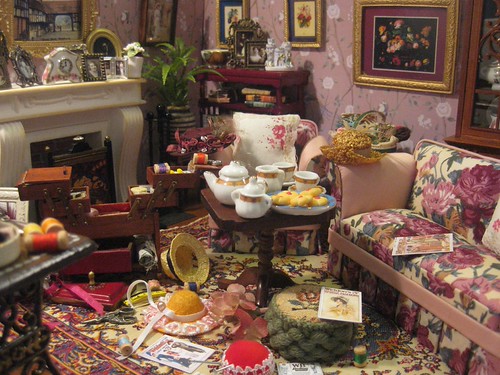
Lettice glances around the front parlour of the Putney villa, which doubles as Harriet’s sewing room and show room for her hats, with the critical eye of an interior designer, all the while listening to the notes of the oboe being played upstairs. The room’s middle-class chintzy décor immediately appals her as she takes in the floral covers of the flouncy Edwardian sofa on which she perches gingerly, and its matching roomy armchair by the fire, a hand embroidered pouffe and the busy Edwardian floral wallpaper. A bookcase stands in the corner, full of mystery novels covered in dust which Lettice suspects might have belonged to Harriet’s father, the deceased Mr. Milford. The bookcase’s top and the fireplace mantle are cluttered with family portraits taken in the possibly happier days of the idyllic summers before the Great War. The walls are hung with a mixture of cheap botanical prints and quaint English country scenes, all in gaudy gilded plaster frames. “How ghastly,” Lettice utters quietly with a sigh.
“I know: you hate the floral chintz,” Gerald says in reply to Lettice’s laconic observation. “You don’t need to tell me. The look of distaste on your face says it all. But you aren’t here to redecorate Lettuce Leaf, so be a darling and remember to mind your manners. You are a viscount’s daughter, after all, and Hattie is just a solicitor’s daughter. However, in spite of her low birth in comparison to your own, she is a good person, and she is my friend. Show some of your good breeding and be gracious.”
Lettice shoots Gerald an annoyed look at his use of her abhorred nickname yet again. “I’m beginning to question your choice of new friends – not that I even knew she existed prior to today.”
“Oh, there is a lot about me you don’t know, Lettice darling.” Gerald says with an air of mystery.
She glances around her again. “It’s awfully untidy in here.” she remarks not unjustly as she takes in the sight of a concertina sewing box on casters which stands cascaded open next to the armchair, threads, embroidery silks, buttons and ribbons pouring from its compartments like entrails. Hats in different stages of being made up and decorated lie about on the arm of the chair and the settee or on the floor in a haphazard way. The brightly patterned rug is littered with spools of cotton, scissors, ribbon, artificial flowers and dogeared copies of Weldon’s** magazines.
“Yes, well, Hattie hasn’t learnt the finer points of presentation yet,” Gerald admits. “But I’m working on that. However, suspend your judgement until you see what she can create for you.” Pointing to the three hats Lettice inspected a few minutes before sitting atop what must have formerly been a tea table, he adds, “You’ve already seen that her work really is every bit as good as Madame Gwendolyn’s.”
“Well, we shall see.” Lettice pronounces, withholding her judgement on Harriet’s work.
Just at that moment, Harriet’s scurrying footsteps across the tiled vestibule floor outside the door announce her arrival and she hurries through the door bearing a tray loaded with tea making implements and a plate of biscuits. “Be a lamb and bring over father’s chess table, will you Gerry darling.” she instructs Gerald.
Obediently Gerald gets up from his seat on the floral sofa next to Lettice, and with the familiarity of a regular houseguest, picks up a tilt table nestled on the far side of the fireplace. Tilting its surface into an upright position, Lettice momentarily sees the chess board set in marquetry on its surface before it is quickly obscured by an old fashioned Edwardian gilt banded tea set and the plate of biscuits as Gerald takes everything off Harriet’s tray.
“Thanks ever so!” Harriet sighs with relief before depositing the tray on the floor by the door, walking back across the room and around the table and then collapsing into the armchair with another deeper sigh.
“As an interior designer, Lettice has just been commenting on your décor, Hattie darling,” Gerald says to their hostess as he resumes his own seat.
“Gerald!” gasps Lettice, her face flushing at her friend’s frank admission.
“Oh I’m sorry it’s so untidy, Miss Chetwynd.” Harriet apologises as she snatches a rather tattered copy of Weldon’s* off the arm of her chair, shoving in behind her floral cushion, and tries to bundle her sewing bits back into the tray of her sewing box on casters. “Gerry has told me I need to improve the presentation of my premises, but having no domestic staff to speak of other than me, and trying to run a boarding house at the same time as make hats means I just don’t seem to have the time to tidy up in here.”
“Nor do I, Hattie darling,” Gerald scolds. “But that’s no excuse.”
Harriet blushes at her friend’s gentle rebuke.
“Shall I be mother then***?” Lettice asks. When Harriet nods in agreement, Lettice perches herself on the edge of the chintz sofa and sets out the tea things. “So,” she asks, pouring hot brackish tea into the first china cup. “You run a lodging house too?”
“Yes, for theatrical artistes.” Harriet explains proudly with a smile. “That’s Cyril playing his oboe upstairs,” She rolls her eyes up to the white plaster ceiling decorated with floral boiseries. “Although he is a professional actor as well as a musician in the West End.”
“Indeed,” muses Lettice.
“Although I do wish he’d play something other than Schumann or Mozart when we have guests.” mutters Harriet.
“Oh why, Miss Milford?” Lettice asks.
“Well, it’s not exactly the jolliest of music, is it?” Getting up again, Harriet walks over to the open doorway leading to the vestibule. Standing astride the threshold she calls up the stairs, “Do you think you could play something a bit jollier on the oboe, Cyril? We have guests. Gerry’s brought a friend. How about a nice bit of jazz?”
The music stops abruptly followed by a rather feminine sounding man’s fey voice opining from upstairs, “How can you, Hattie? I’m an artiste!” The last word is uttered dripping with melodrama. “Jazz music does not make one money.”
“Really? Then explain to me how the Savoy Havana Band**** make a living, Cyril? Please? Do it for Gerry, if not for me!”
“Oh, alright,” the fey voice bemoans. “But only because Gerry brought a chum.” The music recommences, only this time the opening bars to ‘The Sheik of Araby’***** fill the air.
“Hattie had a rather awkward situation with a retired colonel when she first started letting rooms.” Gerald says in a lowered tone as Harriet smiles at the change in music.
“Yes, the old chap couldn’t keep his hands to himself.” Harriet replies with a curt nod as she walks across the room and takes her place again. “Dirty old lecher was old enough to be my grandfather!”
“How awful, Miss Milford!” Lettice exclaims.
“I don’t find I have the same problem with men who are theatrical types, especially those from the chorus, those who paint the sets or work in the wardrobe department,” She smiles at Gerald, who smiles back. “If you understand my meaning, Miss Chetwynd” Harriet says with a wink, returning her attention to Lettice “I feel much safer around the likes of Cyril and his chums.”
“Indeed yes.” agrees Lettice, glancing between Gerald and Harriet, the pang of jealousy curdling her stomach as it did when she first saw Gerald and Harriet embrace in the way she thought only she and Gerald did.
“My father sent me to domestic science classes, so I’m quite a dab hand at plain cooking and keeping house when I get the chance, so my lodgers are happy.”
“Do try one of Harriet’s jam fancies, Lettice,” Gerald encourages, picking up one for himself from the blue and gilt banded sandwich plate, placing it on the edge of his saucer as he picks up his cup of tea. “They really are rather good.”
Lettice picks one up and takes a small bite, the biscuit dough melting in her mouth. “Very good, Miss Milford.” she enthuses. “Every bit as delicious as my maid’s baking.”
“Thank you, Miss Chetwynd.” Harriet replies with a proud smirk. “I’ll take that as a compliment.”
“Considering that Lettice doesn’t know how to make a cup of tea, never mind bake a biscuit, I would.” Gerald remarks cheekily.
Ignoring his remark, Lettice asks, “So how is it that you came to make hats, Miss Milford? I was just admiring those hats on the table over there before you came in. They are beautifully made.”
Turning her head, Harriet gazes pleasingly at the three hats sitting on the table next to her sewing machine in the bay window. “Thank you, Miss Chetwynd. Well, my mother before she passed on taught me how to sew and embroider. She embroidered that.” Harriet indicates to the pouffe at Lettice’s feet with its green flounces and a rose stitched on its top. “I always enjoyed sewing and working with fabrics, so I thought I’d try my hand at making hats.”
“Harriet had to turn over her sewing room to Cyril when he came to board with her.” Gerald adds.
“How do you know where Cyril sleeps?” Lettice asks with mild shock, her face flushing with colour when Gerald clears his throat awkwardly and blushes bright red as a silent form of reply. “Oh… oh, I see.”
“The light is much better in here anyway,” Harriet quickly pipes up brightly in a chivalrous effort to prevent her friend any further embarrassment, a gesture that does not go unnoticed by both Gerald and Lettice who both admire her action. “The bay windows downstairs are much bigger than the oriel windows up under the roof. Besides it’s much easier for customers to step in here than trudge up three flights of stairs to the attic.”
“And your little enterprise has taken off, I believe Miss Milford.”
“I’ve been moderately successful, Miss Chetwynd.”
“You’ve been very successful, Hattie darling.” Gerald corrects her encouragingly.
“And what are you going to call your cottage industry, Miss Milford?” Lettice asks. “Not Hattie’s Hats, I hope.”
“Oh how drole you are, Miss Chetwynd,” laughs Harriet. “No. Well, I hadn’t actually thought what I should call my ‘little enterprise’, as you call it, Miss Chetwynd. Maybe you and Gerry can help me find the perfect name.” Clearing her throat, she carries on. “Which brings me to the reason why you are here. I believe that you are in need of a new hat, Miss Chetwynd.”
“So, Gerald has told you about me then, Miss Milford?”
“Well, yes, Gerry did tell me that you are both to attend your brother’s wedding at the end of November – a country wedding in Wiltshire I’ve been told – and he did tell me that you have fallen out with your former milliner, Madame Gwendolyn of Oxford Street. He also gave me some background to your family,” She leans forward in her seat, her demeanour suddenly going from a relaxed stance to a more professional and formal one. “However, I am also perfectly capable of doing my own research, Miss Chetwynd. I’ve often seen your picture in the society pages in the company of Gerry, Minnie and Charles Palmerston, Celia Bamford, Willie Chelmsford, Priscilla Kitson-Fahey and more recently, American department store heir Georgie Carter: your ‘Embassy Club Coterie’ I believe you call it. You are also acquainted with Elizabeth Bowes-Lyon****** who has been linked romantically with the Duke of York in the last year. I also saw you in Vogue twice this year: once at the wedding of Dickie and Margot Channon in January – Margot Channon née de Virre your best friend – and then again at the marriage of the Princess Royal******* in February.”
“My, you are well informed, Miss Milford!” remarks Lettice, unable to disguise how impressed she is at Harriet’s research.
“I also noticed, without Gerry needing to tell me,” Harriet glances momentarily at Gerald slyly scoffing another of her jam fancies before returning her attention quickly to Lettice. “That the rather fetching straw hat with silk and feather trim you wore to the Royal Wedding was a model bought from Selfridges.”
“Gerald!” Lettice exclaims, slapping him hard on the knee.
Sitting up and spluttering out bits of biscuit onto the floor in front of him he manages to utter between coughs, “I… I didn’t… tell… her.”
“It’s true,“ Harried elucidates. “Gerry didn’t need to. I make it my business to study fashion, and anyone with a keen eye who reads Selfridges advertisements would know that it is a French mode Mr. Selfridge paid to import from Paris. Pretty yes, but not unique. No doubt, after your falling out with Madame Gwendolyn you found yourself in a tight spot Miss Chetwynd, needing a new hat, but not one from her. Being one of hundreds of guests at the wedding, you could get away with a shop bought hat. As a significant event on the Wiltshire social calendar, I imagine that you need something a little more discerning to wear to your brother’s wedding, considering that there will be far fewer guests in attendance than there were at Westminster Abbey, and therefore more attention paid to you.”
“Please forgive me, Miss Milford,” Lettice smiles across at Harriet, suddenly sitting up straight and looking her hostess directly in the eye. “I must confess that I underestimated you. When Gerald brought me here, and when I first met you outside, I didn’t detect an ounce of your shrewdness.”
“My father may not have valued my further education, but I did learn a few tricks and traits from him before he died.”
“Bravo, Miss Milford.” Lettice’s eyes glisten with interest. “You have my full and undivided attention. What are you proposing?”
“I believe you are wearing lemon yellow to the wedding, with russet accents. Is that right, Gerry darling?” Still recovering his breath after choking on biscuit crumbs he can only nod in reply before coughing again. “Then considering the shape of your face and the colour and style of your hair, I would suggest a yellow dyed straw, small brimmed picture hat with lemon yellow muslin and perhaps some russet flowers or autumnal shaded imitation fruit.”
“Hmmm….” Lettice ponders Harriet’s suggestions with a downwards gaze, envisaging what the hat might look like, before looking up again. “Very well Miss Milford. Consider yourself engaged to make my hat for Leslie’s wedding.”
“Oh hoorah!” exclaims Harriet, clapping her hands in delight. “We can settle terms later.”
Just as Lettice is about to agree, a tall, slender and handsome young man with pale patrician skin and a mop of blonde curls walks through the parlour door, dressed in a set of tails with a square instrument box in his right hand. Unnoticed by the party sitting in the parlour, the oboe music had ceased a short while ago, and the player now stood before them.
“Well, I’m off up the West End, Hattie.” Cyril’s voice, still containing that fey quality, was instantly recognisable. Placing a kiss on Harriet’s proffered right cheek, Cyril turns and snatches up a biscuit off the tray on the table before leaning over to Gerald and placing a kiss squarely on his lips, causing Gerald and Lettice to both blush at the brazen expression of affection bestowed upon Gerald so openly by the young men. As if nothing could be more natural, the young musician spins on his heel and elegantly walks to the door. Pausing on the threshold he turns back to the trio and says dramatically, “Don’t wait up.” Then he looks intently at blushing Gerald and adds, “I’ll see you after the show, Gerry darling. Ta-ta!” And he disappears from view, his exit from the villa being heralded moments later by the opening and then slamming of the front door.
The room is suddenly plunged into quiet, broken only by the ticking of the floral china clock on the mantle and the chirp of birdsong in the bushes outside the parlour window, the silence even more evident by the lack of Cyril’s playing drifting from upstairs.
“Well, you were right, Gerald,” Lettice says breathily after a few moments.
“About Harriet?” he asks gingerly.
“Well yes,” she agrees. “But also, about the fact that there is so much about you I don’t know.” She smiles cheekily, breaking the nervous feeling in the room. “So, is Cyril the reason you have come to know Miss Milford, or did you come to know Cyril through Miss Milford?”
*Originating in Seventeenth Century England, the term pin money first meant “an allowance of money given by a husband to his wife for her personal expenditures. Married women, who typically lacked other sources of spending money, tended to view an allowance as something quite desirable. By the Twentieth Century, the term had come to mean a small sum of money, whether an allowance or earned, for spending on inessentials, separate and in addition to the housekeeping money a wife might have to spend.
**Created by British industrial chemist and journalist Walter Weldon Weldon’s Ladies’ Journal was the first ‘home weeklies’ magazine which supplied dressmaking patterns. Weldon’s Ladies’ Journal was first published in 1875 and continued until 1954 when it ceased publication.
***The meaning of the very British term “shall I be mother” is “shall I pour the tea?”
****The Savoy Havana Band was a British dance band of the 1920s. It was resident at the Savoy Hotel, London, between 1921 and 1927. Players in the band included future American crooner Rudy Vallée and British pianist and composer Billy Mayerl.
*****“The Sheik of Araby” is a song that was written in 1921 by Harry B. Smith and Francis Wheeler, with music by Ted Snyder. It was composed in response to the popularity of the Rudolph Valentino feature film The Sheik. "The Sheik of Araby" was a Tin Pan Alley hit, and was also adopted by early jazz bands, especially in New Orleans, making it a jazz standard.
******Elizabeth Bowes-Lyon as she was known in 1922 went on to become Queen of the United Kingdom and the Dominions from 1936 to 1952 as the wife of King George VI. Whilst still Duke of York, Prince Albert initially proposed to Elizabeth in 1921, but she turned him down, being "afraid never, never again to be free to think, speak and act as I feel I really ought to" She was one of Princess Mary’s eight bridesmaids at her 1922 wedding.
*******Mary, Princess Royal and Countess of Harewood (1897 – 1965), was the only daughter of King George V and Queen Mary. She was the sister of Kings Edward VIII and George VI, and aunt of Queen Elizabeth II. She married Viscount Lascelles on the 28th of February 1922 in a ceremony held at Westminster Abbey. The bride was only 24 years old, whilst the groom was 39. There is much conjecture that the marriage was an unhappy one, but their children dispute this and say it was a very happy marriage based upon mutual respect. The wedding was filmed by Pathé News and was the first royal wedding to be featured in fashion magazines, including Vogue.
This rather cluttered and chaotic scene of a drawing room cum workroom may look real to you, but believe it or not, it is made up entirely with pieces from my 1:12 miniatures collection, including pieces from my childhood.
Fun things to look for in this tableau include:
1:12 size miniature hats made to such exacting standards of quality and realism such as these are often far more expensive than real hats are. When you think that it would sit comfortably on the tip of your index finger, yet it could cost in excess of $150.00 or £100.00, it is an extravagance. American artists seem to have the monopoly on this skill and some of the hats that I have seen or acquired over the years are remarkable. The natural yellow straw hat with white ribbon trim on the arm of the settee was made by an unknown artisan in the United Kingdom and was sold through Doreen Jeffrey’s Small Wonders miniatures shop. The red velvet hat covered with roses on the arm of the chair was made by an unknown British artisan. The two hats on the carpet were both acquired from Kathleen Knight’s Doll House in the United Kingdom.
The copies of Weldon’s Dressmaker and the Lady’s World Fancy Work Book scattered about the room are 1:12 size miniatures made by the British miniature artisan Ken Blythe. The books on the bookshelf in the background are also made by Ken Blythe. Most of the books I own that he has made may be opened to reveal authentic printed interiors. In some cases, you can even read the words, depending upon the size of the print! I have quite a large representation of Ken Blythe’s work in my collection, but so little of his real artistry is seen because the books that he specialised in making are usually closed, sitting on shelves or closed on desks and table surfaces. In this case, the magazines are non-opening, however what might amaze you is that all Ken Blythe’s books and magazines are authentically replicated 1:12 scale miniatures of real volumes. To create something so authentic to the original in such detail and so clearly, really does make this a miniature artisan piece. Ken Blythe’s work is highly sought after by miniaturists around the world today and command high prices at auction for such tiny pieces, particularly now that he is no longer alive. I was fortunate enough to acquire pieces from Ken Blythe prior to his death about four years ago, as well as through his estate via his daughter and son-in-law. His legacy will live on with me and in my photography which I hope will please his daughter.
The concertina sewing box on casters which you can see spilling forth its contents is an artisan miniature made by an unknown artist in England. It comes from Kathleen Knight’s Doll House Shop in the in the United Kingdom. All the box’s contents including spools of ribbons, threads scissors and buttons on cards came with the work box. The box can completely expand or contract, just like its life-sized equivalent.
The hand embroidered and home made cream and green pouffe, the black japanned fire screen, the black metal fire tools and the plant in the corner all also come from Kathleen Knight’s Doll House Shop.
Harriet’s family photos seen cluttering the mantlepiece and the bookshelf in the background are all real photos, produced to high standards in 1:12 size on photographic paper by Little Things Dollhouse Miniatures in Lancashire. The frames are almost all from Melody Jane’s Dollhouse Suppliers in the United Kingdom and are made of metal with glass in each.
The porcelain clock on the mantlepiece is made by M.W. Reutter Porzellanfabrik in Germany, who specialise in making high quality porcelain miniatures. The pot of yellow and blue petunias on the mantlepiece has been hand made and painted by 1:12 miniature ceramicist Ann Dalton. The castle shaped cottage orneé (pastille burner) on the bookshelf has been hand made, painted and gilded by Welsh miniature ceramist Rachel Williams who has her own studio, V&R Miniatures, in Powys. The bowl decorated with fruit on the bookshelf was hand decorated by British artisan Rachael Maundy.
The spools of threads, the tape measure, the silver sewing scissors in the shape of a stork and the box of embroidery threads I acquired from Kathleen Knight’s Dolls’ House in the United Kingdom.
The tilt chess table in the middle of the room I bought from Mick and Marie’s Miniatures in the United Kingdom. The Edwardian tea set and cake plate on its surface come from Kathleen Knight’s Doll House in the United Kingdom, whilst the biscuits on the plate come from Beautifully Handmade Miniatures in Kettering.
The sewing basket that you can see just behind the straw hat sitting on the arm of the sofa I bought from a high street shop that specialised in dolls and doll house furnishings. It is an artisan miniature and contains pieces of embroidery and embroidery threads.
The floral chintz settee and chair and the Art Nouveau china cabinet are made by J.B.M. miniatures who specialise in well made pieces of miniature furniture made to exacting standards.
The sewing machine to the left of the photo, I bought from Melody Jane’s Doll House Suppliers in the United Kingdom. It is made with extreme attention to detail, complete with a painted black metal body, authentic sewing mechanisms and a worksurface “inlaid” with mother-of-pearl.
The Chinese carpet beneath the furniture is hand made by Mackay and Gerrish in Sydney, Australia.
The Edwardian mantlepiece is made of moulded plaster and was acquired from Kathleen Knight’s Doll’s House in the United Kingdom.
The bookshelf in the background comes from Babette’s Miniatures, who have been making miniature dolls’ furnishings since the late eighteenth century.
The paintings and prints on the walls all come from Kathleen Knight’s Doll’s House in the United Kingdom.
Posted by raaen99 on 2022-10-16 05:48:22
Tagged: , hat , straw hat , tea set , teapot , cup , sugar bowl , biscuits , pink , green , floral pattern , chintz , ribbon , flower , flowers , tape measure , rose , thread , spool , scissors , table , spool of thread , reel of cotton , sewing box , chair , sofa , millinery , display , hat display , accessory , accessories , sewing machine , seat , millinery display , pincushion , accessories display , fireplace , photo , photograph , photo frame , clock , magazine , Weldon , Ken Blythe , Ken Blythe miniature , drawing room , sewing , picture , painting , frame , photograph frame , picture frame , fashions , handmade , handmade dollhouse miniature , 1:12 , 1:12 scale , dollhouse miniature , dollhouse , toy , antique , artisan , Edwardian , interior , tabletop , tabletop photography , miniature room , diorama , tableaux , macro , macro photography , footstool