tree care’s history and how-to, with nybg’s melissa finley


THE EARLIEST REFERENCES to humans cultivating trees date back to maybe 6,000 BC, and there are records of tree-care tactics in the Bible, too, and from ancient Egypt. These person-to-tree interventions were the start of the science and art of arboriculture, and our best practices of pruning and other how-to have evolved in each successive era to the methods we know today.
I took a look backward in history, and also explored some current recommendations, with Melissa Finley, New York Botanical Garden’s Thain Curator of Woody Plants, and also curator of NYBG’s Peggy Rockefeller Rose Garden.
Woody plants are Melissa’s passion; she is a certified arborist, and was a forester with the New York City Department of Parks and Recreation before joining NYBG four years ago.
Read along as you listen to the Dec. 22, 2025 edition of my public-radio show and podcast using the player below. You can subscribe to all future editions on Apple Podcasts (iTunes) or Spotify (and browse my archive of podcasts here).

 woody plant history and how-to, with melissa finley
Download file | Play in new window |
Subscribe: Apple Podcasts | Spotify
Margaret Roach: How are you in this craziest of winters so far, huh? [Laughter.] Up and down, up and down.
Melissa Finley: It’s so unpredictable. I can’t believe how hard it was raining about 10 minutes ago, and 55 degrees.
Margaret: Yeah. Madness, madness. So speaking of tree care, just a little background: Roughly how many zillion trees and shrubs are there at that botanical garden that you and your crew have to look after [laughter]?
Melissa: What a complex question. I think we have about 5,000 mapped trees and shrubs, but many more that are unmapped and kind of unverified, hanging out in our woodlands and natural areas. So it’s hard to guess.
Margaret: You better stay on your toes, you guys. I think of having a small number of trees and shrubs as a big responsibility, but that’s epic.
Melissa: We stay busy, definitely.
Margaret: Yeah. So I thought we could start with just a few highlights of the history of mankind’s attempts to manage trees. I know we could do 10 whole episodes of the show on different theories and styles that we’ve evolved through the ages, but I wanted to hear some that really stand out to you because I mean, I think trees have been on the earth close to 400 million years or something. We homo sapiens are more like, I don’t know, what, a few hundred thousand years or something [laughter]. So they’ve been around a lot longer than we have. But what, we’ve been cultivating them for 6,000 years or something. So any highlights for you?
Melissa: Yeah. So I became interested in this kind of early history of our relationship to trees when I read some articles just about the history of American arboriculture and how we came to do our contemporary practices of tree pruning and found that the basic articles that were available really stopped short in the late 19th century. So I really wanted to do a deep dive on how people thought about trees and approached their relationship to trees much further back.
So as you mentioned, yeah, our earliest cultivation practices that we have records of are about 6,000 BC in Asia Minor, but those records really do extend. This is early olive tree cultivation moving from Asia Minor into Italy by the 6th century BC, which is just remarkable, unfathomable really amount of time.
And the other things I was looking for were just early mentions of intentional pruning. There are several kind of references to pruning of fig trees in the Bible. They call it “dressing of sycamores,” which refers to Ficus sycomorus, which is the sycamore fig tree.
And then the other very early mentions that we find in the historical records, which I think were just fabulous, were actually from ancient Egypt. We have these wonderful paintings and records of actually the transplanting of large trees by the ancient Egyptians. There’s records from the 15th century [BC], which was during the reign of Hatshepsut, who was a very famous female pharaoh. And she had sent people on an expedition to what we think is probably modern-day Somalia to bring back frankincense and myrrh trees for use in rituals. They extract those resins for mummy embalming, and there’s all these records of them very successfully transplanting these trees, which to us seems so modern.
Margaret: Yes. Oh, absolutely [laughter]. Wow. So I didn’t even know there was a female pharaoh, let alone that she was into transplanting, to having some trees transplanted.
Melissa: She’s very interesting.
 Margaret: Oh, fascinating. So a long history, and it’s gone through a lot of … It’s evolved; the practices have evolved. And I mean, I’d imagine the tools have evolved, obviously. There were no chainsaws and all kinds of things we have today [laughter], big buckets that went up into the treetops and so forth.
So you gave me, when we first spoke about this just on the phone a couple of weeks back or whatever, you gave me some really interesting research papers to read. And it seemed like one of the subjects that had the most kind of differences was the pruning of mature trees, as opposed to the training of young trees when they’re first getting started. It seemed like with the older trees, there was a lot more, well, disparity, almost differences of tactical approaches. Is that the case?
Melissa: Yes, definitely. I think as we’ve been able to codify our scientific approaches to pruning, that the way that we treat mature trees has a lot more … I’m trying to think of the best way to put it. A lot more [laughter] kind of disagreement, I’ll say, in the field about how to approach these things. I mean, trees are very hard to study, and particularly mature trees. It’s hard to do a PhD on the way that pruning affects a mature tree when you really do want to come back not one year later or two years later, but 20 years later [laughter]. How do we do that sort of scientific study in that long of term is very difficult. So a lot of it is short-term observation and applying that as best we can to long-term understanding, which makes it all very difficult, yes.
Margaret: And I mean, I know a lot of arborists from the work I’ve done over the years, and then also arborists where I live, who I’ve employed to help me with things that are too big for me to do with trees, with older trees. And there’s a lot of difference of opinion as a consumer, as a garden owner who needs help. And there’s words that get thrown out, phrases that get thrown out: What’s structural pruning? And then I recently have heard about retrenchment pruning, and lots of what seems like disagreement about that [laughter]. And it’s hard for the consumer to know what’s the right way.
Melissa: It is. And unfortunately, it’s difficult for the expert to know the right way as well [laughter]. What I’ll say is luckily for the home pruner, trees that you can reach tend to be younger trees, and those recommendations have not changed very much in the last few years. That’s what we would call structural or formative pruning, is when we’re approaching a juvenile tree, we’re trying to establish a structure that will be long-lasting, that will allow for proper spacing between branches and reduce the instances of the formation of bark inclusions and other things that might become what we would consider hazardous in the future. So that’s kind of what we mean when we’re talking about structural pruning.
Margaret: So like in the old days, we used to say the three D’s: dead, damaged and diseased, or some people had other ones—or things like crossed branches or inward-facing branches, or as you say, things that were a potential danger. Those are all structural things?
Melissa: Yes, absolutely. So a lot of that comes out of the research from Ed Gilman, who’s a fantastic researcher down at the University of Florida, and he did a lot of research on young tree structural pruning, and that’s where a lot of those phrases come from. I think he might have even coined the three D’s, and that’s all kind of bog-standard since I don’t know how long ago, but his research has really proved that it seems to be good practice.
So yeah, you want to start with your three D’s, eliminate crossers, and then take a big step back, put your saw down, and look at what you have left after you’ve eliminated those, and really just thinking about spacing and the overall shape of the canopy. So all of that is pretty much still recommended. But when we get into the mature trees, that’s when it gets really much more complex.
Margaret: Yes. And so I’ve followed the work of some practitioners who really honor the tree through its whole life cycle, including through its decline into its death and its role in the ecosystem as this biomass that was birthed there and lived there and will die there. And unless there’s grave danger to people or structures they let it do its thing, so to speak. And then I’ve also, again, met people who want to do adjustments to the canopy even of older trees or … Yeah, and I never know [laughter] what’s the right idea.
Melissa: Yeah. So what I’ll say is I think the more recent research we have more and more is pointing to this incredible resilience that we have in trees throughout their whole lives. So in the … I’m trying to remember when this research was. There was some research done about tree life stages, where they were describing each phase of a tree’s life, as you say, as they go from young to mature to over-mature and ancient and start to crumble, that describe these as inherent sort of developmental stages.
And what the kind of newer research is showing is that it’s really best to think about several of those phases as response phases, and not so much always going to happen at such and such age, at such and such period of a tree’s life. So as it’s starting to decline, or change its canopy shape, these are signs that the tree is responding to the world around it, to the conditions it’s experiencing, and is actually actively reiterating its canopy in new ways in response to that environment.
So the trees are really, really resilient. They’re very perceptive of the world around them, and they’re growing new wood, new structures in response to changing weather and to changing branch shapes and all kinds of things. And the field is trying to really understand how trees are shaping themselves. And so over-pruning is, I think … I get it; I feel that need to prune these large trees in order to feel safer. But I think I kind of tend toward the side of trusting them to reiterate themselves and adapt to their environment over time as best we can.
Margaret: And then down to the level of the individual cuts over the years, I’ve heard different … Obviously, there’s some very famous diagrams. I think some of them come from Alex Shigo or someone along the way that taught a lot of this. And we hear about things like the … Well, I was taught it was called the branch-bark collar, but maybe it’s just the bark collar. And flush cuts and how those cause greater wounds. What about when we get to that sort of, O.K., I am going to make a cut for a particular reason? And there are some tree species that have very distinctive difference in the look of their tissue where the branch meets the trunk and some that don’t. It’s a lot [laughter].
Melissa: Right. Yeah, absolutely. So yeah, it was very common practice to recommend flesh cutting for a very long time. The oldest mention of it that I could find was from a book published in 1861 by a man called de Courval. I’m not going to try to pronounce the French. I’ll totally butcher it.
Margaret: I’m terrible at French, so forget it. I don’t mind.
Melissa: But the English translation, which was later published in 1964, was titled “A Treatise on Pruning Forest and Ornamental Trees.” And he was advocating for flush-cutting, which is cutting beyond that branch-bark ridge, directly into the trunk tissue, so that you get as flat a cut as possible. And his argument is that cutting that close and even with the trunk will allow for more sap access to that wound, since the sap is flowing upward in the xylem of the tree, the vascular tissues of the tree, that having it cut flush against that trunk will expose all of the wound edges to actively flowing sap and would therefore close faster.
Which makes sense. And they have actually done studies that flush cuts, those wound edges do start to seal over faster. But because they are a larger wound surface, over the course of about 10 years, they’ve done these A/B testing and shown that eventually the branch-bark ridge intact cuts do seal completely over much faster.
But I was very interested in finding out why they were recommending that. And it really does make sense. It’s accessing that sap, that active wood, might cause faster regrowth.
 Margaret: But now do most arborists go toward the outside the collar, outside the ridge?
Melissa: Correct. Yeah. So that all comes from Alex Shigo’s research, which was just fundamental in restructuring our understanding of trees. We had to wait until we could look at trees with a little finer microscope, and it had to wait until we had chainsaws, basically [laughter]. It allowed him to really finally cut trees and look at different cross-sections with a lot finer view, much more refinement to those cuts with a chainsaw. It’s an unbelievable scientific tool, if you can believe it.
So he started advocating in his 1977 report, “Compartmentalization of Decay in Trees,” this practice called natural target pruning. So it’s replacing this flush cut right against that stem of the tree with instead cutting just outside what you refer to as the branch-bark ridge. So it leaves just a little bit of a nub on the outside there. And the argument is that it both reduces the size of the cut, that cross-section of wounded wood, and it retains this very specialized wood, which research has shown has this ability, the specialized ability, to help seal over to occlude that wound much better than the stem tissue does.
Margaret: Oh. That’s the compartmentalization, is that place is a special place and it …?
Melissa: Yeah. So that tissue is much better at directing the chemistry of the tree to deposit microbe-fighting chemicals, and to physically seal off parts of the wood by depositing gums and just physically shutting off that area from air. All of these invading fungus especially really needs air to live. So if you seal off with gums and all sorts of cool waxes, it’s able to really functionally make a new wall. And that particular area of wood is much more physically and chemically able to do those functions.
Margaret: So speaking of 20th-century developments, did we do things like cabling and so forth before then, or is that a modern-day thing? I mean, because there are now support methods, too, that I see more commonly applied.
Melissa: Right, right. Well, so the steel cabling, which is a very common practice, that was invented by John Davey, who was an English arborist who moved to the U.S. in the 1870s, and he wrote a book called “The Tree Doctor” in 1901, which introduced some of these steel cabling and steel brace rod techniques, but it’s actually a much older approach. We have some evidence of the Greeks and Romans doing techniques like grafting and cabling and just kind of tying together orchard and olive and vineyard plants, and monks also mentioning it throughout the medieval period. But it was much more standardized in the early 20th century by people like John Davey and Francis Bartlett, probably the two most famous arborists from America.
Margaret: Whose names then became the name synonymous with large tree companies, Davey Tree and Bartlett [laughter].
Melissa: That’s right.
Margaret: Oh, I didn’t know that it had an old history before that. That’s interesting.
I wanted to ask you: Back at the botanical garden, are there tree species that take the most resources in terms of your team, your arborist team, your tree-care team there? Are there certain high-need type genera of trees versus low-need? Do you know what I mean?
Melissa: Sure, sure. I mean, it’s an interesting question. Yeah. I mean, I think just looking at the trees themselves, I would say the number one thing that we are always responding to is white pines dropping their branches [laughter]. And it’s a wonderful adaptation. They are adapted to alpine conditions, frequent snow and ice loading and high winds. And rather than sustaining much greater damage, they just are adapted to allow their branches to break off, kind of brittle and very easily, to protect themselves. But yeah, they do make a big mess around here quite frequently.
And then the broader question really is more about placement. So I’ve manufactured a rather complex system of inspections for safety for our trees, and that’s primarily informed by the location of the tree and how many people are often around it, rather than the tree itself. So if it’s over a bench or an outdoor amphitheater or something like that, those are trees that I’m looking at much more, and pruning much more conservatively.
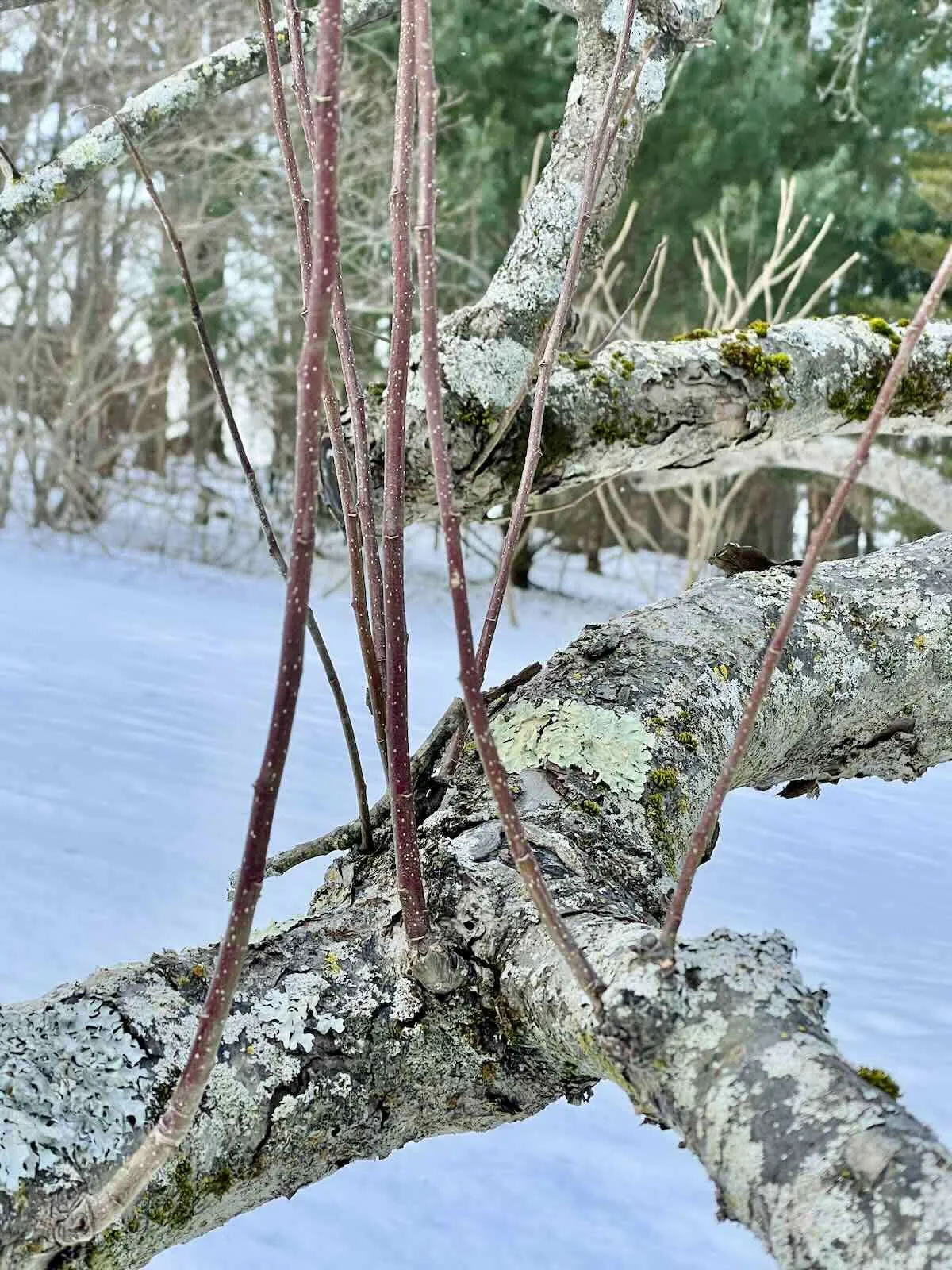 Margaret: Top priority. Because for me, I would have guessed—and again, I’m a gardener; it’s not as extensive a collection by any means—but certain types of trees, like I have some very, very old apple trees and I have a number of old magnolias. Where they have had wounds, so to speak, on their branches, they seem to tend to get a lot of water-sprouty, kind of “bad hair day”-looking growth [laughter].
Melissa: Yes, they do.
Margaret: And that to me is a lot of work, and especially once they’re big; you have to get up in them, and it’s a lot of work. So certain plants, certain trees, seem to have that reaction more than others. I don’t see those vertical shoots as much in other species. And again, I only know those two because I have them here. I’m sure there are others that you know that do that.
Melissa: Oh, and those would be the ones that I would have mentioned, too. Absolutely. Crabapples and cherries, the Rosaceous orchard plants, are very prone to water sprouts and root sprouts, as well as magnolias, depending on the hybrid parents, as well. I’ve found that a lot of the yellow-flowered magnolias are prone to it, and that’s from that parentage from the Magnolia acuminata, the cucumber tree.
Margaret: And are your crews out doing certain pruning tasks now, or do you wait until late winter? Is this a year-round thing or is it-
Melissa: Yeah, I mean, I think in the best of all worlds, we would be waiting until late winter to do pruning. But we have, as I’m sure you can guess, a lot of pruning to do [laughter]. So we do prune throughout most of the dormant season, and of course do emergency pruning throughout the year. But yes, now is a good time if you have a long list of things to prune, but if you can wait until the end of the season, early spring or late winter is a better time, since you’re not leaving a sort of gaping wound that the tree isn’t able to start responding to. I think it gives it a better chance. But yeah, we will start getting into our water-sprout pruning on our crabapples and cherries as we get into the season for sure.
Margaret: Oh, that can go on forever, definitely.
Melissa: [Laughter.] Even here. It’s a constant battle.
Margaret: I always think to myself, I wish I had a use for all those very straight young twigs. And I keep thinking, oh, I should make what we used to call pea brush, where you’d poke them in the ground and “brush up” your peas when you grew peas, as opposed to putting them on a trellis. That was very English, a very British, old-fashioned thing. I’ve never done that with them, but boy, oh boy, it’s a lot of twigs.
Melissa: There’s got to be a great craft for it [laughter].
Margaret: I know. Well, if it were willows, right, we could make some baskets, couldn’t we? There you go. Melissa. Well, I’m so interested to … I never really thought of the history part, and I was glad that you sort of turned me onto it and got me reading some references about it, and I’m glad to talk to you again. So happy year-end and New Year to come, and thanks for making time today.
Melissa: Of course. Happy New Year, and thanks so much for having me.
prefer the podcast version of the show?
 MY WEEKLY public-radio show, rated a “top-5 garden podcast” by “The Guardian” newspaper in the UK, began its 16th year in March 2025. It’s produced at Robin Hood Radio, the smallest NPR station in the nation. Listen locally in the Hudson Valley (NY)-Berkshires (MA)-Litchfield Hills (CT) Mondays at 8:30 AM Eastern, rerun at 8:30 Saturdays. Or play the Dec. 22, 2025 show using the player near the top of this transcript. You can subscribe to all future editions on iTunes/Apple Podcasts or Spotify (and browse my archive of podcasts here).