

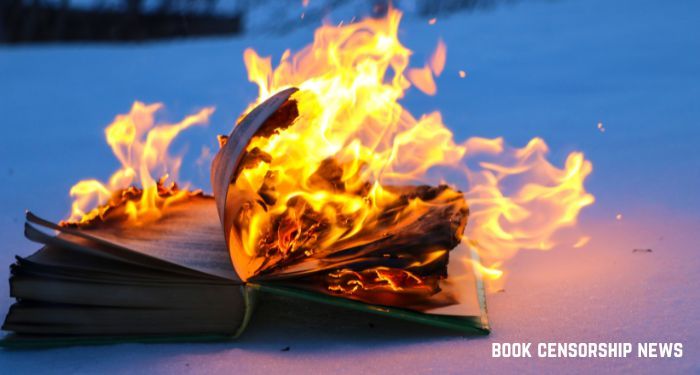
The target? Comics.
Over the next three weeks of Literary Activism’s Friday roundups, we’re going to take a look at the past, present, and future of comics censorship. All three of these posts feature the voices of scholars whose work has included exploring comics and book bans, and they’ll offer insight into why it is this literary format has constantly drawn criticism and condemnation in America–a land that likes to tell a story of being open minded and being a land of free speech and press, but a land where those are indeed stories.
Brian Puaca, Professor of History at Christopher Newport University in Newport News, Virginia, reached out to me earlier this year and shared with me a project he’d been working on called the Comic Book Burnings Project. As the title suggests, it’s a look at how Americans found community through comics burnings in post-war America. It’s an incredible work of scholarship, including timelines, primary sources, maps, and images from this era of nationwide censorship.
Literary Activism
News you can use plus tips and tools for the fight against censorship and other bookish activism!

In turn, I asked Professor Puaca if he’d be interested in writing about comics burnings from this era, as it’s both fascinating and infuriating. He not only offered up one post; he had two ideas for topics. This week, the post that’s more on the depressing side. Next week, a more optimistic view of what the history of comics burnings does–and does not–say about contemporary American comics censorship.
**
The Seductive Appeal of the Flames: Burning Comic Books in Postwar America
Please stop me if you’ve heard this one before: What did the U.S. Army, Catholic nuns, and African-American PTAs all have in common in 1950s America? They were all burning comic books! Contrary to contemporary popular perceptions of fundamentalist book burners in the Bible-Belt South, Americans from all walks of life destroyed comics in very public events in the decade after World War II. These comic book burnings took place across the entire country, and they were especially concentrated in the Northeast and Upper Midwest. They were held as holiday celebrations such as on Halloween. They were coordinated by local politicians, police officers, and firefighters. And they served as the culmination of cultural events like National Book Week. While few would dispute the deep divisions in American society at the time, it’s clear that burning comic books was something that just about everyone could support.
The war – in which America defeated the most infamous book burners in modern history – ended in September 1945. The first recorded comic book burning occurred less than three months later in central Wisconsin. Organized by parents, teachers, and students at a Catholic school in Wisconsin Rapids, the fire consumed thousands of titles such as Crime Does Not Pay, Miss Victory, Wings, and Batman. The burning of these “condemned” books, as the school’s list referred to them, marked the culmination of National Catholic Book Week. This fire would be the first of more than fifty such burnings over the next decade that would only subside with the arrival of the Comics Code Authority in 1955.
In the years that followed, comic book burnings took place with shocking regularity across the nation. There was at least one such event every year until 1956 with peaks in 1948-49 and 1954-55. They took place in rural areas such as Linton, North Dakota. They occurred in mid-sized towns like Mansfield, Ohio. Suburbanites organized burnings in Scituate, Massachusetts, a short distance outside of Boston. And they were held in cities such as Memphis and Chicago, which had a rash of comic book burnings in 1954.
The zeal among Americans to physically destroy comic books transcended politics, religion, race, class, and age. The Catholic Church played an important role in burning comic books, often referring to lists of unacceptable publications drawn up by the Legion of Decency. Notably, Methodists, Pentecostals, Presbyterians, and Evangelicals were involved with many events as well. Parent Teacher Associations in public schools often organized these gatherings, typically with the support of teachers and students. This includes African-American PTAs in the segregated schools of Virginia and Tennessee, as well as their White counterparts. Boy Scouts and Girl Scouts took part in comic book collection drives that would culminate in burnings. Politicians, women’s organizations, civic groups, school administrators, and local fire and police officials all participated as well. Especially prominent was the American Legion Auxiliary, which founded a book exchange program in 1954. Operation Book Swap, as the program was titled, held events across the nation with several – although certainly not all – ending in burnings. Even the Army took part, incinerating hundreds of thousands of Sad Sack comics that it had commissioned to re-enlist soldiers after a U.S. Senator denounced the book as “socialistic propaganda.”
The motivations for burning comic books varied across the different groups, but certainly all of them shared a belief that destroying these publications served to protect Americans from dangerous content. By the late 1940s, comic books had become a scapegoat upon which Americans could project all of their Cold War era anxieties: juvenile delinquency, violence, sexual promiscuity, “deviant sexuality,” non-traditional gender roles, and even Communism. Removing these comics from the hands of young readers, however, was not always enough for these groups. Their specific motivations can often be seen in the ceremonial burnings that they held. For example, high school students in Binghamton, New York sang “For Christ the King,” the Catholic Action youth song, as they burned 2,000 comics they had collected. For students in Port Huron, Michigan, it was both a religious and patriotic duty. Hundreds of students sang hymns on the playground and ended with the Star-Spangled Banner while they watched more than 1,000 comics burn. Students in Louisville, Kentucky burned comics as part of their school’s “Civics in Action” club and pledged, as “junior American citizen[s]” not to buy or read comics that would “endanger the safety or goodness of other American citizens.” Events such as these underscore how religion and patriotism combined into a powerful formula for book burning in the early Cold War.
Yet there were other reasons for burning comic books that dated back even further. Prior to 1945, most criticisms of comic books were based on their supposed cultural inferiority. Critics complained that they distracted readers from “better literature.” These views persisted into the postwar period and also played a role in the age of comic book burnings. They even bridged the racial separation of segregated schools. For instance, in November 1954, an all-White elementary school in Newport News, Virginia had a “Book Character Pageant” to model desirable literature, organized a comic book collection drive, and then burned them with a student government officer and the deputy fire chief lighting the blaze. This was the culmination of the school’s celebration of National Book Week. An unconnected but similar event took place that same month just a little more than an hour away in Hopewell, Virginia. Students in the Library Club at the all-Black Carter Woodson High School destroyed “all available ‘trashy’ and ‘obscene’ literature (comics, crime, love, etc.) that wields undesirable influences over younger readers.” Teachers, librarians, students, and parents – Black and White – expressed their cultural disdain for comic books by setting them ablaze.
In conclusion, the wave of comic book burnings in the United States after World War II vividly illustrates the appeal of extreme censorship. Previously the preserve of totalitarian dictatorships of the Right and Left, physically destroying books now became reconciled with upholding American ideals of family, faith, and nation. Groups that few then (or now) would associate with the tactics of dictatorships – the Boy Scouts, the American Legion Auxiliary, 4-H Clubs – adopted these methods for both symbolic and practical purposes. And the response of their fellow citizens? Many Americans joined them; most were complacent. Americans from all walks of life saw no discrepancy between burning comic books and the freedoms they cherished. While burnings are no longer commonplace, the allure of censorship and its compatibility with the agendas of well-intentioned citizens has changed little since the 1950s. One need only read the newspaper to see the continuing relevance of this dark chapter in comics and American history.
Brian M. Puaca is Professor of History at Christopher Newport University in Newport News, Virginia. He maintains the Comic Book Burnings Project, a digital humanities resource that maps and documents comic book burnings in America after World War II. The site can be visited at: https://arcg.is/PW1yu0. He can be reached at: [email protected].
**
For a little more about the legacy of comics censorship in America, dig into this history of the Comics Code Authority, 10 things you may not know about the Comics Code Authority, and this introduction to comics censorship and the titles which have roused book banners in the 2020s.
Book Censorship News: December 15, 2025
Note: this roundup includes news from the week of December 6 as well.
- The Supreme Court will not be hearing Little vs. Llano County in the upcoming session. This is a huge blow to the freedom to read. With this decision, a few things: first, kudos to Ms. Little and every other plaintiff for pursing this case for years. It’s tireless and emotional work. Second, the standing from the Fifth Circuit which says that the states of Louisiana, Mississippi, and Texas can curate public library shelves by partisanship remains. Third, we now wait to see what may come up from the circuit courts related to public library book censorship in the coming years that could rise to this level. A lot of mixed emotions come with this and all of them are valid. Here are some takes on the story.
- Because the Randolph County Public Library Board of Trustees (NC) did not ban the book Call Me Max from the public library, the county commissioners elected to fire the board. This is what it’s about folks–it’s not the one or two or ten books. It’s about power and control via unrepentant bigotry.
- RatedBooks is creating a new Index to book ratings. What it is and what value such a system holds for school districts already buying into right-wing mis and dis information about books.
- With our current administration, this isn’t going to go anywhere (especially given it didn’t with a far more favorable administration), but any effort is worth cheering. “The American Library Association (ALA) and its division, the American Association of School Librarians (AASL), welcomed yesterday’s bicameral reintroduction of the Right to Read Act by Senator Jack Reed (D-RI) and Representative Adelita Grijalva (D-AZ-07). Originally introduced in 2022 by the late Representative Raúl Grijalva, the Congresswoman’s father and predecessor in AZ-07, the Right to Read Act is designed to ensure all students, including low-income and minority students, children with disabilities, and English language learners, have access to an effective school library staffed by a certified school librarian.”
- The former Dean of Elizabeth Middle School (CO) is suing the district for discriminatory firing after she spoke up against the district’s book banning plans.
- Republican Rep. Nick Kupper of Surprise, Arizona, drank the same nonsense his fellow GOP members elsewhere did and proposed a bill that would ban public schools from paying for their library workers to be members of their professional associations.
- Some bigoted parents in Kettle Moraine School District (WI) are afraid of the book Wishtree because the tree doesn’t have a single gender. They got it removed from a voluntary-at-home reading list. This isn’t about their rights. It’s about their power over everyone else.
- Salado Public Library (TX) will not be removing When Aiden Became a Brother from shelves.
- Individuals who are incarcerated in California have hundreds of books they cannot have access to–including now a memoir from a former incarcerated individual whose work talks about how he helps other people live meaningful lives after jail. Sigh.
- Redlands Unified School Board of Trustees (CA) is going to decide whether or not to remove two books from the district, Push and The Bluest Eye. Recall that California has an anti-book ban law, which is only as good as it’s enforced. Update to this story is that Push has been banned and The Bluest Eye is restricted.
- The Merrimack Valley School Board (NH) removed The Perks of Being a Wallflower from tenth grade curriculum. It was one parent’s complaint that did this. ONE.
- “A conservative New Mexico lawmaker is drafting legislation allowing schools to rate library books for sexual and violent content and possibly materials about LGBTQ+ issues and race and remove them from general circulation, a move another legislator labels censorship and promises to fight. If the bill passes, New Mexico would be the first state in the country to enact a law that incentivizes school libraries to develop such systems.” This won’t pass in New Mexico, but that it’s even being proposed tells you that the masks have long been off related to what these “parental rights” concerns are. It’s outlawing and red labeling anything beyond white supremacist ideals.
- Library Director Luanne James spoke up about all of the illegal and unethical things the Rutherford County Library System’s Board (TN) has asked her to do. This is crucial–and it begs the question of what finally made her do this. To be utterly clear: this is great and more directors need to speak up like this. But James was director at York County Libraries (SC) prior and did not speak up about rampant unethical book bans and censorship there. Understanding what led to the change matters, as it will help spur action for others (guesses include better legal protections in Tennessee, as well as this being related to blatant patron privacy violations).
- New policy in Duval County Schools (FL) requires any book “describing sexual conduct” be pulled within five days of being challenged. Vague terms and swift action = the tools for even more book bans in Duval.
- “They pretended to be warriors against the imagined threats of LGBTQ people lurking in picture books. Yet when confronted with an actual parenting challenge, they resorted to violence, deception, and psychological torture.” This is a deeply disturbing read about parental abuse and the cruel Christian Nationalist agenda targeting books.
- Johnson City and Kingsport Public Libraries (TN) were targeted by “activists” in a raid to identify “inappropriate” books. They noted 140+ titles all which they claim are against the President’s Executive Orders. Recall that Tennessee’s Secretary of State is telling public libraries to remove books that would violate the Executive Orders–which are not, in fact, laws.
- Sioux Center Public Library (IA) found itself reviewing Icebreaker by Hannah Grace because a family complained about the book when their child borrowed it from the library. They’re mad the library is keeping the book, which was always only available in the adult section of the library, as it is an adult book. This is where the “parental rights” arguments made over and over fall apart. If the parents wanted to exercise their rights, then they would have spent a moment learning that the book their kid borrowed from the adult section was an adult book. The parents always had the right to say no, but they didn’t exercise it. They want the government to do that for them.
- Fairhope Public Library (AL) received two donations large enough to cover the money withheld by the state library service. Recall this lengthy battle is over the library’s right to provide LGBTQ+ books to their community.
- Citrus County Libraries (FL) are working on a new display policy following suggestions from members of the board to put up a display related to Charlie Kirk following his assassination. The policy isn’t going to be a great one, folks.
- Darcie Little Badger canceled an appearance at a Utah public university after learning about all of the things she couldn’t say under anti-DEI policies and regulations.
- The Kansas Attorney General’s Office seems to be sending threatening letters to school districts across the state demanding they rescind LGBTQ+ protections and allow parents to demand book removals based on “religious objection.”
- Gardner Edgerton Schools (KS) removed Jesus Land from the school library, despite the school librarian repeatedly telling the board they were breaking their own policy.
- New York’s Freedom to Read Bill is still sitting on the governor’s desk for signing. Many, many, MANY advocates showed up this week at a New York City read-in to urge the governor’s signature.
- The same parent who has been responsible for nearly all of the statewide book bans in South Carolina is fighting to get five more books fully banned from her local district, Beaufort County. They’ve now been restricted in the district. If this one feels like Groundhog Day, that’s because it is. It’s the same person who was behind the challenge of nearly 100 books a few years back.
- The Human Rights Defense Center has filed a lawsuit against the Metropolitan Detention Center over its paper book ban.
- “The Matanuska-Susitna Borough Library Citizens’ Advisory Committee (LCAC), a community-based group that sought to advise the Borough on challenged library materials in public libraries has disbanded during their December 8 meeting. Their work will be absorbed into the MSB’s Library Board.” Tucked into this really illuminating story about how some folks wanted to begin banning adult books in the public library is this little concerning note: “Parents now have the option to get an email regarding what their children are checking out from the public libraries, even if they don’t go with them to the libraries.” That is a blatant violation of patron privacy. I’d be super curious how Mat-Su squares violating youth privacy with what their actual borrowing and cardholder policies say. That doesn’t touch on the ethics here. Again: public library.
- GLAAD has selected and highlighted their 20 under 20, and two of the teens on this list are anti-book ban champions. Check ’em out (& read the interview we did with them here!).
- The Librarians will finally hit streaming via PBS on February 9. Mark it on your calendar and make a plan to watch with friends and family.


