

A groundbreaking police training pilot has revealed the extent of knowledge gaps among UK officers about medical cannabis, seven years after the drug was legalised for prescription in 2018.
The research team behind the paper, published in Policing: A Journal of Policy and Practice, trained 94 Police Constable Degree Apprentices from a single UK force and found that 88 per cent knew little or nothing about prescribed cannabis before the training, with potentially serious consequences for patients and police forces alike.
Before the training, officers’ word associations with “cannabis user” revealed deeply stigmatising attitudes that could harm interactions with legal patients.
When asked to write down the first three words that sprang to mind about cannabis users, the most frequent pre-training responses were “smell” (34 mentions, 12.8 per cent), “addict” (23 mentions, 8.7 per cent), and “young” (15 mentions, 5.6 per cent). The pejorative slang term “baghead” – meaning a drug user and, in some regions, connoting heroin use – appeared ten times.
The word “illegal” appeared 11 times, whilst “medical” appeared only three times and “prescription” was not mentioned at all.
 Pre-training question—the first three words participants thought of when they heard the term cannabis user.
These responses indicated officers assumed all cannabis was illegal and that a typical user was a younger person, conflating prescribed patients with recreational users.
The pre-training survey also exposed fundamental gaps in officers’ understanding of the law they were tasked with enforcing.
When asked what the law said about cannabis possession, 73 per cent stated simply that it was illegal, with no qualification for medical exceptions. Only 14 per cent reported that cannabis was illegal except for medical reasons.
When prompted with a direct question about whether there was any situation in which someone could legally possess cannabis, 86 per cent said yes. However, only 33 per cent clearly mentioned prescription medicine in their explanations.
The confusion was evident in officers’ written responses: “Medical that has been prescribed, No THC”; “Prescribed by doctor (only about 4 people in UK)”; “Medical reasons? (grey area)”.
During workshop discussions, officers revealed they had been misinformed during training that almost no one could legally possess cannabis, with some believing only four people in the UK had been prescribed the drug. They were “shocked” to learn the true figure was approximately 45,000 patients and rising.
Officers demonstrated no knowledge of the legal processes around cannabis clinics and pharmacies, expressing surprise that prescription cannabis could be delivered by Royal Mail or that cannabis flower must be vaped rather than smoked.
Following the three-hour training workshop, 67 per cent of officers reported knowing “a lot” about prescribed cannabis, compared with just 10 per cent beforehand.
Post-training perceptions
The post-training word association exercise showed dramatic shifts in attitudes. The term “medical” rose from three mentions to 39 mentions (15.7 per cent), whilst “prescription” increased from zero to 19 mentions (7.7 per cent). Crucially, the pejorative term “baghead” dropped from ten mentions to zero.
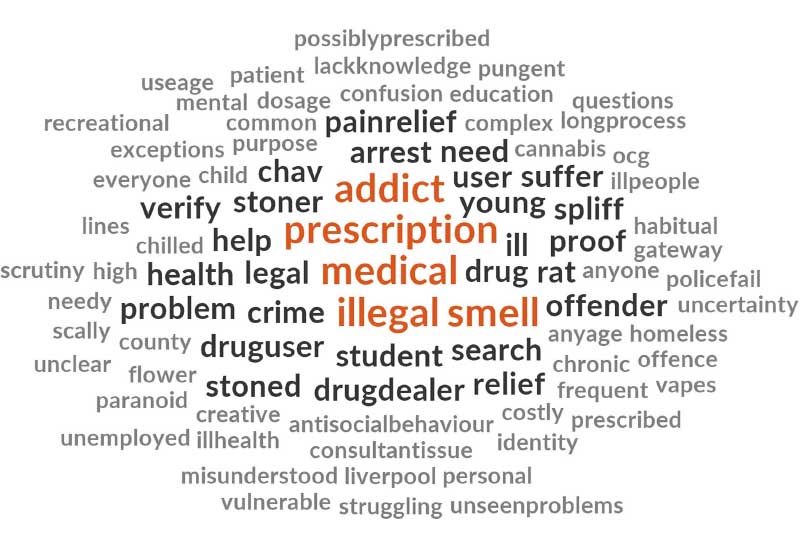 Post-training question—the first three words participants thought of when they heard the term cannabis user.
When asked what would stay with them from the training, 20 per cent of officers cited learning that prescription cannabis was legal, 25 per cent mentioned being surprised by the number of legal patients, and 11 per cent noted new knowledge about medical benefits and patient profiles.
Officers wrote: “That not everyone is using cannabis illegally, more people use it medically than I knew”; “The difficulties that families face obtaining medical cannabis products”; “The back story of people that need cannabis – it gives perspectives”.

However, the study identified significant operational barriers preventing officers from implementing their new knowledge. Forty-two per cent of officers said they intended to change their practice, but 47 per cent stated they would not change anything, with one writing: “Ultimately prescribed or not, cannabis is illegal until innocence is proved with prescription.”
Officers expressed frustration at the lack of clear directives from senior leadership, stating, “Supervisors need to know. This training needs to be presented to Sergeants”, and “Inform senior management as well”.
The research revealed confusion over verification processes, with officers uncertain about “medical cards” offered by some organisations. Despite Home Office guidance that only a prescription is needed as proof, several officers focused on fears of fake prescriptions and suggested elaborate national databases to verify patients.
Concerning attitudes emerged around stop and search procedures, with officers stating they felt pressure from supervisors to search whenever possible, regardless of whether someone produced a valid prescription. One officer said he would “feel obliged to confiscate the cannabis” due to body-worn camera footage being assessed by trainers who are “looking for results”.
Officers were particularly critical of guidance developed to protect the rights of cannabis patients who drive, with nearly all stating they would administer roadside drug tests even if a driver could pass fitness tests and showed evidence of their prescription.
The study’s authors, Dr Lindsey Metcalf McGrath and Helen Beckett Wilson from Liverpool John Moores University, concluded that seven years since legalisation, UK police remain “inadequately trained” on how to respond to patients.
“I am afraid that police officers cannot be expected to know about every aspect of every law that affects UK citizens.”
They recommend that policing policy leaders take urgent action to eliminate “grey areas” around procedural processes for prescription verification, cannabis-related searches, and driving stops, supported by accurate training for both new and experienced officers.
The researchers warned that inadequacies in police knowledge have “serious implications” for citizens in legal possession of cannabis and are “particularly damaging at a time when public trust and confidence in the police is declining”.
In October 2024, when questioned in Parliament about police training on medical cannabis, the Minister of State could only reference a Home Office circular and an NHS document issued in 2018, demonstrating the absence of comprehensive police training programmes.
Impact on patients of poor cannabis training
The research documents multiple cases where a lack of police knowledge has caused significant harm to legally prescribed patients.
In one case detailed in the study, a mother prescribed cannabis to control her epileptic seizures was reported to social services by police officers who questioned her fitness as a parent. Clinic staff were forced to intervene to educate both police and social services about the legality of prescribed cannabis. The encounter caused “immense stress” to the patient, whose medication had helped control her seizures to the point where she no longer needed family support to care for her child.
Another patient was refused entry to an outdoor festival despite carrying his prescription. Police suggested he leave the event and return later without the cannabis, which would have prevented him from taking his medication as prescribed.
A wheelchair user who did gain entry to a similar event expressed anxiety about the unpredictability of encounters, fearing that patients with invisible disabilities might face extra scrutiny. Black patients reported particular anxiety about how uninformed police might treat them, given racist stereotypes associated with drug users and disproportionate stop and search rates for minoritised communities.
The paper also highlighted a Guardian report in November 2023, in which 24 patients had contacted the newspaper about encounters with police who did not accept their explanations for consuming cannabis in public. When one patient complained about their treatment, Sussex Police’s professional standards team responded: “I am afraid that police officers cannot be expected to know about every aspect of every law that affects UK citizens.”