
“We’ve got a long way to go” – Aviation Expert questions Heathrow’s third runway case

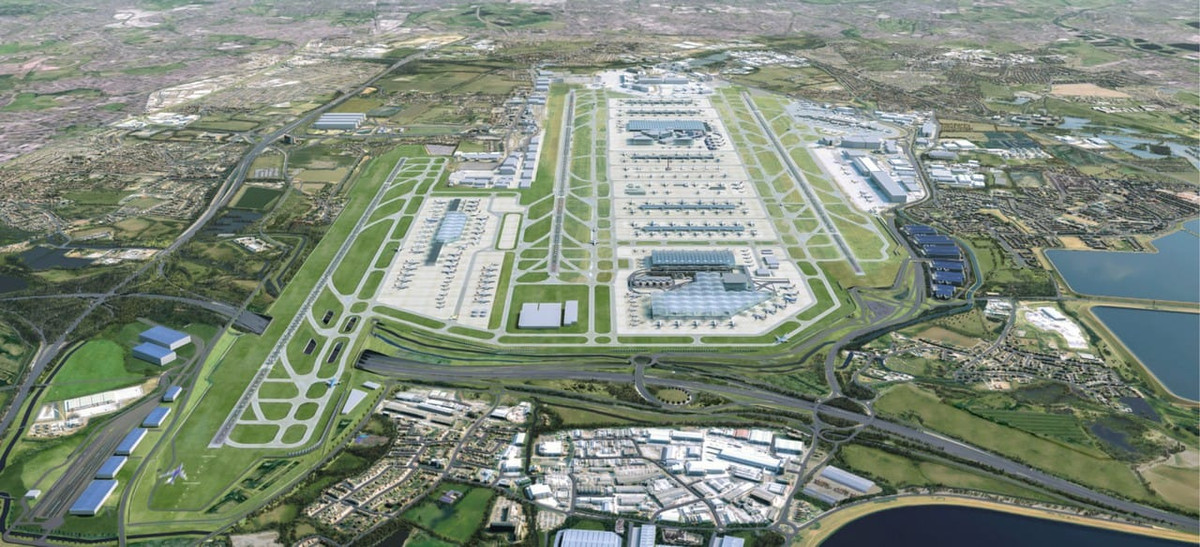
- The UK government’s renewed backing of a £49 billion third runway at Heathrow has reignited debate, but aviation analyst Chris Tarry of the CILT (UK) questions whether the project reflects today’s industry realities.
- He argues that the assumptions underpinning Heathrow’s expansion – GDP growth, hub connectivity, and fleet trends — are outdated. With long-haul routes increasingly served point-to-point from secondary airports and a marked drop in transfer traffic, Heathrow’s role is shifting.
- Tarry also challenges the need for a 3,500-metre runway, citing analysis that nearly all current aircraft operations could be supported by a shorter 2,800-metre runway. Rising costs and regulatory priorities have also raised concerns, with users potentially footing the bill for infrastructure they may never benefit from.
The UK government’s backing of a £49 billion third runway at Heathrow has reignited a long-dormant debate. But for industry analysts like Chris Tarry, Chair of the CILT (UK) Aviation Policy Group, the question is no longer whether the airport can expand—it’s whether the plan reflects how aviation has changed.
“Yes, the government has said, we want to go ahead with a project. We want to expand Heathrow. But the world has changed quite a lot since the Airports Commission made its report… We’re 10 years further on.”
Back in 2015, expansion was justified on assumptions about GDP growth, transfer traffic and Heathrow’s hub role. Much of that logic, Tarry argues, is now outdated.
“The rates [of GDP growth] up until 2019 were probably only about 75 percent of what was being forecast,” he said. “From the period 2023 to about now it’s probably closer to a quarter… Beyond that, it’s probably about half.”
He also pointed to a structural shift in airline behaviour: “If you look at Manchester, 50 percent of the long-haul flights are now point to point… This trend will accelerate.” New narrow body aircraft types like the A321LR and XLR are enabling more direct connections from secondary cities on “thin routes”, reducing reliance on Heathrow as a connecting hub”.
Even at Heathrow itself, the trend is visible. “We’ve seen a reduction of 6 million transfer passengers since the 2018 peak,” said Tarry. “Heathrow is now much more an outbound market.”
Fit for future fleets?
The current proposal includes a 3,500-metre runway, designed to accommodate large new-generation aircraft. But Tarry questioned whether this is fact is necessary.; Indeed, the government itself has noted that the project that actually goes ahead may be different from the one that it announced it was supporting.
“It has to be fit for purpose and also affordable,” he said. “ and meet the need that airlines will have in the future; We can already see what aircraft types are likely for a considerable period into the future, and this doesn’t seem to include a lot of very large new generation aircraft.”
Drawing on Arora analysis, he noted that “at least 97.8 percent of all flight operations could be accommodated in a 2,800-metre runway,” including most widebodies.
That raises the question of whether the current scope is driven more by legacy thinking than operational need.
Affordability remains a critical flashpoint. Heathrow is already one of the most expensive airports for users. “The only question is how much higher costs will be,” warned Tarry. “On the basis of reasonable assumptions is it quite possible that the increase in the charges could be around three quarters of EasyJet’s current average fare”.
Considerable thought is going the shape and nature of the economic regulatory system and here it seems that the CAA has supplanted its primary duty to consumers and users with its secondary duty which is focused on enabling the airport licensee to be able to finance their activities.
“At the present time the CAA’s approach seems to be based on an assumption that this project is going to go ahead. So how can we, the CAA, enable it to be financed ? However, the first question that should be addressed is: is this project actually what is required by users?”
He added: “It’s wrong, in my view, that today’s passengers should pay for something so far into the future that they might not use and also take the risk that at some stage in the future it may not go ahead.”
Tarry acknowledged that while Heathrow’s plan explicitly references additional cargo capacity – forecast to double to around 3 million tonnes; more cargo arriving by air at Heathrow could also have a positive impact on reducing the amount that is carried by road
“Heathrow has addressed it… The Heathrow proposal was seen, in relative terms, as more positive,” he said. “Cargo sometimes gets forgotten.”
At the present time the slot rules make it almost impossible for cargo-only freighters to get new access to Heathrow where a new runway would provide an opportunity for this to be addressed. However, slots are not the only constraint on freighter operations; sufficient time on stand also needs to be available as do handling staff, equipment and appropriate storage (ambient, chilled and frozen).
The underlying concern from CILT (UK) is that key details remain unresolved—not just about environmental impact and traffic projections; there is also the question of how the airport will operate in a fragmented, highly competitive global market and closer to home where we will have already seen a significant increase in capacity at some other airports in the London area several years before the current expectation of when Heathrow’s new capacity might be available.
“We’ve got a long way to go,” said Tarry. “What is less than clear is whether this is exactly what is going to be fit for purpose for the airlines and users and affordable.”




![This app turns your Apple Watch into a Game Boy [Hands-on]](https://som2nypost.com/wp-content/uploads/2025/12/1765269185_FI-Arc-emulator.jpg-336x220.jpg)