How to Build a Dead Hedge That Will Bring New Life to a Garden


Messy gardening. It’s a familiar term for many of us, especially gardeners seeking to boost their garden’s ecological value. As we leave the leaves, add native plants and rain gardens, and keep those dead perennial stems standing through the winter and into spring, we’re encouraged to adopt a messier, less strict aesthetic that increases opportunities for other creatures to share the abundance our gardens can offer.
Imagine, however, ecologically friendly garden enhancements that increase the sense of order and rhythm in your yard. Even better if these creations are beautiful, dynamic, and provide shelter for birds, amphibians, and invertebrates. And the best part? The only supplies are your creative energy and materials you already have on hand.
Introducing . . . the dead hedge!

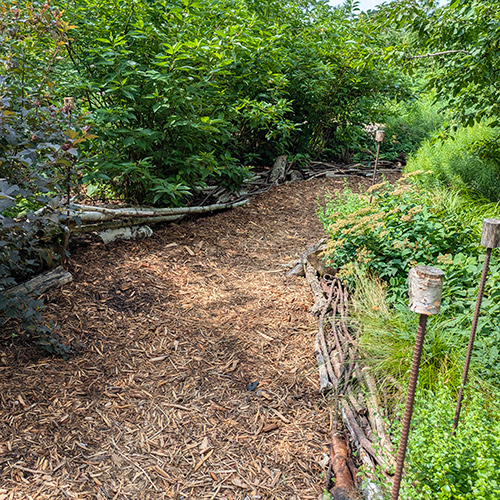
A dead hedge is a garden structure built from dead and dormant plant material ranging from fallen leaves and cutback perennial stems to twigs, branches, and stumps. The shape is only limited by your imagination; a tidy conical heap could be a good place to start, but a sinuous curving dead hedge can be a striking garden feature.
The benefits of building a dead hedge
Dead hedges offer a myriad of benefits for your garden ecology. After spring garden cutback, loosely layering the clipped perennial debris in a dead hedge gives insects that could be overwintering in leaves and stems an opportunity to emerge as the weather warms. Other beneficial insects shelter or overwinter on bark, branches, and leaves safely tucked away in a dead hedge.

Birds benefit too; dead hedges can offer a buffet of plant fibers for nesting, while ground-foraging woodland birds like thrushes are drawn to the hedge’s shelter and snack on ants and beetles hiding underneath. Gradual decomposition within the dead hedge also builds soil, as fungi and microbes slowly break down the plant materials and return organic matter to your garden beds.
3 Guidelines for Great Dead-Hedge Design
For gardeners who may be getting antsy during our long Midwestern winters, creating the framework for a dead hedge is a fun winter project. The design, materials, and goals are open to experimentation, but a few guidelines will keep your new creation functional and beautiful for years to come.
1. Consider the site and placement

Dead hedges can be great problem-solvers in the landscape. A vertical dead hedge can screen undesirable views like utility boxes or tool storage, and a striking dead hedge offers a great focal point in parts of your yard that lack definition and winter interest. Two parallel dead hedges can define a new walking path, while placing one perpendicular to a slope can slow down stormwater and decrease erosion.
Save steps by positioning dead hedges close to the source of garden debris; a dead hedge bordering perennial gardens makes spring cutback a breeze, while a dead hedge constructed from woody material can be a great way to skip hauling heavy trunks after a tree is cut down.
2. Build in “cues to care”

Especially in naturalistic gardens that tend toward looking wild, it’s important to pay attention to details that add order and aesthetic value. Before construction starts, a base of mulch or wood chips for your dead hedge provides a tidy surface to work from. As you begin stacking, place heavier materials at the base to create a stable foundation and prevent your hedge from wobbling or falling over. For more precise designs, cutting ingredients into uniform pieces before stacking can help you stay true to your vision, so keep your hand pruners and pruning saw sharp and at hand.

A dead hedge with a smoothly curving shape or a zigzag reminiscent of split-rail fencing can look more artful than a straight line. Plus, perfectly straight lines can be hard to achieve with natural materials, so a curve is usually more forgiving.
Consider adding wooden stakes or rebar posts along the edges of the dead hedge to make it easier to keep the hedge tidy and vertical as materials are added and the height grows. A width of about 12 to 18 inches is the sweet spot for most dead hedges. You may be surprised at how much material it takes to start building upward!

3. Plant for maintenance
A little annual touch-up keeps the hedge looking sharp. As materials decompose, there may be some shifting, so adding and redistributing materials, especially after winter settling, helps keep a uniform height and appearance.

It may be obvious, but avoid moving materials from the base layer of your dead hedge. The base is where contact with the soil promotes development of fungal networks and boosts soil health as the hedge materials are decomposed and add organic matter into the soil.
Extend the “life” of your plants
These design and maintenance tips will make your dead hedge a creation that combines beauty and function for many years to come, with character that grows over time as it becomes one with the landscape. Keeping our organic materials on-site is just another step toward a sustainable garden. Our plants work so hard to add beauty and support other life in our gardens while they are growing, and a dead hedge is a living monument that helps honor and extend their contributions in death as in life.

Find more information on wildlife-friendly gardening:
Discuss this article or ask gardening questions with a regional gardening expert on the Gardening Answers forum.
And for more Midwest regional reports, click here.
Erin Presley is a horticulturist at Olbrich Botanical Gardens in Madison, Wisconsin.
Photos: courtesy of Erin Presley
Fine Gardening Recommended Products

Modern Shade 5′ x 3′ Wood Privacy Fence Screen (4 Panel)
Fine Gardening receives a commission for items purchased through links on this site, including Amazon Associates and other affiliate advertising programs.
Create a secluded oasis with the Modern Shade Wood Privacy Fence Screen. Crafted from FSC-certified cedar with natural grain and knots, these modular panels conceal unsightly backyard items while adding warmth and style to your deck, patio, or garden. Easy to assemble with sturdy metal stakes, this fence provides lasting privacy and flexibility for any outdoor layout.

SHOWA Atlas 370B Nitrile Palm Coating Gloves, Black, Medium (Pack of 12 Pairs)
Fine Gardening receives a commission for items purchased through links on this site, including Amazon Associates and other affiliate advertising programs.
Lightweight and close-fitting for excellent dexterity. Machine washable. Breathable back of hand to reduce perspiration. Designed for easy movement and continuous wear. Ideal for aerospace, assembly, automotive, construction, final fix, gardening, manufacturing, operating machinery, packaging, precision handling, tiling, warehousing.

Organo Republic 16 Perennial Wildflower Seeds Mix for Indoor & Outdoors
Fine Gardening receives a commission for items purchased through links on this site, including Amazon Associates and other affiliate advertising programs.
Premium 16 Perennial Wildflower Seeds Mix – Special Garden Flower Seeds Blend designed for planting indoor & outdoors across North America. With over 16 varieties and 100,000 wildflower seeds, this mix is the best solution to attract pollinators – bees, butterflies & birds are essential for garden plants health. Our Special Perennial Wildflower Seeds Mix Includes White Yarrow, Columbine, New England Aster, Siberian Wallflower, Shasta Daisy, Lance-Leaf Coreopsis, Sweet William, Purple Coneflower, Blanketflower, Gayfeather, Blue Flax, Lupine, Dwarf Evening, Primrose, Mexican Hat, Prairie Coneflower, Black Eyed Susan. Easy & Fun Growing Experience with our online guides – Don’t plant disappointment – Add more colors to your wildflower garden! We send only super hearty heirloom flower seeds with the highest germination rate and fast sprout. Our detailed growing guide helps you grow seeds the garden of your dream like a PRO. Colorful Wildflower Garden from Seeds – Grow wildflowers everywhere – Indoor in window garden or Outdoors Flower garden Garden make a beautiful design for your garden borders, pathways, field or meadow and attract pollinators. Made in the USA by Small Family-Owned Business – Quality You Can Trust – Our wildflower bulk seeds variety pack are tested at the highest germination rates before being sealed to last for up to 3 years before you need to plant. Each packet of our flower seeds variety pack is resealable to make it easy to store and has its own label with a QR code for the growing instructions.