
How to Handle Family Drinking During the Holidays


Home for the holidays. It might make a great song, but let’s be real—it can fill us with dread. That’s true no matter what the circumstances are, but when you’re trying to live alcohol-free, family drinking during the holidays can be a massive trigger.
I’m Annie Grace, author of This Naked Mind, The Alcohol Experiment, and the upcoming book Live Naked AF: A Joyful Approach to Living Alcohol Free. I’m also a mom who quit drinking right smack dab in the middle of the holiday season (December 13, 2014) after my son refused to sit on my lap because my teeth were purple and my breath smelled funny. Dagger to the heart. I’ve been where you are, and I know that it can be hard to survive family gatherings without falling back into old drinking patterns.
That’s not all I know though. Time has taught me that you don’t have to white-knuckle your way through another holiday season. You don’t need to be “stronger” or “tougher.” You need practical tools, a little self-compassion, and permission to do things differently this year.
Consider this your guide to surviving family gatherings – a place to normalize your fears, understand the science behind your triggers, and walk away with actionable strategies for how to deal with family triggers without drinking.
TL;DR: Your Quick Guide to Alcohol-Free Holidays
Family drinking during the holidays triggers old patterns because of stress, tradition, and habit loops in your brain. You can navigate gatherings alcohol-free by: preparing your nervous system beforehand, using in-the-moment tools (pause, name, soften, choose), having scripts ready for pushy relatives, reimagining traditions, practicing micro-boundaries, and treating any slips with compassion instead of shame. The goal isn’t perfection—it’s showing up as the calmest version of you and actually remembering the moments that matter.
Jump to What You Need Most:
Why the Holidays Hit Different: The Science Behind Holiday Drinking
What is it about the holidays that makes us drink more? Let’s start with the obvious culprit: stress. The American Psychological Association reports that nearly 89% of adults experience holiday stress from money worries, missing loved ones, and anticipating family conflict. That’s almost everyone feeling the pressure.
Then there’s the fact that booze seems to pop up around every corner during the holidays. The National Institute on Alcohol Abuse and Alcoholism (NIAAA) notes alcohol is “more present than usual” during this season, and even people who don’t usually drink may overindulge. Office parties, neighborhood gatherings, family dinners—alcohol has become as synonymous with the holidays as twinkling lights and wrapping paper.
And then there’s the one that really trips so many of us up: tradition. Maybe it’s always having wine while you decorate the tree. Or the spiked hot chocolate that has become as standard as “Jingle Bells” in your home. See, family drinking during the holidays usually isn’t done to spite you or make things harder—it’s just what they’ve always done. The problem is, now we’re hyper-aware of it.
Join me for a walk-through on how to deal with family drinking during the holidays. We’ll cover the most common questions around it, ways you can respond to nosy relatives, the science behind it all, and pile up more self-compassion and love than there are gifts under the tree.
Question #1: Why Does Family Drinking During the Holidays Feel More Triggering Than Any Other Night?
Welcome to what I call the “holiday trigger stack.” It looks a little something like this: family roles + old stories + unresolved stuff + visible family drinking during the holidays = a perfect storm.
What does that look like in real life? People-pleasing to keep the peace, downing a drink because someone started that age-old fight that should have been resolved back in 2003, and suddenly Scrabble has become a drinking game. Sound familiar?
Why do we reach for a drink when family stress hits us? Because that’s what we taught our brain to do. Here’s the science: Stress releases cortisol, and your brain immediately reaches for the quickest relief it knows—alcohol.

These habit loops look like this: trigger → behavior → reward (relief). Dr. Judson Brewer, an addiction psychiatrist and neuroscientist, explains that the brain is always searching for efficient ways to get things done. A habit loop forms as the brain cycles and stores information to simplify tasks.
Breaking the Habit Loop: Dr. Jud Brewer’s Three-Step Method
Dr. Brewer’s method for breaking a habit loop involves three steps:
1. Become aware of the habit loop
- Identify the trigger: Recognize the cue that starts the habit (Uncle Mike’s political rant, your mom’s critical comment about your career)
- Observe the behavior: Notice what you do when the trigger appears (reaching for wine, excusing yourself to the bar)
- Understand the reward: Ask yourself what you get out of the behavior (temporary numbness, social lubrication, escape)
2. Explore the results with curiosity
Instead of automatically repeating the behavior, shift your perspective with curiosity. Investigate the physical and emotional sensations of the urge without judgment. This curious awareness helps you see the temporary nature of cravings and interrupts the automatic, fear-based reaction to them.
3. Find a “bigger better offer”
This is a new, more rewarding behavior to substitute for the old one. Curiosity itself can be this offer, as it provides its own reward and shifts your focus from the old craving. By choosing curiosity over the habit, you gather new information for your brain that the old habit is not as rewarding as you thought, helping to update the reward value and break the loop.
As I often say: “A drink will probably make you feel good for maybe 20 to 30 minutes.” After that? Stress rebounds, cravings deepen, and the cycle continues.

Research published in BioMed Central confirms this pattern, showing that family-related stress and problematic family alcohol use are linked to higher psychological distress and drinking as a coping mechanism. Understanding this isn’t about judgment—it’s about giving yourself the tools to respond differently.
Need an instant supportive community that is always at your fingertips and ready to help? Join the This Naked Mind Community right now! It’s where everyone from coaches to those navigating their first holidays alcohol-free are all supporting each other from all over the globe!
Question #2: How Can I Prepare My Nervous System Before a Gathering So I’m Not Blindsided by Triggers?
One of the most powerful things you can do is prepare before you walk through that door. This isn’t about building armor—it’s about building a foundation of calm. Here’s your pre-event “calm plan” for staying calm at family gatherings without alcohol:
Physical Preparation
- Sleep, food, hydration, and time buffers: Don’t show up hungry, exhausted, or rushed. These are the conditions that make us most vulnerable to triggers.
- Decide in advance: Will I attend? For how long? What’s my exit plan? Give yourself permission to answer these questions honestly.
Emotional Preparation
- Name your specific fears: “They’ll comment on my body,” “They’ll ask why I’m not drinking,” “They’ll bring up that thing from five years ago.” Write them down. When fears live in the shadows, they have more power.
- Choose one or two intentions for the gathering: Maybe it’s “I want to connect with my niece” or “I want to leave proud of myself.” These intentions become your North Star when things get overwhelming.
Body-Based Tools
- Simple breathing practice: Try a three-breath reset—breathe in for four counts, hold for four, out for six. This activates your parasympathetic nervous system (your calm-down system).
- Have exit strategies: Remove yourself and go for a walk, make coffee, excuse yourself to wrap gifts. Movement and space are your friends.
As I remind our community: “You don’t need to cope with your emotions. You need to understand them.”

And as behavior scientist BJ Fogg puts it, “People change best by feeling good, not by feeling bad.” So your job before a family gathering isn’t to bully yourself into being “stronger.” It’s to set yourself up to feel safe, supported, and proud of even the tiniest wins.
At This Naked Mind, we’ve seen these strategies work for thousands of people in our Live Alcohol Experiments and challenges. We know from real experience—not just theory—that preparation is the foundation of success.
Question #3: How Do I Deal With Family Triggers Without Drinking in the Moment?
Okay, you’re at the gathering. Your heart is racing, your jaw is tight, and someone just said that thing they always say. Here’s your quick in-the-moment protocol for managing emotional triggers during holiday parties:
The Four-Step Protocol
1. Pause & Notice: Acknowledge “I’m triggered.” Notice the physical signs—heart racing, jaw tight, stomach churning, the urge to pour a drink.
2. Name It: Label the emotion. Is it shame? Anger? Grief? Frustration? Research shows that simply labeling feelings activates the prefrontal cortex (your thinking brain) and calms the amygdala (your emotional alarm system). This is called “affect labeling,” and studies from UCLA demonstrate it’s one of the most effective emotion regulation techniques we have.
3. Soften: Offer yourself a self-compassion phrase: “This is hard. I’m human. I’m doing my best.”
4. Choose: Pick an alternative action. Step outside for fresh air, text a trusted friend, grab an alcohol-free drink, help in the kitchen, play with the kids.
The ACT Technique
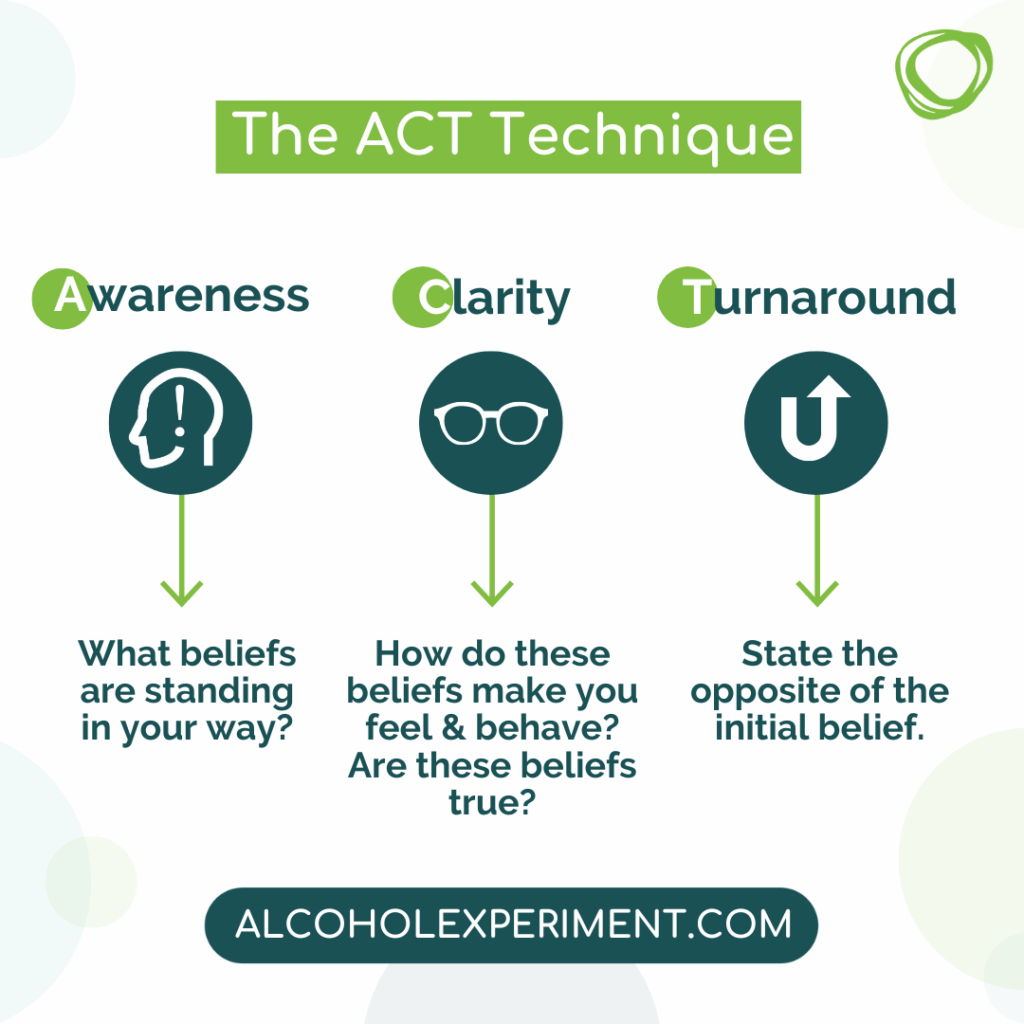
This is also a great place to use the ACT technique—Awareness, Clarity, Turnaround:
- Awareness: Notice you’re being triggered. That’s step one.
- Clarity: Examine why you think a drink might help in the moment. Will alcohol actually do what you think it will? Is your belief true?
- Turnaround: Take that emotion and the trigger and state something that is true. “I’m feeling anxious being surrounded by family, and a walk around the block will help me relax and feel at ease.”
Dr. Kristin Neff‘s research on self-compassion shows us why this matters. Karen Bluth, Ph.D., summarizing Neff’s work, explains: “Self-compassion is associated with greater emotional resilience, more accurate self-concepts, [and] more caring relationship behavior.” Studies consistently link higher self-compassion to better emotional regulation and lower anxiety.
When we show ourselves love, compassion, and empathy, we create space within ourselves to sit with an emotion and understand it rather than fight it. That alone alleviates anxiety by taking away that fight-or-flight response.
And here’s something I want you to remember: “You are not responsible for making anyone else happy, for crafting a perfect holiday for them.” Let that sink in. You can release the “I have to fix everyone’s mood” pressure right now.
Question #4: What Can I Say When Relatives Push Drinks or Question My Choice Not to Drink?
What is it about the holidays that turns Aunt Janet into the neighborhood dealer trying to push drinks on anyone whose glass isn’t overflowing? Geeze Louise, can’t a person just enjoy the sparkling apple cider?
The truth is, when people push drinks on you, it’s rarely about you. It’s about them. Here’s the uncomfortable reality: your choice not to drink mirrors their drinking back to them. It’s that whole safety-in-numbers concept. As long as everyone else is drinking, they don’t have to question their own drinking habits and their feelings or discomfort about it. It’s not that they really care about why you’re not drinking—they only care about the fact that it makes them feel uncomfortable about their own relationship with alcohol.
Scripts for Common Questions
For “Why aren’t you drinking?” or “Come on, just one—it’s Christmas!”
Light responses:
- “I’m good with this sparkling water, thanks—loving it this year.”
- “I’m taking a break and feeling great!”
- “Trying something new this season.”
Boundary responses:
- “This is just working better for me. I’d love to talk about something else.”
- “I appreciate the offer, but I’m all set.”
- “My doctor and I decided this was best. How about those [insert local sports team]?”
The “In and Out Like a Robbery” Strategy
If celebrities can make cameo appearances, so can you. Consider arriving early and leaving early to reduce exposure to heavy drinking. Avoid the interrogation by popping in, being seen, and then making your excuses and leaving. Everyone understands a busy holiday schedule, and you can totally get away with it: “I’ve still got so many places to stop by—don’t want to overdo it too early!” Throw in a chuckle for good measure.

Communication research shows us that warm, curious responses and brief personal statements open minds more than arguments or over-explaining. You don’t owe anyone your full story.
📌 Save these 3 one-liners to your Notes app before you go:
- “I’m driving tonight—sticking with this [AF drink].”
- “Taking it easy this year, and honestly, I feel amazing.”
- “I’m good, but tell me about [change subject].”
Question #5: How Can I Manage Emotional Triggers During Holiday Parties When Old Traditions Are Soaked in Alcohol?
Let’s talk about traditions. Not all traditions deserve to be preserved, especially if they leave you resentful, exhausted, or reaching for a drink.
Inventory Your Traditions
Ask yourself:
- Which traditions actually feel nourishing?
- Which are “we’ve always done it this way” but no longer serve you or your family?
I love the story of my husband crossing dishes off the Thanksgiving menu. We’d been killing ourselves making 17 different sides, and one year he just said, “What if we cut half of these?” You know what? No one missed them. Not one person.
As I often say: “Traditions are great if you enjoy them—when they become an unwelcome obligation, it’s time to let them go.”
Real-Life Example: When Tradition Becomes a Burden
One member of the This Naked Mind community shared a powerful story. Her family had a tradition of celebrating on Christmas Eve that went back generations and actually came over with the family from Europe. They kept doing things the way they always had, forcing everyone to make it fit. What started as one family of five people living in the same home keeping this tradition had morphed into over 30 people spread across many miles still trying to conform.
Until finally someone spoke up and said, “Hey, let’s do this the Saturday after Christmas instead. This is just becoming too much for us.” Not one person complained. Instead, everyone expressed relief and gratitude.
The lesson? Traditions can evolve.
New Traditions Not Centered on Family Drinking During the Holidays
Consider introducing:
- Mocktail tasting parties (make it fancy!)
- Board game tournaments with wild prizes
- Family volunteer opportunities
- Photo scavenger hunts around the neighborhood
- Dessert-only open houses
- Holiday movie marathons with popcorn bars
- Cookie decorating competitions
Tie these new traditions to memory and presence—being able to remember the night clearly versus piecing it together through a hangover haze. Which version of the holidays do you want your kids to remember? Which version do you want to remember?
Question #6: How Do I Stay Calm at Family Gatherings Without Alcohol When There’s Conflict, Grief, or Loneliness?
Let’s normalize something right now: the holidays are not always merry and bright. For many of us, they’re a complicated mix of joy and pain, connection and loss, gratitude and grief.
The American Psychological Association and psychiatric associations consistently identify financial strain, grief, and family conflict as top holiday stressors. You’re not broken if you feel this way. You’re human.
Tools for Staying Calm at Family Gatherings Without Alcohol
The 90-Second Wave Technique
Neuroscientist Dr. Jill Bolte Taylor discovered that when we allow an emotion to flow through us without resistance, the physiological response only lasts about 90 seconds. Let the emotion crest like a wave and fall. Don’t try to stop it, don’t judge it, just notice it. “Oh, this is sadness. This is what sadness feels like in my body.” And breathe.
Micro-Boundaries
You don’t need to excuse yourself for an hour. Try these small acts of self-preservation:
- Step outside for two minutes
- Sit with the kids at the kids’ table
- Wash dishes (seriously, the rhythm can be meditative)
- Call a friend from your car
- Take a bathroom break and do some breathing exercises
Grief Rituals
If you’re missing someone this year, create a small ritual to honor them:
- Light a candle in their memory
- Share one favorite story about them
- Create a small memory space with a photo
- Wear something that reminds you of them
Stephanie Preston, a psychology professor at the University of Michigan, offers this wisdom: “Give yourself and others grace… Real life is complicated and messy. We’re all human and need to savor the moment.”
When to Seek Professional Support
If the holidays feel dangerous or truly unmanageable—if you’re experiencing thoughts of self-harm, if the family situation is abusive, or if you feel like you’re spiraling—please reach out for professional support. Talk to a therapist, call a helpline, contact your doctor. The NIAAA and APA provide guidance on when holiday stress crosses into something that requires professional intervention. There is zero shame in asking for help. In fact, it’s the bravest thing you can do.
Question #7: What If I Slip—How Do I Recover From Old Patterns With Compassion Instead of Shame?
Let’s get real for a moment: changing your relationship with alcohol is not a straight line. There’s no perfect path, no gold star for getting it “right” every single time. If you slip, if you have a drink when you didn’t want to, if you fall back into an old pattern—you’re not a failure. You’re in the messy middle of change, and that’s exactly where you’re supposed to be.

Why Shame Fuels More Drinking
Here’s what the science tells us: self-criticism activates our threat systems and actually predicts worse outcomes. Shame doesn’t help you change—it keeps you stuck in the cycle. Self-compassion, on the other hand, supports sustainable change.
Dr. Kristin Neff’s research shows that self-compassion is linked with lower depression and anxiety and greater resilience. People who practice self-compassion recover faster from setbacks and actually learn more from them because they’re not spending all their energy beating themselves up.
Your Repair Plan
1. Pause the inner critic: Would you speak to your best friend the way you’re speaking to yourself right now? If not, stop.
2. Get curious, not furious: What was I feeling? Where was I? Who was I with? What was happening right before I reached for a drink? Use this as data, not evidence of your unworthiness. This is information that helps you adjust for next time.
3. Adjust one small thing: Maybe next time you leave earlier. Maybe you bring your own alcohol-free drinks. Maybe you text someone before you go. You’re not starting over—you’re taking what you learned and moving forward.
4. Reconnect with your “why”: Why did you want to change your relationship with alcohol in the first place? That reason still matters. That reason is still true.
As I remind our community: “Self-compassion says, ‘This is hard. I’m human. I’m doing my best with the tools I have.’”
You are allowed to be imperfect. You are allowed to be learning. You are allowed to keep showing up for yourself even when it’s hard.
Question #8: How Can I Rewrite Family Drinking Traditions So They Support Connection, Not Numbing?
Imagine two versions of your holiday season.
The Default Path: More wine, less memory, more conflict, bigger hangovers. You piece together conversations from photos. You wake up with regret. You promise yourself “next year will be different.”
The Intentional Path: Less alcohol (or none), more presence, small but meaningful moments that you actually remember. You wake up clear-headed. You feel proud. You’re creating the holiday experience you actually want.
Which path do you want to choose?
Starting Collaborative Conversations
If you have trusted family members who are open to change, try starting gentle conversations:
- “What if we tried a hot cocoa bar instead of shots this year?”
- “Can we make one event alcohol-free so the kids see another model?”
- “I’d love to start a new tradition—anyone interested in [activity] instead of drinks?”
You might be surprised. Often, people are relieved when someone else voices what they’ve been feeling too.
The Ripple Effect
Research shows that parental and familial drinking patterns significantly influence children’s stress levels and later alcohol use. When we change our relationship with alcohol, we’re not just changing our own lives—we’re potentially changing the trajectory for the next generation.
As I love to say: “Let’s knock alcohol off the pedestal that society has put it on.”
Because here’s the truth: alcohol doesn’t make the holidays special. Connection does. Presence does. Love does. Laughter does. The people around the table do.
Alcohol might have been part of your traditions, but it was never the magic ingredient. You were. Your family was. The love was. And all of that is still there, waiting for you to show up fully and remember it.
Question #9: What Would It Feel Like to Meet This Year’s Holidays as the Calmest Version of You?
Close your eyes for a moment (okay, finish reading this first, then close them).
Picture this: You’re walking into the gathering grounded and hydrated. There’s an alcohol-free drink in your hand that you actually enjoy. You’ve got your exit plan ready. You have those scripts in your pocket. You know exactly how long you’re staying and what you’ll do if you feel triggered.
Someone offers you a drink, and you decline with ease. Someone makes a comment, and you let it roll off your back. You step outside when you need air. You connect with the people you actually want to connect with. You protect your peace.
And later that night, you’re driving home clear-headed. You’re proud. You’re present. You remember the entire evening—the good parts and even the awkward parts—and you feel at peace with how you showed up.
You meet your own eyes in the rearview mirror, and you think, “I did it. I chose me.”
What would that feel like?
You Don’t Have to Do This Perfectly
I’m not going to tell you that navigating family drinking during the holidays is easy. If it were easy, you wouldn’t be here reading this right now. But I will tell you this: it’s possible. It’s worth it. And you’re not alone.
Every year, thousands of people in our This Naked Mind community navigate these same challenges. They use these same tools. They stumble, they learn, they show up again. And every year, they send us messages that say, “I did it. I survived the holidays without drinking, and I’m so proud of myself.”
You can be one of those people this year.
You have the tools now. You understand the science. You know why your brain reaches for a drink when stress hits, and you know how to interrupt that pattern. You have scripts, strategies, and most importantly, permission to do things differently.
Family drinking during the holidays doesn’t have to derail you. Old triggers don’t have to control you. Traditions can evolve. Boundaries can be set. And you can walk through this season as the calmest, most present version of yourself.
So take a deep breath. You’ve got this. And we’ve got you.
About the Author: Annie Grace is the author of the multi-million-copy bestseller This Naked Mind and The Alcohol Experiment, and founder of the This Naked Mind movement. After experiencing her own awakening to the truth about alcohol in 2014, Annie has dedicated her life to bringing a science-backed, shame-free approach to changing your relationship with alcohol to millions of people worldwide. Her forthcoming book, Live Naked AF, continues this mission with practical, compassionate guidance for living joyfully alcohol-free.
Copyright © 2025 This Naked Mind. This material is original content and is protected by international copyright laws. Unauthorized reproduction or distribution of this content will be met with legal action.