Almaty Museum of Arts: Stone Meets Aluminium Design


The skyline of Almaty has a striking new addition: a museum that doesn’t just house art, but makes the building itself a bold statement on design, context and materials. The recently opened Almaty Museum of Arts stands out, literally, as a contemporary architecture piece where stone and aluminium meet to craft a space that bridges nature, city, art and community.
A design rooted in context: Mountains, cityscape and modernity
Covering an area of 10,060 m², the museum was conceived by the British architectural firm Chapman Taylor. Its location at the edge of the city against the majestic backdrop of the Tian Shan mountains sets the tone for the entire design. The aim was clear: reflect both the natural grandeur and the urban dynamic of Almaty.
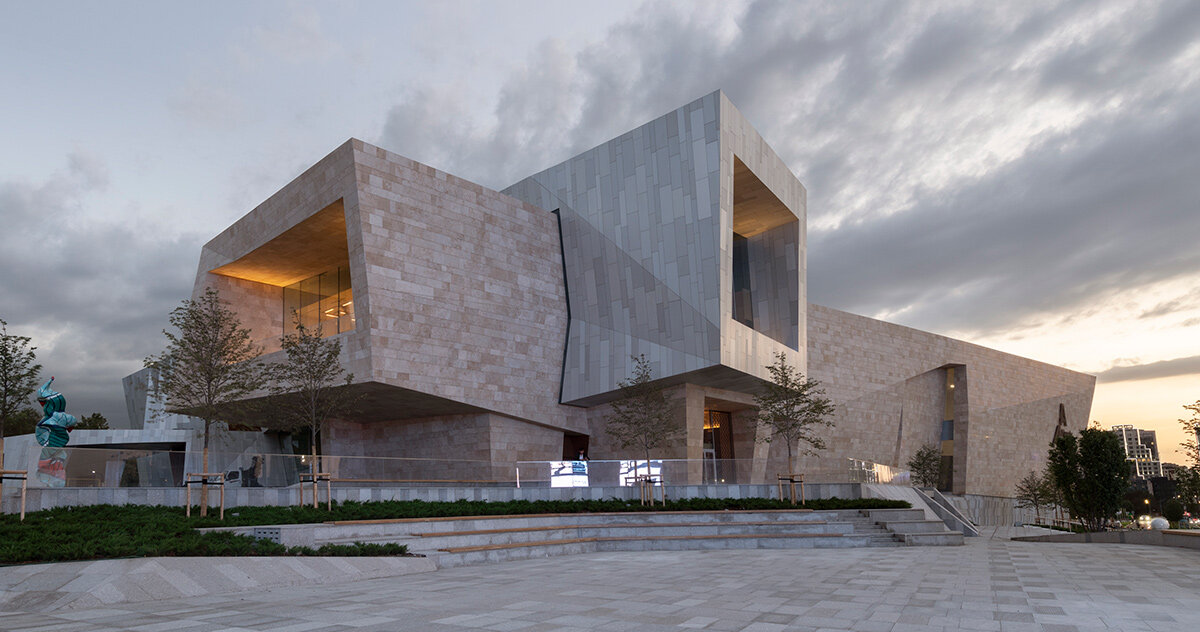
Architecturally, the building is composed of two interlocking “L”-shaped volumes:
- One volume clad in warm Jura limestone, anchoring the museum to the land and evoking solidity and timelessness.
- The other volume wrapped in sleek aluminium cladding, reflecting light, city energy, modernity, evoking the shimmer of mountain peaks and drawing a subtle parallel between raw natural landscape and refined contemporary urbanity.
Between them lies the bright, glazed central atrium, the “Art Street”, a light-filled spine of the museum that invites natural light, frames views of the surrounding mountains and establishes a fluid transition between indoor galleries and the outer world.
This combination, stone + aluminium + glass, isn’t just aesthetic. It creates a dialogue between permanence and flexibility, tradition and modernity, nature and urban life. In short: a building that belongs to its environment, yet stands out as a marker of contemporary vision.
More than walls: A museum that breathes community, art & culture
The Almaty Museum of Arts isn’t a static monument. Inside, the design flows through:
- Spacious exhibition galleries for both temporary shows and permanent installations.
- Creative studios, educational spaces, a café with garden and sculpture views, giving it a living, breathing feel rather than a “closed-off gallery” atmosphere.
- Flexible auditorium and performance spaces ready to host live shows, workshops or community events.
- Outdoor terraces, plazas, landscaped grounds and commissioned sculpture installations extend the art experience into public space and anchor the museum as an urban destination, not just a private fortress.
As the architects put it, the building was meant to “feel porous belonging as much to the city as to the art.”
Art from Central Asia to global icons: A vast collection on display
The museum opened on 12 September 2025, founded by entrepreneur-philanthropist Nurlan Smagulov, who donated over 700 works from his collection, effectively seeding a major cultural institution in Almaty.
But AMA doesn’t limit itself to regional art. The inaugural programme is ambitious: it includes a retrospective of leading regional talent, but also long-term installations from global heavyweights, giving visitors access to works from both Central Asia’s contemporary art scene and internationally renowned artists.
On the grounds, large-scale sculptures from globally celebrated artists add an open-air dimension to the experience, inviting the city to engage with art beyond gallery walls.
Why this matters: Aluminium’s role beyond industry, in culture
For us at AL Circle, where materials, design and industrial vision often take centre stage, this museum is more than architecture. It’s a real-world example of how aluminium can transcend its traditional roles (industrial, structural, functional) to become part of cultural expression and identity. The aluminium-clad volume doesn’t just look modern, it signals a bridge between heritage and future, between craft and innovation.
The marriage of limestone and aluminium suggests a narrative: respect for history, integrity of place, and readiness for modernity. A bold choice, but in the context of Almaty’s landscape and ambitions, a natural one.
The Bigger takeaway: Material & vision – When they work together
Almaty Museum of Arts shows that when architects, patrons and material vision align, the result can be more than a building; it becomes a cultural platform that:
- Reflects the identity of a city and its geography
- Offers a space for art, performance and social interaction
- Leverages material innovation (like aluminium cladding) to make design bold, modern and contextually relevant
- Becomes a landmark not just for art lovers, but for the city, the region and global visitors
For an industry often focused on throughput, efficiency and supply chains, this is a reminder: the materials we work with have the power to shape culture, place and identity.
Source: Stone and aluminium define Kazakhstan’s bold new museum landmark