

From Psychology to Creative Renewal
The artistic journey of e.wasserhase is rooted in an unusual combination of scientific understanding, global experience, and a profound connection with nature. Born in Hamburg, Germany, in the Chinese Year of the Water Rabbit, she adopted “Wasserhase” as her artistic identity, embracing the symbolism of tranquillity, harmony, peace, and emotional balance that the zodiac represents. Throughout an extensive international career with the World Health Organization in Geneva, she travelled widely while living in Germany, England, France, Switzerland, and later dividing her life between the Algarve in Portugal and Andalucia in Spain. Although art was never her formal academic path, her studies in psychology shaped the way she understands human behaviour, emotional wellbeing, and the influence that systems have on people’s lives. Rather than viewing psychology and creativity as separate pursuits, she considers them complementary ways of understanding and restoring the human experience. This perspective established the foundation for an artistic practice that focuses not only on visual beauty but also on emotional restoration, reflection, and personal growth through creative expression.
Her transition into a more dedicated artistic life unfolded gradually alongside an exceptionally demanding professional career. During those years she experimented with numerous forms of creativity, including painting, sculpture, and stone carving before later embracing pottery after relocating to southern Europe. A defining emotional turning point arrived following the death of her mother, who had discovered painting at the age of seventy and spent five fulfilling years immersed in artistic creation. Witnessing that late creative awakening became an enduring source of inspiration, reinforcing the belief that personal growth should never be limited by age or circumstance. That experience strengthened her commitment to lifelong learning and encouraged her to embrace the creative side of herself after many years dominated by analytical work. She often reflects that creativity belongs to everyone, provided individuals allow themselves the time and freedom to reconnect with their inner voice. This philosophy remains central to both her artistic process and her broader outlook on life.
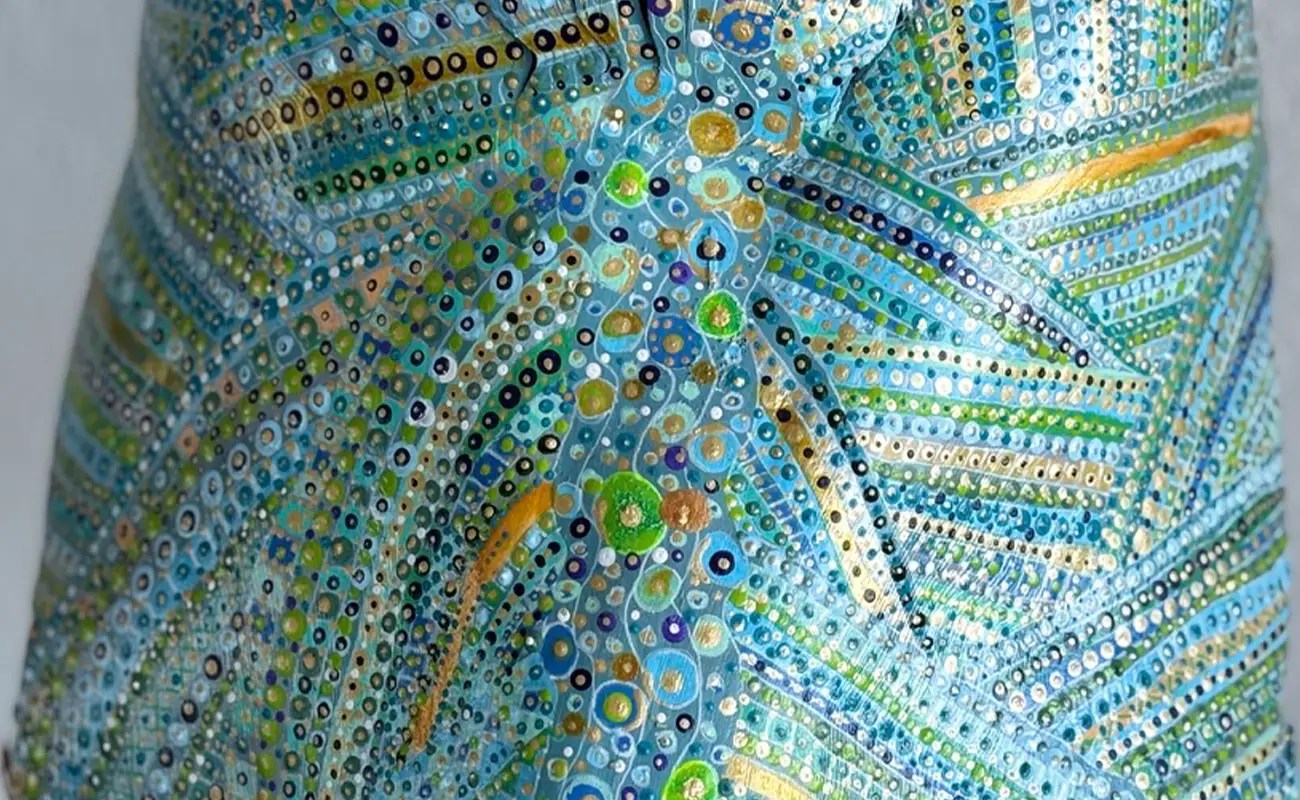
Living in Portugal and Spain introduced her to natural materials that would fundamentally reshape her artistic language. Eucalyptus bark, palm bark, and palm leaves immediately captured her attention, not as discarded organic matter but as sculptural forms already rich with character and possibility. Working with these naturally weathered surfaces inspired the development of her distinctive dot painting technique, which has become one of the defining characteristics of her work. Thousands of carefully placed dots transform overlooked fragments of nature into detailed visual compositions that invite prolonged observation. Meditation, Tai Chi, yoga, and energy work all influence this slow and reflective process, allowing every artwork to emerge intuitively rather than according to rigid planning. She approaches each bark as a collaboration with nature itself, creating pieces that honour organic forms while expressing personal symbolism, mindfulness, and the possibility of healing through attentive creative practice.