

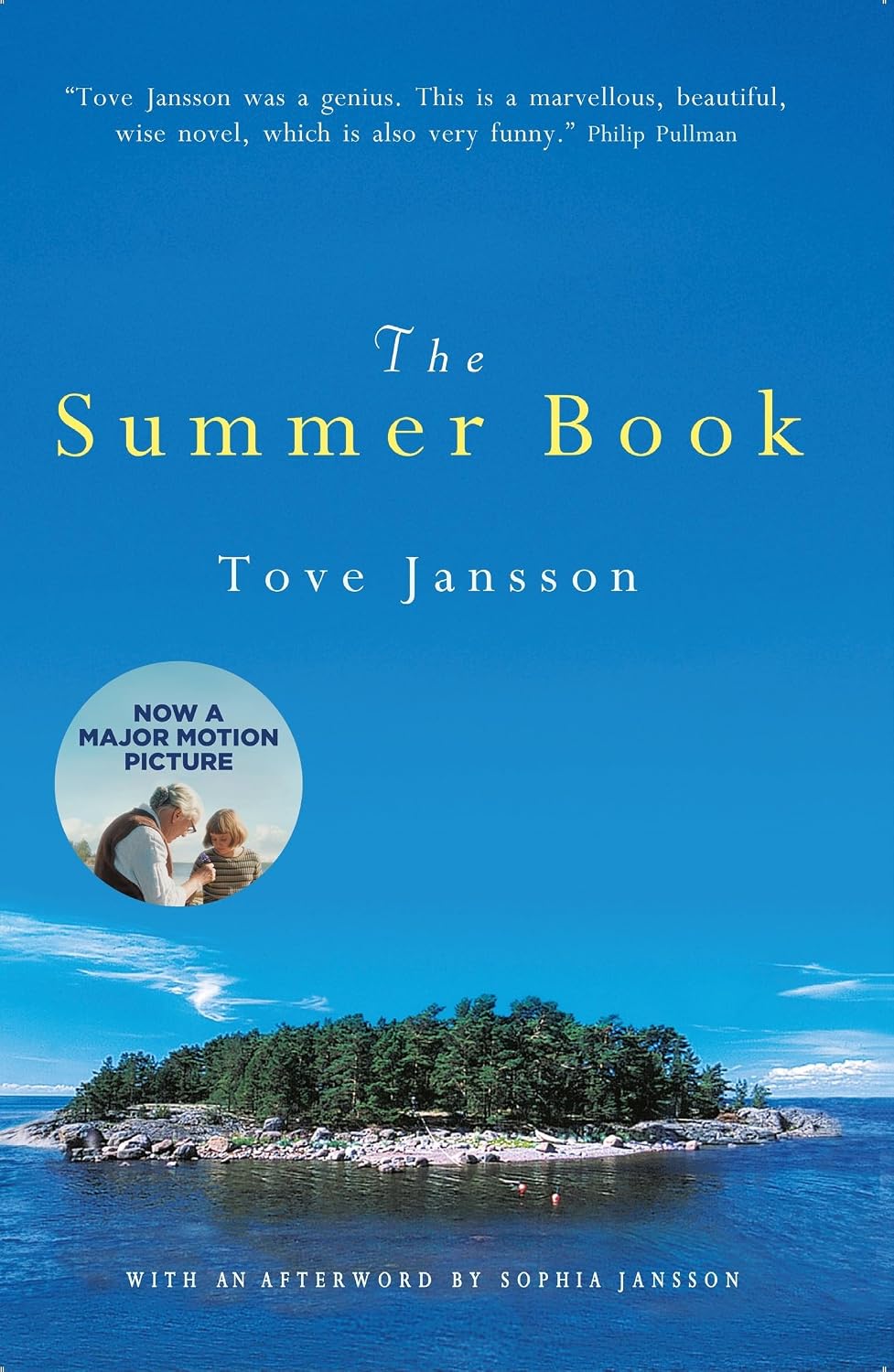
An elderly artist and her six-year-old granddaughter while away a summer together on a tiny island in the gulf of Finland.
Gradually, the two learn to adjust to each other’s fears, whims and yearnings for independence, and a fierce yet understated love emerges—one that encompasses not only the summer inhabitants but the island itself, with its mossy rocks, windswept firs and unpredictable seas.
Full of brusque humour and wisdom, The Summer Book is a profoundly life-affirming story. Tove Jansson captured much of her own experience and spirit in the book, which was her favourite of the novels she wrote for adults. This new edition sees the return of a European literary gem—fresh, authentic and deeply humane.
My Review
I read this as the August choice with my U3A book club. It was suggested by a member of the group, Toby, who is Danish (though born and brought up in England) and had similar experiences as a child.
I have always been a fan of Tove Jansson and love the Moomins, but I had never read anything by her for adults. I also knew a fair bit about her.
Because I read this on my Kindle, the version I downloaded (and only me it seems) was the anniversary edition with another whole chapter by Sophia Jansson, Tove’s niece. Tove never had any children of her own. Sophia tells us a few interesting things. ‘Sophia’ in The Summer Book is based partly on her, partly on Tove’s childhood and partly made up. She tells us about the island where she spent summers with her grandmother ‘Ham’. Bringing us up to date, Sophia’s own first grandchild was born during Covid and Sophia had to isolate for two weeks before she could visit. Since then, her granddaughter has already spent summers with her on the island. According to Toby it is usual for Scandinavians to have holiday cottages where they spend months of the year.
But back to the book. Sophia, who is six at the start, is living with her elderly grandmother, and father (who takes a back seat in the story). Sophia’s mother has died, but we hear little about her. Grandmother tries to make the child’s life as normal as possible, more with physical activities than emotional support. This was the 1960s.
The book is a series of vignettes, and I have chosen a few examples. We all seemed to like the one about the cat. Sophia has a kitten called Moppy. She wants it to be a fluffy, soppy cat that sleeps on the bed and cuddles her. Unfortunately Moppy just kills things and brings them home. When visitors arrive who wanted a cat to keep the mice away, they got a fluffy lap cat. So they swap. But Sophia now misses Moppy so they swap back. No-one tells her that she made her choice and should live with it.
Then there is the poor child who comes to stay. She has never experienced Sophia’s lifestyle and everything frightens her. They are very unsympathetic and the child never comes again.
At one point, new neighbours build a large house nearby, which Grandmother thinks is unsuitable for the environment. And they still haven’t moved in, so she takes Sophia and they pick the padlock and break in. Not the best example to set a child.
I liked a lot of the stories, but there is no plot, so while I appreciate the beauty of the prose and the relationship between grandmother and granddaughter, I wouldn’t have wanted it to be any longer. I also found Sophia a bit of a brat (as I know did others), but again Toby told me that Scandinavian children are often much more forthright in their manner than us Brits, who would probably have reigned Sophia in much more. And been more overprotective.
Highly recommended as a book club choice.
About the Author
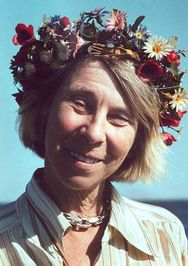
Tove Jansson was born and died in Helsinki, Finland. As a Finnish citizen whose mother tongue was Swedish, she was part of the Swedish-speaking Finns minority. Thus, all her books were originally written in Swedish.
Although known first and foremost as an author, Tove Jansson considered her careers as author and painter to be of equal importance.
Tove Jansson wrote and illustrated her first Moomin book, The Moomins and the Great Flood (1945), during World War II. She said later that the war had depressed her, and she had wanted to write something naive and innocent. Besides the Moomin novels and short stories, Tove Jansson also wrote and illustrated four original and highly popular picture books.
Jansson’s Moomin books have been translated into 33 languages.