
Robin Wu is an Edinburgh-based artist whose dynamic mixed-media landscapes reflect archetypes and memory. He gives us a glimpse inside his sketchbooks, revealing how observations from life become the seeds of his studio practice. Within their pages, he allows himself complete creative freedom, moving between a minimalist use of pen and ink and an exuberant, maximalist approach to materials. In this article, Robin reflects on the importance of the sketchbook as a space for artistic liberty, where experimentation happens freely.

I love my sketchbooks and use them for a variety of different reasons. I often have several on the go at once; some might be a book to take on my travels and trips, almost as a visual diary, while others might be for taking to a specific location to gather information to bring back to the studio. Others might even be a way to explore materials and just play or try out ideas for paintings. I also like to write in them and draw mind maps that help me explore areas of interest within my work.

I think the central thread that runs through all my sketchbooks is that they are a very permissive space – if I feel like drawing my cat and flowers, then I am allowed; if I want to play with a colour idea, then I do. There are no wrong moves, and anything goes really.

I don’t make them particularly with a view to them being seen by others, so that frees me up to use them as an explorative and playful space. I think this is an essential thing for any artist – whether it takes place in a sketchbook or elsewhere.

I use a mix of different kinds of sketchbooks. More recently I have been enjoying the Pith sketchbooks handmade in Berwick-upon-Tweed – I love how they will sit open really flat due to the bindings and that the paper stock can take a variety of media really nicely. There’s a lovely mix of tactile covers and colours, and they are just beautiful objects. I have also enjoyed Moleskine sketchbooks over the years – I like the slightly shiny, creamy paper stock that can again take a variety of materials really well.

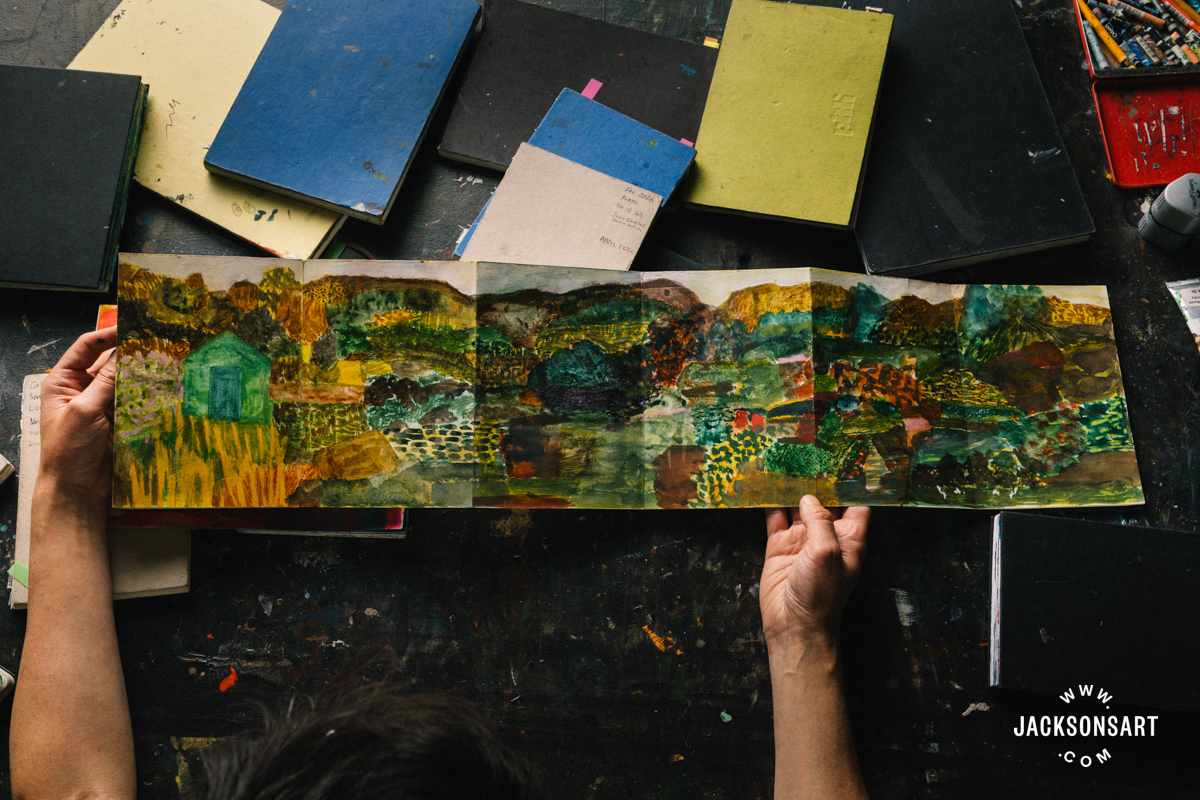
I also love a concertina. I particularly like the way they encourage you to grow a drawing, make connections, or do something unexpected – for that reason I often use them when I am teaching too – sometimes making homemade ones that fold up in different ways.

They are brilliant for doing long, expanded drawings that explore a whole environment, and I have even used them for just working abstractly with colour, mark, and surface. Sometimes a concertina might become a single piece of work in a sketchbook format.

These days, I tend towards sketchbooks that are not too large in size, say A5, so that they are quite portable, although I do keep a larger one on the go in my studio too.

In terms of the materials that I like to use in my sketchbooks, I can range from very minimalist to very maximalist. If I am away, for example, in a city on holiday, I might limit myself to just a few black pens, Sakura Micron pens of a few thicknesses, or even just a good old biro! I weirdly enjoy the fact that I can’t erase them like a pencil and that they don’t smudge after drying quickly.

I have also just started using Kaweco fountain pens and am enjoying the slightly more fluid and organic quality of the nib and ink. This kind of minimal kit is brilliant for simplifying the whole process of engaging with my sketchbook and surroundings on the move and removing a whole bunch of decisions and options. It’s obviously also great for being easy to carry – I slip a small sketchbook and a few pens in my pocket and off I go.

That said, in almost all other situations my commitment to minimalism goes out the window. If I am working in a sketchbook at a specific location or at home or in the studio, then I have a whole host of materials that I love to lug around and use with a very free mixed-media approach. In fact, part of the joy of the sketchbook again comes back to that idea of the permissive space – that idea very much extends to materials too – a chance, as a somewhat restless artist, to try different things out and just see what happens.

For many years, I have loved having a tray of Kuretake Gansai Tambi watercolours on the go – a great mix of colours, not too expensive, and I like how they have a little more body and opacity than some others. I also use a lot of coloured pencils – I like the way they feel a bit stark and unpromising when I start a drawing, but I can then build them up and layer them up in rich, intense ways and have to push a bit – I particularly like the Lyra Rembrandt or Faber-Castell Polychromos pencils. Or Derwent Inktense for water-solubility and vibrancy. Pentel brush pens are great for an immediate sugar rush of intense colour and are also rechargeable.

White acrylic paint is also a must for me if working with a larger range of materials, so I always carry a small tube in my materials bag. I use it to erase things, layer things, bring light back in, prime areas of the surface, or even mix with other materials. A little jar of water, too, for cleaning brushes, and one of those portable sharpeners that catches the pencil shavings.

In my studio, I make paintings and often these come about from a mixture of drawings done in my sketchbook on location in tandem with memory, written notes, and imagination. So the sketchbook might provide the all-important seed or departure point for the painting.

While I don’t usually paint directly from life, the drawings done on location often feel very vital to the success of the painting. For example, I might use a quick little pen sketch of something that I have seen out on a walk, or I might have gone to a particular environment that I am interested in and made a long concertina drawing – I might then find a section of that drawing that becomes the basis for a painting. Sometimes, I look back through old sketchbooks and find a drawing that I want to use years later. A drawing does not have to be detailed or elaborate. Often it’s better if it’s not!

Other ways that I use the sketchbook are to draw from paintings that I like in a gallery – this was something that I was encouraged to do when studying at the Royal Drawing School. It’s such a brilliant way to engage with a piece of work – more active, slow, and exploratory – you get to feel your way into its spaces, and you learn lots.

The other joy of sketchbook work for me is that it’s the space where I can return to observational drawing directly from life, especially as that is something I don’t do in my studio paintings.

A continued practice of drawing from observation is really important as it feeds into my ability to paint from memory and imagination in the studio and flesh things out in a convincing way. There is also something freeing and enjoyable about drawing from life – a different kind of pressure than a studio painting.

I think it’s taken me time to get into working in sketchbooks, but they are now an invaluable resource and source of great pleasure. I think making the most of sketchbooks is mainly about building the habit of using them. Tell yourself it doesn’t have to be perfect; I’ll just bring it with me and do a little something in that moment that I have.

Draw something, record something, write things down, stick things in – you will be surprised by how addictive and natural it becomes quite quickly. I remember a quote that I really like (although I can’t remember who said it) – ‘find a drawing in any situation’ – it’s stuck with me, and it’s a great idea to put into practice, as you will always surprise yourself by finding something and perhaps doing something you didn’t expect.

Materials
Kaweco Sport Fountain Pens
Lyra Rembrandt Coloured Pencils
Faber-Castell Polychromos Coloured Pencils
Faber-Castell Sharpener with bin for shavings
Kuretake Gansai Tambi Watercolour Set
Small range of Golden Fluid Acrylic paints
About Robin Wu
Place and moment in the real world interwoven with memory are the departure point for Edinburgh-based artist Robin Wu’s paintings. He is interested in painting with the archetypal possibilities of ‘things in the landscape’ – trees, bodies of water, structures, mountains, flowers, ships, clouds – as totems that are both personal and specific but also universal. Colour, texture, substance, and surface are key as carriers of ideas, feeling, and aliveness.
Robin Wu (b.1977, Edinburgh, United Kingdom; lives and works in Edinburgh). Recently completed the Turps Correspondence Course (2024/2025). Studied at The Royal Drawing School (The Drawing Year, 2009), Leith School of Art (The Painting Course, 2007), Camberwell College of Art (BA Hons), Central Saint Martins (Foundation). Recent solo show Desire Lines, 2025, at Whitespace, Edinburgh.

Further Reading
Frances Ives Tests Pith Sketchbooks
Inside the Sketchbook of Tereza Horáček
Inside the Sketchbook of Cai Arfon Bellis
A Guide to Drawing in Galleries and Museums
Shop Sketchbooks on jacksonsart.com