


At the end of this issue we take a look at which breweries have been the largest producers in modern history, and there is something of an elephant in the room with the stats. The number of breweries that have disappeared over time – even in the big leagues is quite jarring.
We’ve all likely heard the sobering figures of how brewery numbers have dropped from a peak of around 30,000 to today’s figure, which tends to hover close to 1000-1200 depending on who you ask. Even with that number it seems we never know for sure because there are a number of breweries which are inactive yet retain their brewing license because….well, you never know when you might be able to start brewing again – or maybe you may be thinking of selling the license off to an enterprising upstart. Whatever the reason is, the numbers are a little murky.
Every year we hear that breweries are closing for various reasons, but usually financial or succession related, however we don’t often hear specifics about which breweries. Sake breweries rarely go out with much fanfare. They don’t have scavenger sales, sell off their equipment and clear out stock at half price. Nor do they take out big notices letting everyone know of their closure. There’s no farewell festival or big send-off. Occasionally you might see a social media post, maybe an article in a local newspaper, akin to an obituary, but that’s about it
For sake fans, the closure of a brewery – whether it’s a well-known brewery or not – is something of a big deal. We all hate to hear that another one has fallen by the way. But the reality is it happens more than we realize and quite often no one ever tells us. Why is that?
A couple of obvious reasons which could be considered are pride and privacy. As a culture and people, the Japanese are notoriously proud people who are historically mortified at the prospect of having failed or let down their family, company or community. Most breweries would prefer to go quietly into the night rather than highlight something which they would likely simply see as a form of failure – regardless of the circumstances.
Another possibility is the earlier mentioned license. Some kuramoto may wish to lay low holding on to a thread of optimism that there will come a day when someone will fire up the koshiki once again and bring the family brewery back to its former glory. Perhaps they may consider their closure a “temporary speed bump” – albeit usually a pretty big one.
However, as domestic sake sales continue to struggle, perhaps it’s time for the wider industry and the media to shine a brighter light on this issue. Consumers, and the general public should be made aware that producers of their national drink are closing every year. Japan, as a nation, should be livid that a huge part of their culture is slowly disappearing and that something needs to be done to help turn it around. And while we don’t like to get political here at SIN, the political landscape here has been leaning more and more toward nationalistic pride and the desire to retain Japanese culture.
Well, if the Japanese populace is serious about wanting to retain its traditions and culture, one area where the people, media and government could help out, is in supporting the breweries which have been producing “Japanese culture-in-a-bottle” for hundreds of years.
Tell your Japanese friends: Drink more sake – choose it over foreign-made beverages if they’re serious about preserving Japanese culture. Visit more breweries, attend more festivals and events. Buy local. Demand the local restaurants and bars stock sake (you’d be surprised how many don’t!)
It’s actually not hard to do on a grass-roots level. Hopefully that Japanese pride will kick in and we’ll see more breweries manage to hang on for a few more years.
And now for the news…

Moon- We’ve seen sake made with yeast launched into space, and now Dassai is in the process of making sake in space, but one brewery is looking to take things up a few notches.
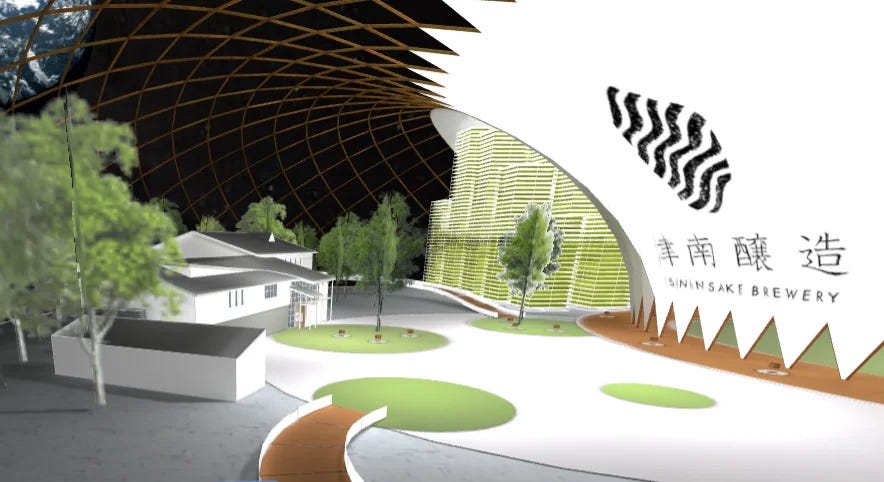
Tsunan Jōzō is floating plans to construct a brewery on the surface of the Moon by 2040. The brewery claims it will use the facility as a base for researching fermentation technologies in space. In the meantime Tsunan Jōzō has launched a metaverse facility called Moon Surface Sake Brewery: Lunar (Getsumen Sakagura Lunar), which can be visited “virtually”.
Located in Niigata Prefecture, Tsunan Jōzō is known for its use of traditional brewing methods combined with smart brewing practices that utilize cutting-edge technologies such as generative AI. CEO, Kengo Suzuki, is a co-founder of Euglena (a nutrition, biotech and sustainability enterprise) and a fermentation technology specialist who also serves as a team leader at RIKEN’s Microalgae Production Control Technology Research Group. After investing in Tsunan Brewing in 2019, he became fully involved in sake production.
Suzuki later met Remi Enomoto, a freelance announcer and “space caster” (people who connect the marvels of space with us mere mortals) who serves as a navigator for JAXA’s Space Innovation Partnership. Through this encounter, his research evolved toward cultivating a sustainable food culture capable of supporting human life in space.
Plans to build a brewery on the Moon are targeted toward around 2040, when it is estimated that around 1000 people will be inhabiting the Moon’s surface. To help people better understand the concept behind this project, Tsunan Brewing developed the metaverse sake brewery Lunar Brewery as a promotional initiative for audiences in Japan and overseas.
The facility is designed to provide insights into lunar architecture and the potential for microbial production on the Moon, with the aim of becoming a space where people around the world can discuss fermentation technology together.
At present, visitors can explore the facility by controlling penguin-like avatars. Plans are in place to hold international conferences on the platform to grow a community of like-minded fermentation enthusiasts.
Source – Forbes Japan
JG: They may be on to something here, but I doubt it. And in any event, it will take a lot longer than 14 years to make something like this a reality. Many if not most of our biggest developments were initially considered ridiculous ideas. But it might happen; who knows. In the meantime, I will work on improving sake consumption here on earth.
月面酒蔵 Lunar Brewery , 津南醸造(つなん)
Japan- On February 4, a total of 42 breweries (down one from last year?) from across the country will release their Risshun Asa Shibori sake.
Risshun marks the first day of spring under Japan’s traditional lunisolar calendar and was once regarded as the start of the New Year. Although the modern calendar places the beginning of spring in March, risshun remains a meaningful seasonal milestone for many breweries.
Since 1998, sake bearing the official Risshun Asa Shibori label has been pressed at dawn on risshun itself and released as nama genshu later that same day. The practice has become a distinctive annual event in the sake world.
For brewers, the release demands meticulous scheduling to ensure the sake reaches peak condition at precisely the right moment. For brewery staff, it can mean a frantic day of bottling, labeling, and shipping – all completed within hours of pressing.
It is expected that around 260,000 bottles of Risshun Asa Shibori will be shipped this year.
Source – Sakuranbo
JG: My local sake shop here in Kamakura works with a distributor (Nihon Meimon Shukai, or Japan Prestige Sake Association) to pre-sell and arrange delivery of this asa shibori sake. Since it is always still very cold on risshun, that traditional first day of spring, looking forward to a sake delivery of stuff pressed that morning does indeed enliven an sake fan. Pretty slick.
立春朝搾り
Tochigi- Kojima Shuzō has found an unusual way around the rising price of sake rice with the introduction of Alpha rice into its brewing process.
Alpha rice is rice that has been cooked and then quickly dehydrated. It can be eaten with the addition of water to rehydrate. The rice is often used as emergency rations in the event of disasters such as earthquakes. The use of Alpha rice means the initial steps of washing, steaming and cooling are not necessary.
Kuramoto/toji Taku Kojima, cites achieving the desired water content as one of the major obstacles in using Alpha rice. However the use of Alpha rice also had its upsides with Kojima noting that brewing steps which normally took close to three hours were completed in around 20 minutes.