
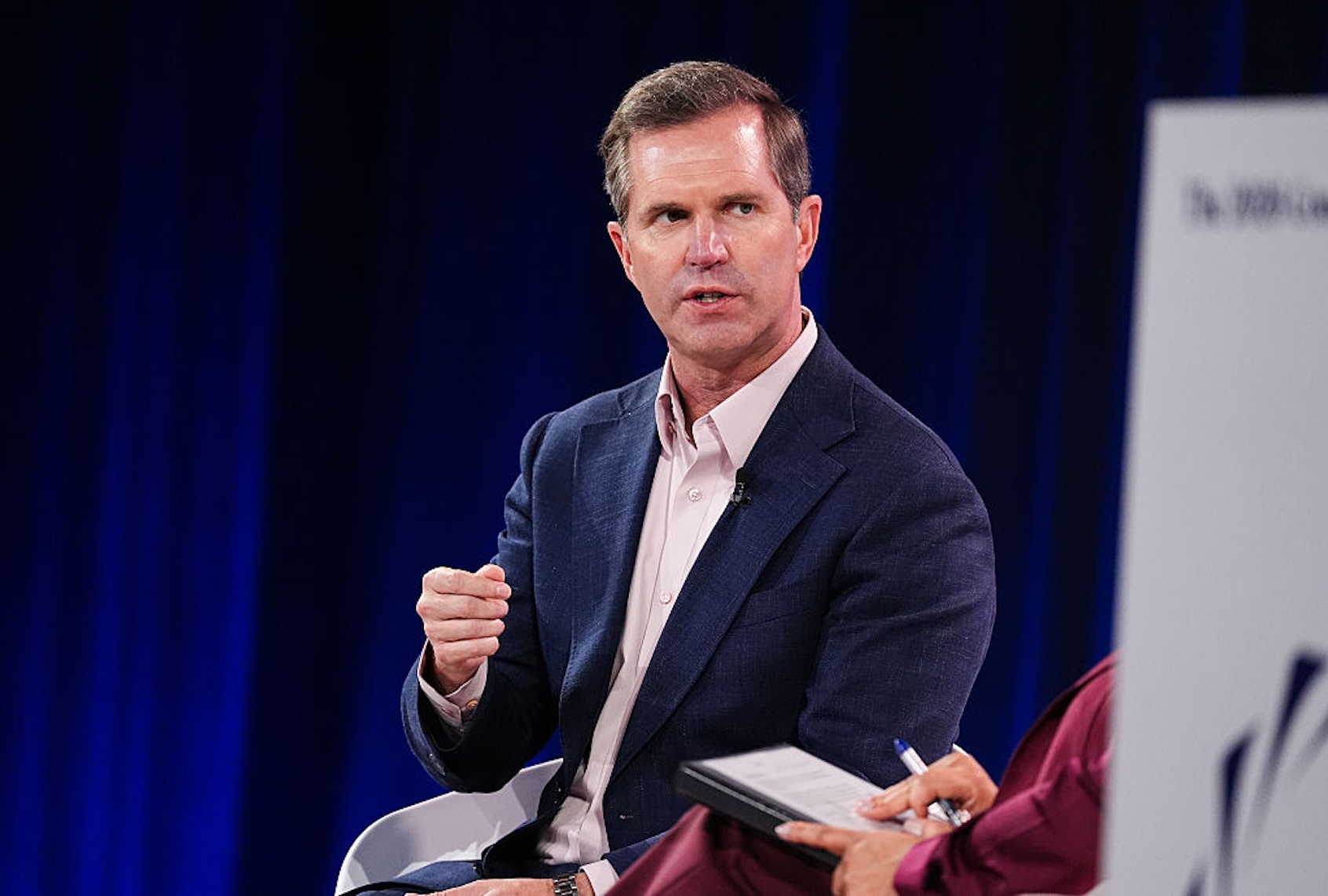
Andy Beshear has a favorite song: “Universal Sound” by Tyler Childers, a country music artist with a special place in the Kentucky governor’s heart. That title is something of a metaphor, about connecting to a deep, abiding spirituality accessible to us all. It’s meant to be an ecumenical message — just like the one Beshear hopes to deliver.
“Universal Sound” carried him through a “nasty” reelection campaign in 2023, which ended with a comfortable victory over his GOP opponent, state Attorney General Daniel Cameron, who had been hand-picked for the race by Sen. Mitch McConnell. Amid mounting speculation that Beshear could become a leading contender in the 2028 Democratic presidential primary, “Universal Sound” may well become familiar to more voters.
Beshear’s newly published book, which is de rigueur for potential candidates seeking to raise their political profile and lay out a vision, is also stoking talk of 2028. With its title taken from the biblical parable of the Good Samaritan, “Go and Do Likewise: How We Heal a Broken Country” explores how President Donald Trump and his administration have, in Beshear’s words, “hijacked” Christianity, and how the governor’s brand of inclusive faith underpins his political life, offering readers a blueprint for governing with compassion.
I interviewed Beshear last week on the sidelines of Bourbon & Beyond, the music festival held annually in Louisville, Kentucky. He spoke about a reinvigorated religious left, addressed the tricky question of whether Trump should be considered a Christian, discussed his willingness to take unpopular stands in a red state, hinted at his plans for 2028 and explained why, as a politician often compared to Mr. Rogers, his kindness shouldn’t be mistaken for weakness. (Full disclosure: My husband, the novelist Silas House, served as Kentucky poet laureate under Beshear, and I once briefly assisted the governor on a writing project.)
This conversation, which took place in a backstage trailer vibrating from the country and hip-hop tunes emanating from nearby stages, has been edited for length and clarity.
Governor, thank you for taking the time to talk. “Go and Do Likewise” is centered around the parable of the Good Samaritan from the Bible. What do you think that story has to tell us and teach us today?
Well, it’s a perfect story for a moment of division. So the parable of the Good Samaritan is about a man lying bloodied and naked on the side of the road, and everybody that looks like him and thinks like him and votes like him and prays like him and loves like him goes to the other side of the road, ignores him and walks on. But Jesus chooses someone who’s raised to hate that man on the side of the road — the man on the side of the road was raised to hate the Samaritan — and that’s the person he has come over, not kick the man while he’s down, but lift him up, carry him to safety and, if you read it carefully, pay for his healthcare moving forward.
But the parable of the Good Samaritan is more than just a story to emulate; it’s an instruction, because Jesus then looks at the crowd and says, “Now go and do likewise” . . . This is one of the fundamental — not teachings but instructions of the Bible. It’s for us to be good, especially when it’s hard. For us not to judge people, and at people’s worst moments, to just be good to each other.
Faith is obviously so important to you, and I’ve heard you many times refer to it as your “authentic why.” What do you mean by that?
“In an age of authenticity — when your Instagram video is important and your TikTok video is important — people want to know you, what drives you. They don’t have to agree with what drives you. They just want to see that it drives you to do good. And for me, that is my faith.”
Well, first, I would never impose my faith on anyone. I’m not somebody who thinks that my faith needs to be written directly into law. That’s Christian nationalism, and I’m against that. But I do think in an age of authenticity — when your Instagram video is important and your TikTok video is important — people want to know you, what drives you. They don’t have to agree with what drives you. They just want to see that it drives you to do good. And for me, that is my faith.
It tells me I’m supposed to leave this world a little better than I found it, and that’s one of the reasons I’m still [here]. You know, I thought that two terms as governor would be enough, and they still may be. But I see a world now that’s moving backward and not forward. And doesn’t faith call you to stand up and to speak out at that moment?
What do you think being in that position — I imagine you sitting there in Frankfort at night, weighing this [calculus] — has taught you?
First, I believe in any job that I’ve taken on. I am fully dedicated to the people of Kentucky, and when I fight with the president, it’s not because I’m a Democratic governor and he’s a Republican president. It’s because he’s doing something that hurts the people of Kentucky, and whether it’s popular or not, that was the job I took on to do my very best to move us not right, not left, but forward.
But you know, [the COVID pandemic] taught me a lot of lessons. I did what I thought was the right thing, that might not be the popular thing, the thing that would save the most lives. And you know what I found? As long as you’re willing to respect people enough to explain your why and not just your what, doing the right thing is oftentimes the politically popular thing, even if it wasn’t beforehand. People respect conviction, even if they don’t necessarily agree with it. And when you’re willing to explain why you did something, people can disagree with you but still believe you’re coming from a good place.
One thing I’ve been thinking about as I read your book is that the religious left used to be such a strong force in American politics. You know, Bobby Kennedy, all of his work —
All of the War on Poverty, even if not couched in those terms —
Yes. Bobby Kennedy’s work for social justice was rooted in his Catholicism. Jimmy Carter, famously a Sunday school teacher, spoke about his faith a lot. Even Hillary Clinton, in her husband’s 1992 presidential campaign and administration, talked about her faith and took a lot of flak from establishment media. What happened to the religious left? Why do you think it declined, or kind of went underground?
Well, what I think we’re seeing now, when you see the James Talaricos of the world, our Kansas Senate candidate [Democrat Adam Hamilton] who’s a Methodist minister and others . . . you know, the media will always try to take something as a tactic. They’re like, “Why are Democrats talking more about faith right now?” instead of “Why are people of faith running as Democrats right now?” And I think it’s because there is such a manipulation and a hijacking of faith going on, in such a transparent manner, that people of faith are saying, “I’ve had enough.”
When you see Donald Trump hold a Bible in a way that you’re pretty sure he’s never held it, much less never read it; when he says he doesn’t think there’s any way he’s going to heaven, he doesn’t seem to be worried about it; when he walks out after Erika Kirk gives voice to the Golden Rule in such a beautiful way, and says, No, no, I believe in the exact opposite; when you see JD Vance using faith to kick people while they’re down instead of lift them up, and to judge as many people as possible — then I think people of real faith want to stand up and take that back. Or at least to provide the counterexample. I think people are tired of seeing faith used for bad in public life instead of for good, and that’s the core of why I wrote the book.
You don’t shy away from going after President Trump. You write that he “makes people feel good about themselves by telling them it’s okay to be the worst version of themselves.” At another point you say, “Trump may occasionally talk about Jesus (or ‘Two Corinthians’), but he has missed the point. Jesus lifted up the very people this Republican administration pushes down . . . Trump throws Gatsby parties with his billionaire friends, while Jesus hung out with the exact opposite. Trump clears the very people out of city parks that Jesus would minister to.”
That’s a powerful indictment. You’re saying that the president doesn’t love his neighbor as himself.
No, he calls his neighbor “the enemy from within.” It is the most stark contrast. I think about “love your neighbor as yourself” versus the president [characterizing] your neighbor as the enemy from within. I also think about Erika Kirk saying, I forgive my enemies, and Donald Trump saying, no, I hate my enemies . . . It’s just the exact opposite of what the Bible is supposed to teach us.
At one point, you question if he even knows the story of the Good Samaritan.
I’m not sure he does.
Christ said, “You will know them by their fruits,” right? Do you think President Trump is a Christian?
I try not to question people’s faith, because I admit that that is judging. But he is not living and he is not governing like a Christian. Now, when you think about the miracle of the fishes and the loaves in each of the four first books of the New Testament, it’s that important. Jesus, in a time of scarcity, makes sure everybody has enough. Donald Trump has repeatedly tried to take food off kids and seniors’ table [and] was willing to use starving Americans as leverage during a government shutdown. That is not living or governing like a Christian, and I doubt they ever run out of food at the White House.
“Jesus, in a time of scarcity, makes sure everybody has enough. Donald Trump has repeatedly tried to take food off kids’ and seniors’ tables [and] was willing to use starving Americans as leverage during a government shutdown. That is not living or governing like a Christian.”
I think about the “Big Ugly Bill,” and it’s causing kids to lose having enough food, but it’s also taking doctors away from the sick. And while I think he was talking about spirituality, the actual words of the Bible — which many people believe is the direct word of God — is that Jesus said a doctor is for the sick. Yet there’s a lot of sick [people] that aren’t going to have a doctor. So Donald Trump certainly isn’t living out faith. And for those that preach that he is a person of faith, my granddad, a lay Baptist minister, always said, you know, faith without action —
Yeah, is “dead.” In the book you call for a “Great American Reset.” What do you mean by that? How would you define that?
I did not live through McCarthyism, but we have read about McCarthyism — about attacking and othering people, throwing them in jail — and Donald Trump’s doing it right now. He’s so desperate, he’s calling people communists. I mean, just blatantly ripping off Joseph McCarthy. But the president himself is doing it. But we reached a point where people said enough, and they took a breath, and we came back together and did not repeat it — at least until now.
I don’t want to leave a broken country to my kids or to anyone else’s. I don’t want to leave this divided of a country to anyone else. I don’t want to leave a country where we are told it’s OK to hate each other and that your neighbor is the enemy. And so while I judge MAGA politicians, I don’t judge MAGA voters — and I don’t even use that phrase. Why? Because I want them to take a breath and to say, “OK, you know, let’s do something better. You know, this went too far. Let’s repair the wounds that we have,” so that we don’t move from retribution from one side to retribution to another side, and back and forth and back and forth, but that we get something more like what we had growing up.
When you were talking, I thought of another scripture — “the repairers of the breach,” which Bill Clinton used quite a bit. That’s kind of what you’re talking about, bringing people back together, healing divides.
I feel like we’ve done that better in Kentucky than most places. I still don’t always agree with the way people vote, but if you look at where we were with [my predecessor as governor] Matt Bevin, [who was] going after everybody who is different, othering anyone and everyone, judging everyone . . . Look at where we are now. That last [presidential] election, you didn’t see nearly the signs or the flags or anything else. You saw people who, in the very least, wanted to genuinely respect their neighbors.
You talk about that happening here in Kentucky. How do you think that can begin nationally, though, when a lot of MAGA Republicans out there think, as you write in the book, that “Democrats are Satan in the flesh”?
Well, Republicans right now are costing them about $4,500 extra a year in tariffs, about $800 extra a year in gas. If they need diesel, it’s even worse. So they might think that Democrats are Satan in the flesh, but Republicans are bankrupting them. If you want to eat, to be able to afford groceries for yourself or your kid, if you want to be able to see a pediatrician for your child in your own community, you’re going to think about things a little bit different. Democrats have the chance to grab that lane. And we should be. That’s where we should want to be. That’s certainly where I’ve always governed.
Think about a soybean farmer, and you and I both know we got a lot in Kentucky, and I’m not sure if any of them voted for Kamala Harris. But look at what’s happened to them. First, the USAID program’s eliminated. That’s one of their major clients, because if you feed starving nations, people like the United States better. Then [Education Secretary] Linda McMahon comes in, using her wrestling knowledge, to end the farm-to-cafeteria program. Then Donald Trump — and he alone decides on tariffs — throws them on China, and they stop buying our soybeans. They’re the largest purchaser in the world. They move to Brazil and Argentina.
Then he decides to get in a war with Iran that he doesn’t even explain to the American people a couple days before in his State of the Union. And now the price of diesel, which runs all farm equipment, is at an all-time high. If that’s not enough, a third of the world’s fertilizer runs through the Strait of Hormuz. So, a soybean farmer that voted for Donald Trump, who believed that was their guy, is totally betrayed, trying to decide if they’re going to plant crops at all, or if Donald Trump has bankrupted their family farm.
You’re the most popular Democratic governor in the country, according to the polls, and this book is introducing you and your beliefs to a whole other set of people, of potential voters. What are your plans for 2028?
Well, I haven’t made any final decisions, but I will say when I walked off the stage in 2023 . . . I looked at [my wife] Britainy, and I said, “Hoo, I’ll never have to run for anything ever again.” As I’m here today, I’m not sure that’s the case anymore. And I’ll make that decision later.
But I think about two core tenets of my faith. Number one, that I am made by a loving God that calls me to love other people, and that ought to be the baseline. And number two, I ought to leave things better than I found them.
Listen: When you’re governor of a place you love, it’s enough. It’s special. What we’ve done in Kentucky together, all of us, people of all different parties over the last seven years, [has] been transformational, and I couldn’t be more proud — and I was willing to go out on top . . . But I can’t watch a country slide back. I can’t see progress that folks in Selma marched for 60 years ago, undone by a rogue Supreme Court. So I don’t know exactly what my role will be in the future, but I just will not leave a broken country to my kids or anyone else’s. I will not.
I want to ask you sort of a different question. Let’s say that a popular Democratic governor, who has been elected twice to that job in what many see as one of the reddest states in the country, decides to run for president. What would they offer the American people?
Well, a vision of both reviving the American dream, of proving to people [who] believe the economy is broken that it can work again. That if you work hard and play by the rules that you can get ahead — that you can take your kids on the same vacation that you went on, that you can leave your family better off. That we can fix the darn government that people look at as corrupt right now, and we can heal this divide that is such a threat to our future as Americans. And none of us enjoy — none of us wants to be mad at the person that lives across from us. I think we can get back to being, yes, an imperfect nation, but one that’s stable, [where] at least we are moving toward progress each and every day.
“Don’t mistake kindness for weakness. If I’m Kentucky’s ‘Mr. Rogers’ — he went up against Trump before Trump. He went up against a Republican incumbent governor that attacked him every day for four years, and the ‘Mr. Rogers’ is the one still standing.”
Right now, polls are showing that Democratic voters want fighters, leaders who are unafraid of punching back against corrupt and MAGA politicians. Some Democratic politicians are resorting to using strong language, dropping F-bombs to get their point across. You, by contrast, have built your political identity on leading with kindness. “Kentucky’s Mr. Rogers” is how many people see you. One of your book’s chapters is titled “Be the Adult in the Room.” So I wonder if you think there’s room for that kind of politics in the party and America today, coming in the wake of Donald Trump.
Don’t mistake kindness for weakness. If I’m Kentucky’s “Mr. Rogers” — he went up against Trump before Trump. He went up against a Republican incumbent governor that attacked him every day for four years, and the “Mr. Rogers” is the one still standing. A lot of people can claim they’re fighting in different ways from the bluest of states. How many people have sued [Trump] 30-plus times from the reddest of states? How many people speak out against him when it could negatively impact their approval rating instead of positively impact their approval rating?
You know, every day that I stand up for Kentuckians and Americans, every day that I fight back against this administration, I have more to lose than anybody else. But what’s an approval rating worth if you’re not going to use it for something? So there are different ways to fight, and here’s what I’d say to a lot of people: If somebody’s yelling, and you yell back, then nobody can hear a thing. There’s effective ways to defeat that person to fight and win. But shouldn’t we want one that will actually win in the end? And so I think that when people look at who’s fighting in the hardest of places, they see this governor.
The midterms are about six weeks away. What do you think the Democratic Party is getting right, and where do you think it’s falling short?
“What’s an approval rating worth if you’re not going to use it for something? There are different ways to fight, and here’s what I’d say to a lot of people: If somebody’s yelling, and you yell back, then nobody can hear a thing. There’s effective ways to defeat that person, to fight and win.”
I think that they are getting right how hard the world is on American families right now. I hate to use the “affordability” word, because I believe it’s becoming like a political science term. What it really is is that your medical bills cost too much. That’s why we forgave $250 million in medical debt here in Kentucky [via executive order]. It’s that your utility bill is going up. It’s that groceries are too much, and my goodness, gas is through the roof. We need to make sure that we’re communicating in terms that the American people communicate in.
You said something at a recent book event that caught my ear, that the Democrats have gone too far on a few things. I’m wondering what those might be.
We went too far on overregulation. We’ve got to protect our environment, we’ve got to protect our workers. But if we make things so onerous, then it takes a long time to accomplish anything. If you believe we need more housing, and it takes that much longer to build housing, then people lose out. If it takes too long to build a factory, you don’t have those jobs that pay the good wages. So we’ve got to have a sense of urgency . . . Democrats have to design our policies in a way to get results, and if we believe truly in something, even if we’re only 80% right on what the policy looks like, understanding if we get it done faster, it benefits more people.
You come from what many observers would call the party’s more traditional wing. Right now, there’s a lot of energy behind progressives like Dr. Abdul El-Sayed of Michigan, and democratic socialists like Alexandria Ocasio-Cortez and Zohran Mamdani. Do you think there’s room in the party for this wide range of political identities?
I think — and you’re not doing it — but I think that the media tries to put everybody in a box to have a narrative. How many people in a Trump plus-30 state that have vetoed every anti-LGBTQ+ bill that [has reached] their desk would suddenly be lumped in as a moderate? And that’s not to suggest I view myself as a progressive. I just — I don’t view myself as either. I view myself as pragmatic.
Start your day with essential news from Salon. Sign up for our free morning newsletter, Crash Course.
My job is to stand up for my people and all their rights, live out my faith and to see everyone as a child of God, but [also] to solve problems. And that’s where Democratic governors are. You know, I think that this debate can play out in the House and in the U.S. Senate, where they might have different caucuses. But governors aren’t one of 50 or one of 24 in a party. You’re one of one, and your job, if you’re doing it right, is to get things done, to actually improve people’s lives. So, I can’t be as ideological as someone who votes on the amendment to the rule, right? My job has to be to figure out how to get the best results for our people on each and every day.
Are you worried that Republican attempts to deploy terms like “communist” across the board will hurt the Democratic brand overall?
Oh, I think what the president’s doing is so hyperbolic and so transparent that people see right through it. There is only one elected official in the entire country actively engaged in socialism, and his name is Donald J. Trump.
The definition of socialism is government ownership of the means of production, and he is the only person negotiating a U.S. government interest in a private company. But, you know, what you do is you call people the name that you’re worrying that you are, and so he’s calling people “communist.” So now that he’s engaged in socialism, which he is, what is the difference between that and communism? It is the people in charge enriching themselves, which he and his family are doing. It’s turning the police and the justice system into your own personal force, which is what he’s doing. You see in each and every one of these that the things that Trump is calling people is what he’s actively engaged in.
Read more
from Jason Kyle Howard