
To receive Morning Links in your inbox every weekday, sign up for our Breakfast with ARTnews newsletter.
Good morning!
- Puerto Rican musician-turned-artist Rafael Ferrer has died at age 93.
- Preliminary court proceedings have begun against the mayor of the Spanish town of Villena and the director of the local MUVI museum, both accused of neglect leading to the theft of the Villena Treasure.
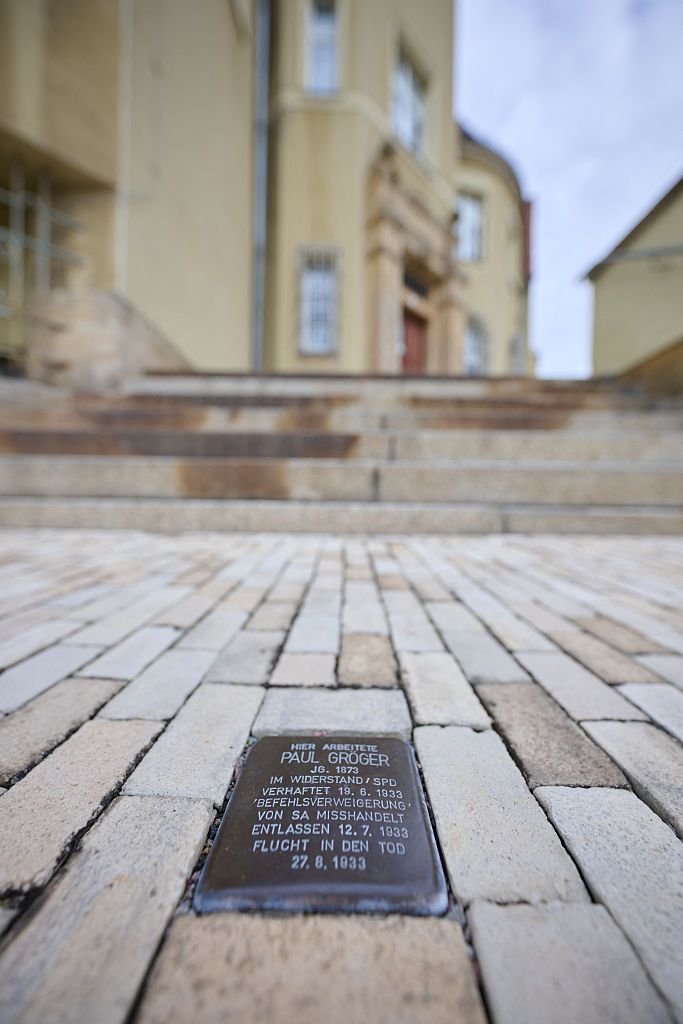
- The German town of Heidenau has voted to stop installing new “Stolpersteine” (or “stumbling stones”), the small engraved brass plaques conceived as an artwork to commemorate victims of the Holocaust.
The Headlines
IN MEMORIAM. Puerto Rican, New York-based artist Rafael Ferrer has died at age 93, the Muséo del Barrio announced last night. Ferrer was “a groundbreaking artist whose singular and influential practice challenged boundaries” across multiple mediums and disciplines, stated the museum. Indeed, he first worked as a jazz drummer before moving to visual arts after discovering Surrealist artists and writers during a 1954 trip to Paris, an influence that could be felt throughout his works. In 2010, the museum presented Ferrer’s first major solo museum exhibition, surveying the artist’s practice over five decades, titled “Retro/Active: The Work of Rafael Ferrer.” That show drew belated attention to the artist and was “almost criminally overdue,” per a review in the New York Times. It led to a succession of solo exhibitions, including at the Guild Hall, East Hampton (2011), Lancaster Museum of Art (2012), and the Museum of Contemporary Art, Chicago (2015). “The general impression is of someone who would figure out how to make art if confined to a nearly empty room,” the Times added in a glowing review. Indeed, Ferrer used almost anything and everything to create: from paper bags on which he drew, to calabash gourds and garbage can lids in hanging, Dada-like assembled sculptures, or installations using straw, dried leaves, and ice. In the 1960s and ’70s, he built a reputation for his avant-garde ephemeral Process Art installations and was shown at major institutions, such as the Whitney Museum of American Art, with other conceptual artists. Eventually, he returned to painting around the 1980s, making ‘faux-primitive’ works that often featured tropical homes and people. A recipient of the Guggenheim Fellowship in 1975 and the Pew Fellowship in the Arts in 1993, Ferrer’s works are now in major museum collections around the world.
Related Articles

VILLENA TREASURE TRIAL. Preliminary court proceedings have begun against the mayor of the Spanish town Villena and the director of its Villena Museum (MUVI) for possible neglect leading to the shocking theft of what is known as the Villena Treasure, one of Europe’s most important Bronze Age gold artifacts, reports El Pais. In its filed complaint, the Association for the Defense of the Rule of Law and the Fight Against Corruption (ADED) has also included museum personnel responsible for security, claiming that gross negligence of security measures is responsible for the theft, which constitutes a crime against historical heritage. Since the museum is owned by the city, the ADED has accused left-leaning local Mayor Fulgencio Cerdán and another local official of failing to protect the museum as well. The judge in the case has requested that the public prosecutor’s office determine whether the trial can go forward. The Villena Treasure includes 66 items, including 11 gold bowls, 28 gold bracelets, and more, adding up to about 10 kg (22 pounds) of gold. On August 27, thieves made off with almost all of it, leaving behind only a small handful of silver vessels, one bracelet, ornaments, and one of four crowns, thought to have been dropped in their escape.
The Digest
The city council in the German town of Heidenau has voted to stop installing new “Stolpersteine” (“stumbling stones” in English), or small engraved brass plaques, which are artworks conceived to commemorate victims of the Holocaust outside the homes where they once lived. [The New York Times]
Alfred Wierusz-Kowalski’s late 19th, early 20th-century painting Winter – Napoleon’s Retreat from Moscow has been restituted to the National Museum in Warsaw by a private owner, after learning it was looted by Nazi’s and hung in an SS officers’ club. [Notes from Poland]
Greece and Bulgaria have agreed to a new “Memorandum of Understanding” that will see Sofia returning 48 relics looted during WWI to Athens, in exchange for the mortal remains of Tsar Samuel of Bulgaria, who reigned from 997 to 1014, which are currently housed in a Greek museum. [Voria]
Senator Mike Lee single-handedly blocked a bill on Monday night, aimed at preventing President Trump from tearing down presidential memorials, notably including the John F. Kennedy Center for the Performing Arts. [The Washington Post]
Patrick Branco Ruivo, the director of the company that runs the Eiffel Tower for the city of Paris, will step down at the end of the year, following a major upset and workers’ strike over the removal of female workers from the monument earlier in September and their replacement with men to accommodate a religious delegation visit. [Le Figaro]
The Sámi art collective Dáddadállu has won the MUNCH Award, including NOK 300,000 ($31,270) [ArtReview]
The Kicker
BEING AND TIME. A new documentary about the life, art, and radical mind of Etel Adnan takes the viewer deep into the late artist’s poetic universe, reports ARTnews. Adnan being and time (2026) is the first feature film by director Marie Valentine Regan, made during the last five years before Adnan died on November 14, 2021. It travels between Adnan’s home in Paris to Mount Tamalpais, a subject of Adnan’s poems and artworks over decades of living at its base, in Sausalito. Throughout, the artist muses circuitously about the many facets of her extraordinary life: facing history “head on” after a childhood spent in Beirut; how she “absorbed” the lived catastrophes of her Syrian father and Greek mother, who witnessed the fall of the Ottoman Empire and the 1922 burning of her mother’s native “lost city” of Smyrna (now Izmir, Turkey); maintaining a visual art practice “in Arabic”; and what it means to experience “being and time,” central concerns of her art and writing.