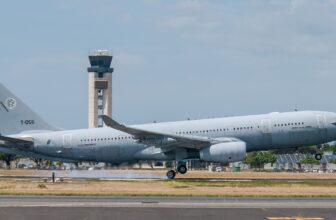


Delhi will welcome a new airline this month. Russian carrier Ural Airlines will launch flights between Yekaterinburg and Delhi on October 27, 2026, operating thrice weekly on Tuesdays, Fridays and Sundays. The route will be flown by the airline’s two-class Airbus A319 with 8 Business class and 132 Economy class seats, making Ural Airlines only the second Russian carrier, after Aeroflot, to operate scheduled flights to India.
U6 815 departs Yekaterinburg at 0555 and lands in Delhi at 1130, while the return U6 816 leaves Delhi at 1230 and arrives in Yekaterinburg at 1735. That is five hours southbound and five and a half hours on the way back, with the aircraft spending just an hour on the ground at Delhi before heading home.
When the route was first filed in July, it was planned as a twice-weekly operation on Tuesdays and Fridays, with extra flights added over the New Year holidays. The addition of a Sunday frequency even before the first flight takes off is an early sign of confidence. Ural’s CEO Kirill Skuratov has pitched the route as a way to strengthen business ties between the Urals region and India, calling India one of Russia’s key partners.
Ural Airlines and India: not the first attempt
Ural Airlines traces its roots to 1943, when an air squadron was set up at Koltsovo Airport in Sverdlovsk, as Yekaterinburg was then known. The Ural Airlines brand came about in 1993, when the Sverdlovsk aviation enterprise was split into an airline and an airport, one of the many “Babyflots” born from the break-up of Soviet-era Aeroflot. From 2006 the carrier began moving away from Tupolevs and Ilyushins to the Airbus A320 family, which today makes up its entire fleet of around 50 aircraft.
India has been on Ural’s radar for a while. In 2018, the airline came to OTM Mumbai pitching connections from Indian cities via Yekaterinburg to Moscow, St. Petersburg and onward. In 2019 it launched a seasonal Moscow Domodedovo to Mumbai service, and for summer 2020 it put four weekly A320neo flights on sale. The pandemic ended that plan before it could take off, and 2022 shut the door on most international ambitions.
While Russia and Russian carriers remain under sanctions, India does not enforce unilateral Western sanctions, and Aeroflot has flown to Delhi throughout this period, so the operating template already exists at Delhi airport. Ground handling, fuel and overflight arrangements that work for Aeroflot will largely work for Ural too. What remains a risk is an aircraft going technical in Delhi, where finding parts and engineering support quickly is far harder for a sanctioned operator.
The market: no more detour via Moscow
Today, Aeroflot is the only airline flying nonstop between Russia and Delhi, operating the Moscow Sheremetyevo to Delhi route. Indian carriers have been absent from Russia for years. For a passenger from Yekaterinburg, getting to Delhi meant flying west to Moscow, around 1,400 km in the wrong direction, before heading south, or connecting via Tashkent, Almaty or the Gulf hubs. A nonstop five-hour flight cuts the journey roughly in half.
The demand case rests on three pillars. First, students: Russian medical universities host thousands of Indian students, many in cities across the Urals and Siberia. Second, trade: Yekaterinburg is an industrial centre for metals, heavy engineering and machinery, sectors where India–Russia trade has grown since 2022. Third, Russian outbound tourism, which has turned towards “friendly” destinations, with Delhi serving as the gateway to the Golden Triangle and onward to Goa. Yekaterinburg (also known as Ekaterinburg) is the fourth largest city in Russia with a population of over 1.5 million.
Yekaterinburg also brings a network angle. Ural Airlines operates a domestic web to cities such as Chelyabinsk, Perm, Omsk and destinations further east. The afternoon arrival back into Yekaterinburg lends itself to evening connections, though the 05:05 departure means passengers from feeder cities will need to arrive the previous night.
Network Thoughts
The choice of the A319, the smallest aircraft in Ural’s fleet, is a sensible one to begin operations, especially when Aeroflot already serves the market during the winter months. It limits the downside if loads are thin, and the three-class cabin gives the airline a product for business travellers on a route where the alternative is a connection through Moscow. Going from two to three weekly flights before launch suggests bookings are holding up better than the airline expected.
For Russian carriers, India is one of the few large markets still open to them, and with Europe closed, aircraft need to be deployed where they can earn. Delhi is quietly becoming a busy gateway to the CIS and Central Asia, with Aeroflot, Uzbekistan Airways and Centrum Air, Air Astana, Turkmenistan Airlines, Aero Nomad and the likes already present. Ural adds a regional Russian point to that mix.
The bigger question is whether this opens the door for others. Will S7 or Red Wings follow with flights from Novosibirsk or Kazan? And will Indian carriers ever return to Russia, where the market is served entirely by Russian airlines today? As with much in aviation these days, the answer lies as much with geopolitics as with demand.
Found this article informative? Think of supporting Network Thoughts with Power of 10

Running this website incurs some cost, along with the data sourced for analytics. If you have liked this article, consider paying INR 10 via UPI. The site will continue to be free. This will help with the maintenance, upkeep and funding the research. You can also pay via Debit or Credit card by clicking on this link.
You can support Network Thoughts by ordering Network Thoughts baggage tags and lapel pins !
Follow NetworkThoughts on X (Formerly Twitter), Bsky, Facebook and YouTube
Related