


Danny Cameron won a Guest Judge’s Choice Award in Jackson’s Art Prize this year with his work The Madonna of the Rose Garden. In this interview, he discusses how even a glance at a stain on the street might inspire him, the cherub-like figures that emerged in his work after becoming a father, and painting about paint.
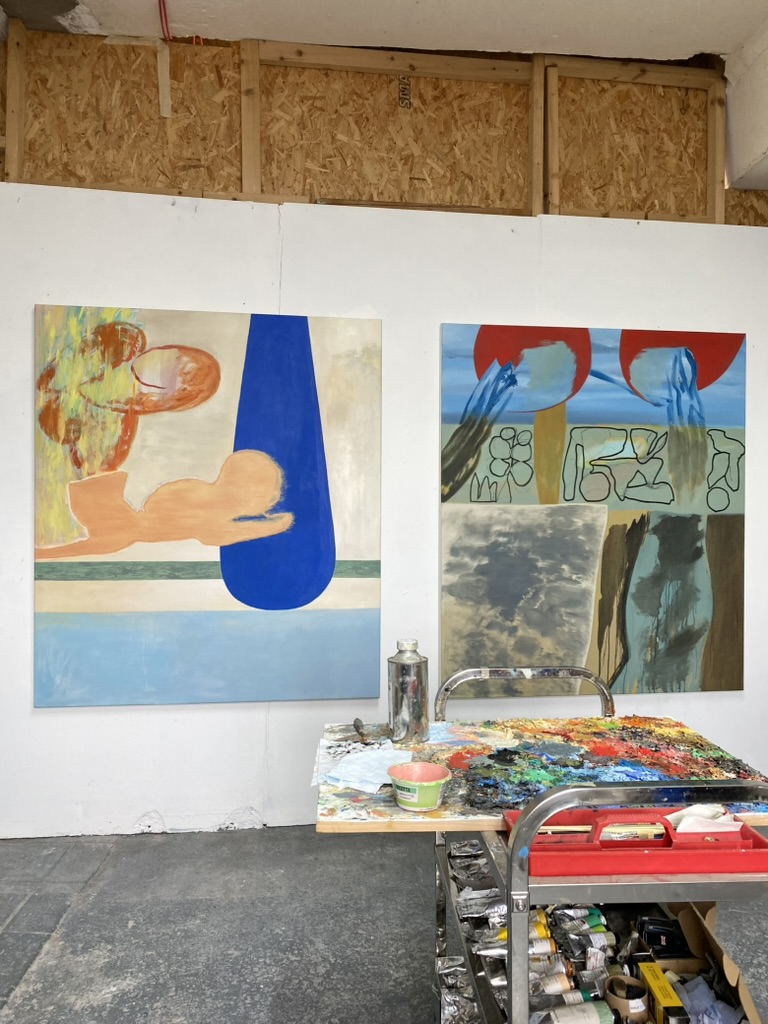
Above image: Danny Cameron in his studio

Danny Cameron
Acrylic and oil on canvas, 110 x 90 cm | 43.3 x 35.4 in
Josephine: Could you share the story of how you became an artist and tell us more about your artistic background?
Danny: Art was always my favourite subject at school, even though we had what was probably a pretty typical educational approach in the 90’s, whereby, we’d be instructed to copy, say, a Van Gogh, in oil pastel. The next week we’d copy it again, in biro pen, and then maybe in charcoal after that!
I would always ask for art materials at Christmas. I remember getting some oil paints when I was around 12 years old and spending hours making a small painting of an otter, obsessed with trying to make it as realistic as possible. It was very ‘chocolate box’ but it definitely spiked an interest in the material of paint, which subsequently led to many hours of exploration and experimentation.
I was also obsessed with cartoons, (which were all over the telly then) and used to spend hours drawing them and creating my own at a table in my bedroom, which, as it turns out, wasn’t a complete waste of time, as one of my current jobs is being a freelance Cartoonist.

Danny Cameron
Acrylic and oil on panel, 50.8 x 60.9 cm | 20 x 24 in
Josephine: What does a typical working day in the studio look like for you? Do you have any important routines or rituals?
Danny: I suppose the short answer to that is there isn’t a ‘typical’ day. Every day is different albeit with certain mini rituals. I always take a flask of black coffee and then have a quick flick through my sketchbook, often finding drawings that I have no recollection of. One might spike my interest. I’ll perhaps read a paragraph or two of something I’ve been looking at and then I’ll get to work, often working on a few paintings at once.
Josephine: Which materials or tools could you not live without?
Danny: I think I’d be pretty lost without my A5 sketchbook and pencil, and then it would definitely just be the oil paints, of which there are many! I mostly have a mixture of Jacksons’ Professional, Wallace Seymour & Michael Harding.

Josephine: Do you work from a reference? Tell us more about your process.
Danny: My process has evolved considerably over the last couple of years. One of the most significant shifts has been that I used to work from, and refer to preparatory studies and drawings quite stringently, whereas now, the drawings have become their own entities rather than acting as a direct support for a subsequent painting. Other factors can direct the painting elsewhere, the process is much more open and intuitive now. I might glance at a stain on the street walking to the studio which could directly inform part of a painting.

Danny Cameron
Felt tip marker pen on paper, 21 x 30 cm | 8.2 x 11.8 in
Josephine: Do you regularly draw or keep a sketchbook? If so, how does this inform your work?
Danny: Yes, I try to draw regularly in my sketchbook, sometimes it is an image I’ve been thinking about for a while and I have to make a quick sketch of it before it is gone. Other times I just begin to draw on a blank page and see what comes out, which will inevitably be a culmination of all sorts of things I’ve been thinking about that day and beyond.

Josephine: Have you ever had a period of stagnation in creativity? If so, what helped you overcome it?
Danny: Yes, many periods and I’m sure there’ll be many more! I think as painters we are plagued by doubt. The times where everything seems to be flowing just right are sporadic (even though when we are in them we might feel as though they can go on and on). I have come up with certain coping strategies over the years, one being delving into a textbook, revisiting a favourite artist’s work. The drawing is often the saviour, even if it is just a few quick sketches, maintaining this constant thread is vital, I find.

Josephine: Are there any specific artists or mentors who have inspired you?
Danny: I studied on the Turps Correspondence Course back in 2022, which was exactly what I was looking for and needed at the time, it completely transformed my practice. I had Phil King as a mentor and Neal Tait as a guest mentor for one of the feedback sessions, who both seemed to have a knack for saying exactly what I needed to hear, so perceptive. I have re-read the notes from my crits so many times, and refer back to them regularly.
There are loads of artists that I have been hugely inspired by, one of the foremost being Georg Baselitz. Looking at his work is what instigated the complete shift in approach, to paraphrase him, it became more about; ‘Saying something with painting, as opposed to making paintings that say something.’ I’m also a huge admirer of Markus Lupertz, Rita Ackermann, Cecily Brown, Prunella Clough, Albert Oehlen, Carrol Dunham, Amy Sillman, Jo Bradley, Richard Aldricht, John Walker, Philip Guston, COBRA, Roy Oxlade, Rose Wylie, Matisse, Picasso and Don Van Vliet (the list could go on!) I love Magritte’s Vache period for their playful dark humour and sense of the absurd, as well as Francis Picabia. I also look a lot at religious ICON paintings, Giotto, El Greco and Tintoretto, Giotto, Fra Angelico.

Josephine: What were you thinking about or exploring at the time you made The Madonna of the Rose Garden? What inspired it, and how did it come to be?
Danny: I got a book on Baselitz paintings and drawings from the 80’s. I loved their immediacy, rawness and energy. I had been preoccupied with the motif of the Madonna for years and had been gifted an old book entitled ‘Madonna paintings ’(one of which was a 16th century painting of the same title) I think partly, it has something to do with the fact that I was brought up in the church, and was exposed to many religious works of art. I had been playing with the idea of bringing the cartoonish/ caricature aspect into the painting, and had started to make several ‘Cartoony’ Madonna drawings in felt pen. They were loose and felt dynamic, and so the challenge was then how could I capture that sense of dynamism in paint. The cartoon aspect acted as a sort of cipher, I wanted the painting(s) to be about the paint, the paint is the subject. They had to retain a raw energy, and so, erasure became fundamental to the process. There are several failed attempts layered underneath the final image.

Danny Cameron
Oil and acrylic on canvas, 90 x 110 cm | 35.4 x 43.3 in
Josephine: What made you submit this piece to Jackson’s Art Prize?
Danny: I think I submitted about 5 paintings in the end, but this one felt quite impactful in the sense that it had that gestural dynamic approach, I think it manages to retain an immediacy.

Danny Cameron
Acrylic and oil on panel, 50.8 x 60.9 cm | 20 x 24 in
Josephine: Bertie Brogan stated your work is “full of feeling, and dripping with confidence in his own perspective”. The explosion of paint and movement in your works always brings such joy to the viewer. How do you know when to stop?
Danny: I don’t! I have ruined many paintings by carrying on and not knowing when to stop. But I think generally, the painting dictates this to a large extent. With this painting in particular, I remember it just looking hideous for quite a while! I had a few sketches and also the 16th century painting of the same name which I was referring to. It was looking like a bit of a cheesy transcription, and it had this bright acid yellow all over, which ended up working out great in the end, as it almost acted as a backlight after painting over large swathes of it. There’s a great Guston quote where he talks about having his artist influences in the studio with him, and then they leave one by one, and if you’re lucky, you also leave, and i think when the painting works out, it is when you aren’t really fully conscious of it. The last session on this piece was quite a frenzied hour or so with no idea about what I was doing or where it would lead. I think it’s perhaps also important to say that when approaching painting in this way the final image is only one possible outcome.

Danny Cameron
Acrylic and oil on canvas, 130 x 150 cm | 51.1 x 59 in
Josephine: Was this your first time explicitly referencing Madonna and child? What drew you to it? I find your painting very emotive, a gorgeous balance between irreverence and earnestness, lightheartedness and tenderness. Is your connection to Madonna and child emotional or historical or both?
Danny: I think I alluded to this long held fascination with this particular motif earlier. I couldn’t really pinpoint one thing that would succinctly explain the connection. There is a childhood connection, in that I was a church regular for many years.
I also like that painting is full of these antagonisms, the sacred and the profane- which I think is evident in this piece, it becomes fun to play with these historical references. I mentioned the Magritte Vache works earlier, I find them, in one sense so moving, yet simultaneously full of dark humour. I think also becoming a father has brought an emotional significance, the cherub like figure started to surface a lot in my drawings.

Danny Cameron
Charcoal and pastel on Saunders Waterford paper, 56 x 76 cm | 22 x 29.9 in
Josephine: Are there any new techniques or ideas you’re excited to explore using the materials from your prize?
Danny: I bought a load of new brushes which I have already been experimenting with. I’ve also grown really fond of painting on panels and have purchased several of the Jackson’s wooden panels along with a primer. I’ve also bought a set of acrylic marker pens and am excited to experiment with those in the drawings.

Josephine: How did it feel to move through the stages of the competition and win Brogan Bertie’s Choice Award?
Danny: I try not to pay too much attention to the early stages, as I have entered quite a few open calls over the years so am well used to not making the cut. There are always so many great paintings entered, so it would be ridiculous to get carried away. I was commuting back from work on the train when I found out about the award, and so it was a complete shock, and I was absolutely over the moon!

Danny Cameron
Acrylic and oil on canvas, 90 x 110 cm | 35.4 x 43.3 in
Josephine: What’s coming up next for you?
Danny: Well, I think the next Jackson’s Art Prize open call is coming up again soon!
I have just returned from London where it was great to be part of a group show in Peckham organized by @blinkandyoullmissitart at Safehouse, which was such a great and unusual space to exhibit. It’s just really a case of cracking on in the studio- I’ve been working on some new paintings on wooden panels, there’s a bit of cross pollination going on and they are slowly evolving over an extended period. I don’t know when, but it’d be good to get to a stage where I have something that resembles a cohesive body of work, as I’d really like to do a solo show at some point.

Further Reading
Meet Angela Lizon, Winner of Jackson’s Art Prize 2026
Jackson’s Art Prize 2026 First Prize Winner Announced
How We Collaborate With Artists
Expert Advice on Making Your Way as an Artist
Shop Acrylic Painting on jacksonsart.com
The post Danny Cameron: The Paint is the Subject appeared first on Jackson's Art Blog.


