


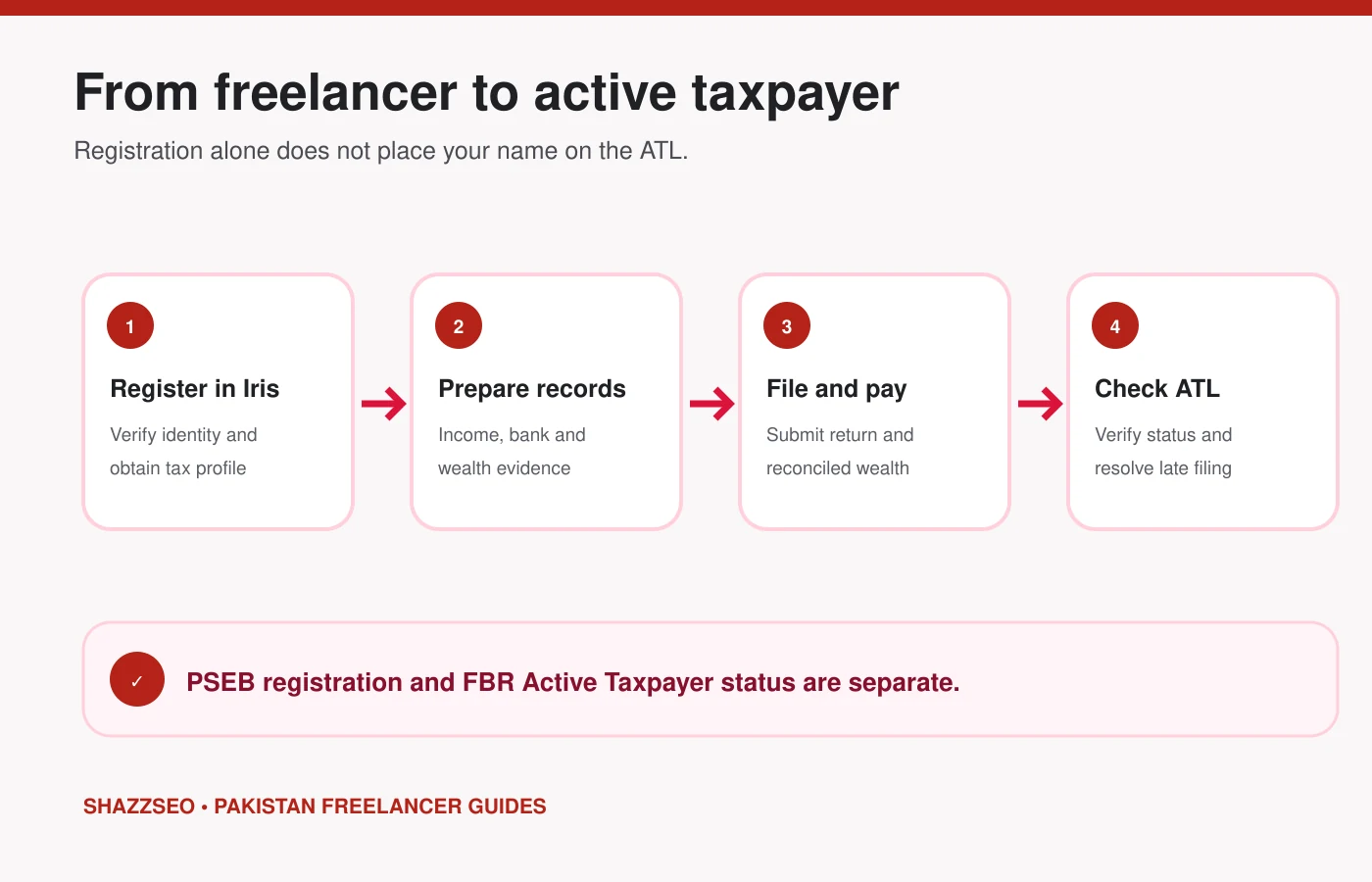
To become an active tax filer in Pakistan, a freelancer must do more than obtain an NTN. You normally need to register in FBR Iris, file the required income-tax return and reconciled wealth statement for the relevant tax year, pay any tax and surcharge due, and then verify that your name appears on the Active Taxpayer List.
Registration, filing and active status are three separate stages. Many freelancers complete only the first one and continue calling themselves active filers even though their ATL status is inactive.
Quick route: Register or recover access to Iris, correct your profile, prepare income and wealth records, file the appropriate return and wealth statement, pay the generated liability, and verify ATL status through FBR. If you file after the due date, check whether an ATL surcharge or other late-filing consequence applies.
What does “active tax filer” mean?
FBR describes the Active Taxpayer List as its central record of online income-tax return filers for the relevant period. Appearing on the ATL can result in lower withholding rates on various transactions. It does not certify that every number in a return is correct or that no tax is due.
|
Status |
What it means |
|---|---|
|
Registered taxpayer |
You have an FBR registration or NTN and access to a tax profile. |
|
Return filer |
You submitted an income-tax return for a particular tax year. |
|
Active taxpayer |
Your status appears active on the current FBR ATL under the applicable rules. |
|
PSEB-registered freelancer |
You hold a separate industry registration. It does not replace FBR filing or ATL status. |
Who may need to file?
Filing obligations can arise from income level, business activity, assets, vehicle or property ownership, registration status and other statutory conditions. Freelancers should not assume that keeping money in Payoneer, earning below a particular platform threshold or receiving funds as a remittance removes the obligation.
Check the current law and FBR criteria for the tax year. A person may also choose to file for a documented tax history and ATL benefits even where professional advice confirms no tax is payable.
Step 1: Register with FBR Iris
Use the official FBR Iris portal. First-time filers must register before submitting a return. Prepare:
- CNIC and a mobile number registered in your name.
- Personal email address you control.
- Residential and business address details.
- Pakistani bank account information.
- Business or professional details relevant to your freelance work.
For an individual, the CNIC normally functions as the tax registration identifier. If you already have an account, recover access rather than creating inconsistent registrations.
Step 2: Correct your registration profile
Before filing, check your name, address, contact details, bank accounts, business activity and registration particulars. Your profile should be consistent with your CNIC, bank, PSEB record, invoices and freelance platform accounts.
Do not add a fictional office, business name or activity to fit a tax category. If you work from home, use the lawful and accurate profile treatment.
Step 3: Build the freelancer evidence file
Collect the records for July 1 through June 30:
- Fiverr, Upwork and other platform earnings reports.
- Direct-client invoices and contracts.
- Payoneer or other payment-account statements.
- Pakistani bank statements and foreign-remittance advice.
- ePRCs or PRCs where available.
- Withholding-tax certificates.
- PSEB certificate for the relevant period if applicable.
- Details of salary, local clients, profit on debt and other income.
- Opening and closing assets, liabilities and personal expenses.
Your figures should bridge gross earnings to fees, withdrawals and the amount received in Pakistan. See our guide to receiving international payments in Pakistan for the banking routes.
Step 4: Determine the correct income treatment
Separate local freelance income from exported services. Separate qualifying IT and ITeS export receipts from services that do not meet that definition. PSEB registration may be relevant to concessionary treatment for eligible IT and ITeS exports, but it is not a blanket classification for every freelancer.
Do not choose an income code solely because it has the lowest rate. Match the code and treatment to the actual service, payment route, realization evidence and current Finance Act.
Step 5: Prepare the wealth statement
The wealth statement reports assets and liabilities at the year end and explains the movement from last year’s wealth. It may include:
- Pakistani bank balances and cash.
- Payoneer and other controlled payment-account balances.
- Vehicles, property, investments and business capital.
- Loans and other genuine liabilities.
- Personal and household expenses.
The reconciliation must balance. If it does not, investigate missing income, duplicated withdrawals, omitted opening assets, transfers between your own accounts or unrealistic personal expenses. Do not invent a gift or loan.
Step 6: File the return and pay the liability
Review the completed return and wealth statement before submission. Generate the official payment slip or reference through the FBR process for any amount due, pay through an authorized channel and retain proof.
FBR’s standard due-date page lists September 30 for individuals and associations of persons. Extensions can be announced separately, so check the current FBR press releases rather than relying on last year’s extension. Filing after the applicable deadline can create late-filer consequences even if the return is accepted.
Step 7: Verify Active Taxpayer List status
Use FBR’s official online ATL-status facility or the SMS method shown on its status-check page. Save a dated screenshot or PDF for your records.
If the return is visible in Iris but the ATL remains inactive, check the tax year, submission status, due date, outstanding payment and any required ATL surcharge. FBR has stated that qualifying late-filing individuals may enter the ATL after paying the prescribed surcharge, which its published guidance has listed as PKR 1,000 for individuals. Verify the current amount before payment.
Benefits of active filer status
- Lower withholding rates on various banking and other transactions where the law provides an ATL distinction.
- A documented income and asset history for loans, visas and major purchases.
- Cleaner support for foreign-remittance and freelance-income questions.
- Better alignment between your bank, PSEB and tax records.
ATL status is not a tax exemption. It usually reduces specified withholding rates and demonstrates filing activity.
FBR and PSEB are separate
FBR handles federal tax registration, returns and the ATL. PSEB registers eligible IT and ITeS exporters and supports industry-specific benefits. You can be registered with PSEB but absent from the ATL, or active on the ATL without PSEB registration.
If your services qualify, follow the PSEB freelancer registration process separately and keep the certificate valid for the relevant period.
Common problems and solutions
I have an NTN but my status is inactive
An NTN only proves registration. Check whether the correct return was submitted and whether the ATL rules, payment and timing requirements were met.
I filed but forgot the wealth statement
Check the submission record and current Iris requirements. FBR provides a process for revising a wealth statement in permitted circumstances. Do not file conflicting replacements without understanding the revision.
I missed the deadline
File accurately as soon as possible, determine any penalty or ATL surcharge, and check whether a lawful extension applied. Do not wait another year.
My Payoneer income is not in my Pakistani bank
That does not automatically remove it from income or wealth reporting. Preserve the platform and Payoneer statements and seek advice on the applicable recognition and asset disclosure.
I have local and foreign clients
Separate the income streams. Local receipts should not be disguised as export remittances, and foreign receipts should be supported by the banking trail.
Frequently asked questions
Can I become a filer without paying tax?
A correctly filed return can result in no additional payment where the law and your figures produce no liability. Filing status and tax payable are different questions. Never submit a false nil return.
How quickly does ATL status update?
Update timing depends on FBR processing and whether the return was timely. Use the official status check after filing and keep the submission and payment receipts.
Do I need a tax consultant?
A simple first return can be manageable, but professional review is valuable for export income, PSEB treatment, multiple platforms, foreign balances, old unfiled years or wealth-reconciliation problems.
Does active filer status expire?
ATL status depends on continued filing under the applicable rules. Filing once does not make you permanently active.
Which tax year should I file?
The tax year normally covers the twelve months ending June 30 and is named for the calendar year in which it ends. Select the year that matches the income period you are reporting.
Final checklist
- Register or recover your Iris account.
- Correct your profile and bank details.
- Reconcile freelance income and withholding.
- Prepare closing assets, liabilities and expenses.
- File the correct return and wealth statement.
- Pay the official liability and any applicable surcharge.
- Verify your ATL status directly through FBR.
For a broader walkthrough, read how to file an income-tax return in Pakistan.
This guide provides general educational information, not individualized tax or legal advice. FBR forms, deadlines, rates and ATL rules can change. Check the current tax year and obtain professional advice where needed.


