
Renée Fleming’s Strauss savvy is unimpeded by the San Francisco Symphony’s dense sound – Seen and Heard International


 United States R.Strauss: Renée Fleming (soprano), San Francisco Symphony / Santtu-Matias Rouvali (conductor). Davies Symphony Hall, San Francisco, 1.10.2026. (HS)
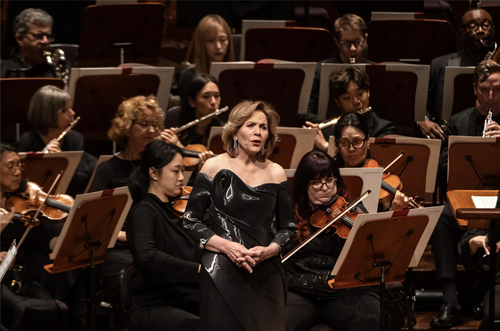
R.Strauss – Four Last Songs; Ein Heldenleben
Encore: R. Strauss – ‘Morgen’
San Francisco Symphony’s Richard Strauss program contrasted one early and one late work of the composer’s, opening with Four Last Songs and finishing with Ein Heldenleben. The most memorable moment, however, came as a sort of coda to the song cycle – an exquisitely languid encore of Strauss’s ‘Morgen!’
The choice of that particular lied, which came without pause after enthusiastic applause for the song cycle died down, also underlined the autobiographical nature of the entire program. Strauss wrote ‘Morgen!’ in 1894, part of set of four lieder as a wedding gift to his bride. Four Last Songs were among the final pieces completed before his death in 1949, a set of poems written to celebrate a lengthy married life as death approaches.
With soprano Renée Fleming in the spotlight, a gentle smile reflecting her soft, glowing voice, the four seasons of each song’s settings carried subtle but recognizable distinctions. The first, ‘Frühling’, unfolded with disarming simplicity and ‘September’ followed with shadows darkening Fleming’s tone just enough. ‘Beim Schlafengehen’ created a remarkably peaceful aura and the last song, ‘Im Abendrot’, which explicitly describes a sense of oncoming death shared by a couple, floated with an unexpected buoyancy as Fleming made the long lines feel endless.
Conductor Santtu-Matias Rouvali, in his San Francisco Symphony debut, drew the richest possible sound from the orchestra, resulting in a density of tone that unfortunately covered the vocal line’s lower notes. The 67-year-old soprano still sings with remarkable effortlessness and knows her way around this piece, having performed (and recorded) it often. We could feel every aspect of what the songs mean.
This brings up a concern about the formidable orchestra. In the first several concerts of this season the musicians have reveled in creating spine-tingling climaxes and contrasted them with beautifully refined pianissimos. Mezzo piano and mezzo forte sections too often have felt several decibels too loud, and that is what got in the way in the orchestra’s otherwise impressive contributions to Fleming’s well-defined singing.
In contrast, ‘Morgen!’, in a 1897 orchestration of strings plus a harp and three relatively subdued horns, wrapped an ultra-soft blanket around Fleming’s supple soprano. Concertmaster Alexander Barantschik draped luxuriant solo violin lines elegantly in response to the soprano’s melody and in refined counterpoint.
Rouvali showed the proper restraint in this one, as expected of one of the growing number of formidable conductors emerging from Finland. As principal conductor of London’s Philharmonia Orchestra, he has recorded five of Strauss’s tone poems, most recently a 2025 Ein Heldenleben. This performance in San Francisco emphasized precision and technical details but there were also moments of release and freedom. In soaring climaxes, the brass and percussion found round textures and bold colors. When the orchestration was winnowed down to just a few instruments, it could produce lovely moments, especially Barantschik’s Romantic solos and similarly deft contributions from clarinetist Carey Bell and oboist Eugene Izotov.
Rouvali’s careful detail-seeking did pay great dividends in the final section, subtitled ‘The hero’s retreat from the world’. The density softened into more clarity and Russ de Luna’s English horn solo created a genial moment.
As in the song cycle, however, stretches of narrative in midrange dynamics rambled along aggressively rather than stepping back and developing in intensity. Ein Heldenleben, which often references or alludes to previous Strauss works as it traces the life of a hero, needs those connecting elements to get the most out of the big climaxes. Even so, those big moments sounded great. It all finished well.
Harvey Steiman


![Interpol at Mercury Lounge [photos + review]](https://som2nypost.com/wp-content/uploads/2026/09/1_Interpol_Mercury-Lounge-336x220.jpg)


