


The oldest human genome recovered from the Americas came out of a Clovis burial site in western Montana, from a child known as Anzick-1 who died about 12,800 years ago. Nothing older has been sequenced from either continent, which means that every genetic argument about when the first Americans arrived is built on people who lived later, with the earlier events inferred from statistical models fitted to their DNA. About 257 whole genomes and genome-wide data from 1,204 ancient individuals have now been published for the hemisphere, and the review that tallies them (Bethany Potter and Jennifer Raff of the University of Kansas, with Savannah Hay and Archana Singh, in Current Opinion in Genetics & Development, 2026) is frank that this is still a thin and uneven sample.
Most readers who follow the field carry a tidy story about it. Clovis First, the idea that hunters of the Clovis culture, around 13,500 years ago, were the original colonists, collapsed when older sites turned up, and the story since has seemed to be one of dates sliding steadily backward: White Sands at about 23,000 years, Chiquihuite Cave at about 32,000, the Cerutti Mastodon site in southern California at 130,000. Genetics, in this version, is the slow discipline waiting to be persuaded. The review describes the relationship differently. The genomes that helped finish off Clovis First also put a limit on how far back the ancestors of living Native Americans can be pushed, because the diversification of their lineages, the pattern expected when a founding group first spreads into a new region, appears in the genomic record no earlier than about 21,000 years ago.
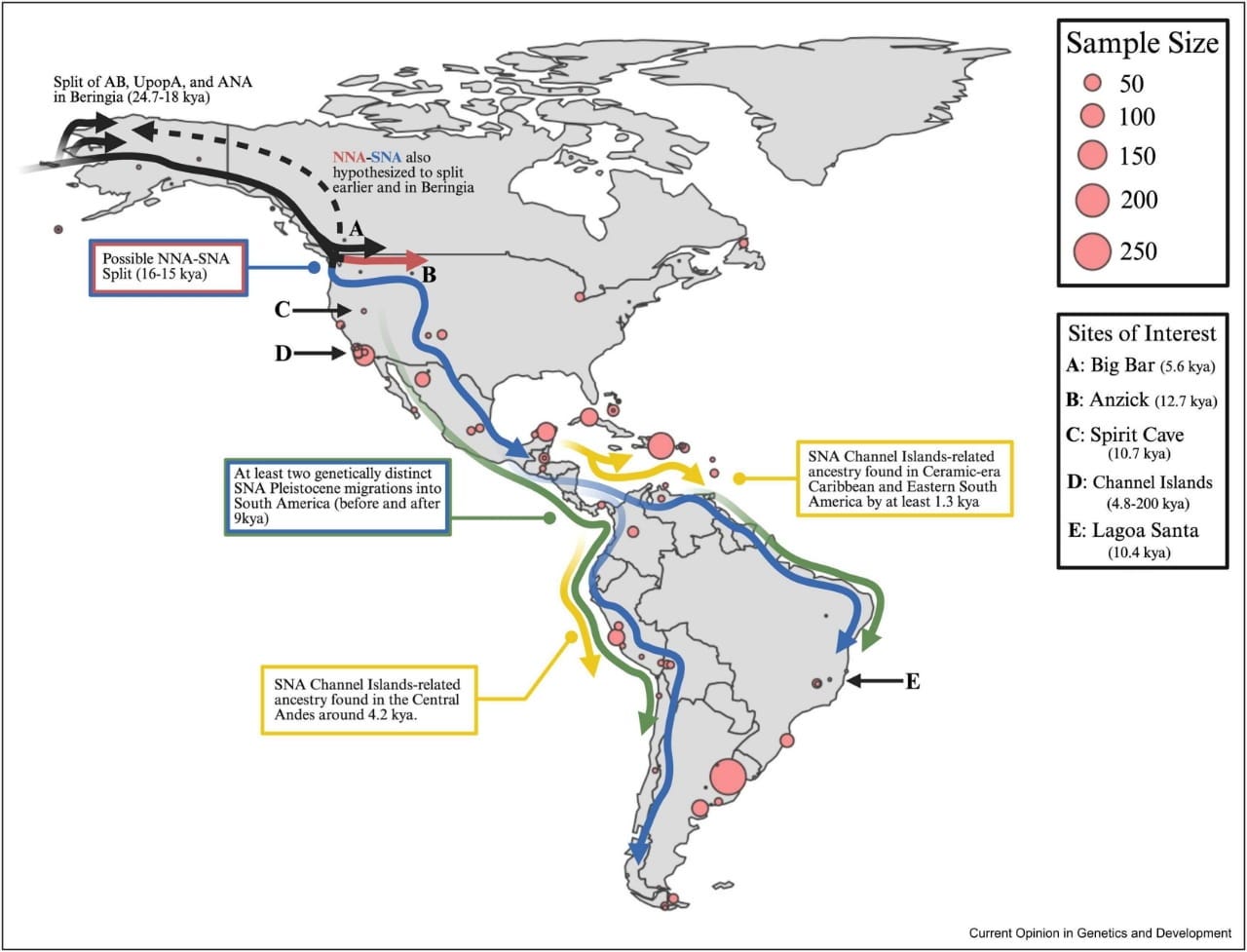
The authors make a point about the Americas that sets them apart from the rest of the Homo sapiens story, in which our species repeatedly moved into continents already held by Neanderthals, Denisovans and other so-called archaic hominins. Here the genomic data imply that a small group of people entered two continents with no other humans on them. That predicts a sparse early archaeological record, with few sites, made sparser by the extra thousands of years in which weather, rivers and soil could destroy what was left. The authors argue that the post-glacial record of both continents looks exactly like this.
The Cerutti claim runs into the sharpest version of the problem. If DNA were ever recovered from a site that old, the authors write, it should belong to Neanderthals, Denisovans or some unknown lineage, since Homo sapiens did not begin its persistent expansion beyond Africa until 60,000 to 70,000 years ago. The oldest Native American genomes, from Upward Sun River in Alaska and from Anzick, carry patterns of archaic admixture that do not match that scenario. Even a much later arrival shortly before the Last Glacial Maximum (LGM, about 25,000 to 20,000 years ago) fits the genetic evidence poorly, though the authors treat arrivals at 40,000 years or later as more feasible than the 130,000-year claim.
The Siberian background is better documented than most of what follows it. Humans were living in the Arctic of East Siberia by 32,000 years ago, at the Yana Rhinoceros Horn sites, and genomes from two people there define a group called the Ancient North Siberians. The Yana people did not contribute directly to the ancestry of the First Peoples, the review’s term for the direct ancestors of Native Americans, but a group largely descended from related ancestry did, and it is represented by a 24,000-year-old individual from Mal’ta in south-central Siberia. That Ancestral North Eurasian ancestry makes up as much as 40 percent of the First Peoples lineage. Between 25,000 and 20,000 years ago, a group carrying it met ancient East Asians, and the resulting metapopulation then sat in isolation through the cold and dry peak of the LGM, a span called the Beringian Standstill. Where it sat is unresolved; researchers have proposed a refugium east of Lake Baikal, the East Siberian Arctic Shelf, and central Beringia.