

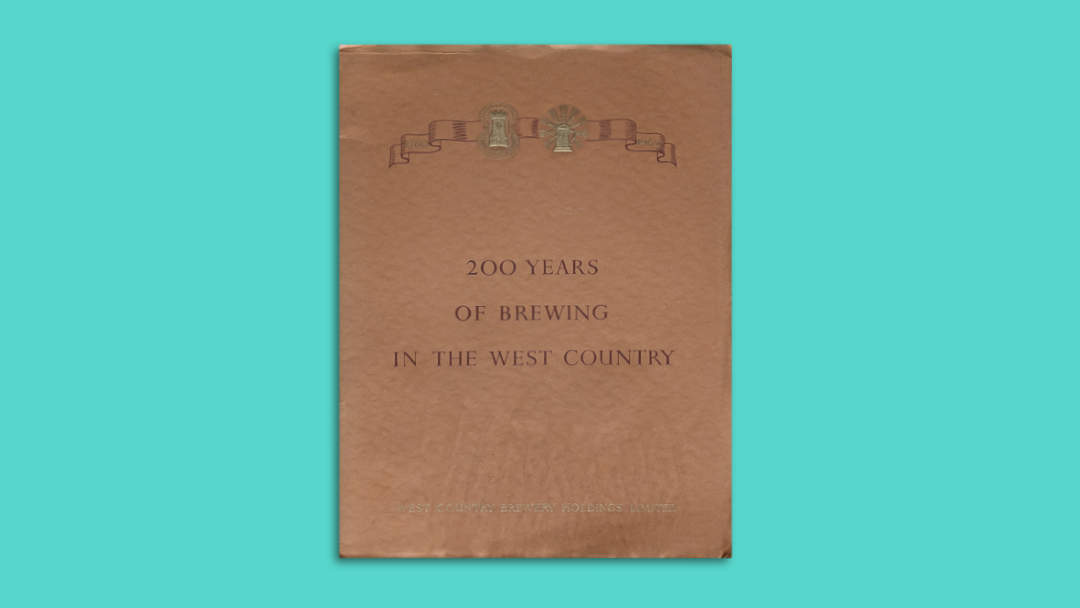
We keep an eye out for ephemera relating to brewing and pubs and were pleased to stumble upon this bit of prestige bumph by West Country Breweries from 1960.
You might not have heard of West Country Breweries. We certainly hadn’t. That’s partly because it only existed for about four years.
It was formed by a merger between The Stroud Brewery Company and Cheltenham & Hereford Breweries in 1959 and popped out of existence in 1963 when Whitbread acquired the operation and renamed it Whitbread Flowers.
In 1960, though, it was very much a going concern and its owners were keen to signal how jolly well they were doing, and had been doing so for centuries, and would likely continue to do so for many years to come. An excellent investment.
Hence this publication, 200 Years of Brewing in the West Country, a 40-page booklet, approximately A4 sized, with embossing and gilding on the cover and very posh, textured paper throughout. (Which made it very hard to scan, by the way, hence the grotty images in this post.)
From the first page, though, it’s clear that something unusual was going on. The obligatory foreword from the chairman is signed by… Colonel W.H. Whitbread. He was also chairman of Whitbread itself and his presence here signals that West Country Breweries was under the larger brewery’s protection as part of the so-called ‘Whitbread Umbrella’.
The Whitbread Umbrella was “a novel structural arrangement that incorporated a dual-voting shareholding structure aligned to a controlling interest in the publicly listed Whitbread Investment Company (WIC), an investment trust that housed minority shareholdings in some twenty regional brewers” (Julie Bower, 2016).
Protection is an interesting word, isn’t it? In organised crime it’s a euphemism for extortion and predatory behaviour by criminals. Well, in British brewing after World War II, it meant just about the same thing. By investing in smaller regional breweries, Whitbread was supposedly helping them stay afloat and resist takeover. But their presence on the boards of these breweries inevitably led to an eventual takeover by Whitbread itself.
What comes across most strongly from the various brewery family trees and accompanying narratives in this booklet is (a) how many breweries had already been swallowed up by larger competitors and (b) how complicated company structures can be. We still see this today when any attempt to discuss British breweries or pub companies eventually descends into: “Ah, well, see it uses the Thornbridge name, but it’s actually a partnership with…”
For example, the booklet tells us that the Frome & Lamb Brewery at Frome, Somerset, was taken over in 1956 by a partnership formed by the Stroud Brewery and Ushers of Trowbridge. Ushers would later be taken over by Watney’s while the Stroud Brewery became part of West Country Breweries, which became part of Whitbread. Phew!
A craft of science and great care
The booklet gives several pages to the head brewers from both Cheltenham (Mr K. Mead) and Stroud (Mr S.L. Staley) to talk about the thing we’re all actually interested in: beer.
While researching Brew Britannia back in 2012 to 2014 we spent ages hunting down uses of the word ‘craft’ in relation to brewing, attempting to pin down the history of the term ‘craft beer’. The headline in this section is “The brewing of fine ale – an art, a craft and a science of great care”.
The article is mostly the same old ‘How beer is brewed’ that you’ll have read a thousand times before but there are a couple of interesting nuggets.
First, there’s no mention whatsoever of keg beer, even though a beer called Double Gloster Keg is pictured later in the booklet. There is, however, an interesting statistic about bottled beer:
Changes in social habits in recent years have brought about a big increase in the consumption of bottled beers, and today about 40 per cent of the output of both the Cheltenham and Stroud breweries ends up in a bottle.
Secondly, there’s a note on regional preferences:
The West Countryman often prefers a glass of bitter, whereas the Midlander and the Welshman frequently shows a liking for milder beer.

A complete list of beers
West Country Breweries produced the following draught beers c.1960:
- Stroud Bitter
- Stroud XX
- Stroud XX Mild
- Cheltenham Pale Ale
- Cheltenham Bitter
- Cheltenham Mild Ale
- Double Gloster Keg
So, that’s three milds and four bitters, we think, although we’re not sure how XX differs from XX mild. Maybe one was dark and one was light? If you happen to know, comment below.
In bottle there was:
- All Bright
- Chelt Ale
- Chelt Brown Ale
- Cotswold Brown
- Cotswold Ale
- Gloster Stout
- Home Brewed
- Stroud Nourishing Stout
- West Country Ale
That’s two stouts, two brown ales, and various ‘ales’ which we assume were forms of bottled bitter. We’re intrigued by Home Brewed – an answer to Mann’s Rustic Ale, perhaps?
Cider drinkers
Of course a company called West Country Breweries needed a facility for making cider.
During an earlier period of consolidation, in the 1920s, a brewery at Wickwar, Gloucestershire, was turned over entirely to cider production, at great trouble and expense.
In 1959 Bulmer’s of Hereford took a 51% share in what had become the Gloucestershire Cider Company mostly, it seems, to prevent Stroud Brewery getting its cider into pubs around Hereford. Again, there was so much politicking and horse-trading going on that it can be hard to keep track of.

Post-war pubs
The main reason we bought the booklet was for the images of brand new post-war pubs and post-war interior refurbs. If you’ve followed us for a while you’ll know this is an obsession of ours and, indeed, prompted us to write an entire book about how pubs evolved in the 20th century.
The Royal Oak at Hucclecote, Gloucestershire, opened c.1959, is still there, trading as a Greene King Hungry Horse.
The Double Barrel at Warden Hill, Cheltenham, became a CO-OP convenience store in 2013.

The Swallow at Bishops Cleave, Cheltenham, c.1959, is still trading. There’s more on its history at the Gloucestershire Pubs website.
The Bell & Gavel in Gloucester closed in 2001 and was later demolished.
The Tankard & Castle in Cheltenham was apparently the first pub to be built by West Country Breweries after the war; developed a reputation for roughness; and was demolished in around 2004.
Dusty old pamphlets
There’s usually something of value to be found in these damp-stained, warped, smelly old bits of brewery propaganda.
In this case, there were few revelations, but it did provide a lens through which to view the era of brewery consolidation that followed World War II.
A final word from the managing directors at Stroud (Mr W.S.J. Watson) and Cheltenham (Mr N.H.R. Wardle) tries to predict the future:
There will be great revolutions in the public house as it endeavours to meet the challenge of changing tastes and demands… In this revolution it is inevitable that some of the smaller houses will disappear and be replaced by modern premises better equipped to cater for forthcoming generations.
For all the many reasons why there are fewer pubs now than in 1960 the fact that breweries and pub companies find it easier to manage a smaller number of bigger, more profitable, more efficiently designed pubs is often overlooked. They chose to do this. It was the future they wanted.