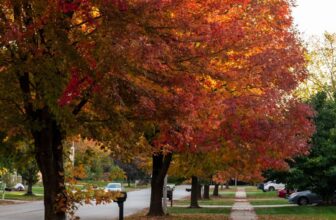


Today we’re here in Fort Worth, Texas, inspecting a large mature Red Oak growing in an environment where almost its entire functional root zone has been covered by artificial turf, hardscape, and pool decking.
When you look above ground, you see a large established shade tree.
When I look below ground, I see a completely different problem.
This tree has essentially been placed on an island.
Artificial turf covers a significant portion of the surrounding landscape. Pool decking and other impermeable surfaces occupy additional areas around the tree. After evaluating the site, we’re left with approximately a four-foot radius of exposed soil around the trunk where normal soil-atmosphere interaction can occur—and even that remaining soil is severely compacted.
That’s nowhere near the amount of functional soil environment I would like to see supporting a tree of this size.
This is why we’re bringing in pneumatic soil-aeration equipment.
Our objective is not simply to make the soil look loose.
We’re attempting to restore macropore space, oxygen diffusion, water infiltration, biological activity, and a more favorable environment for absorbing roots.
Before reaching for another systemic treatment, we need to address the physical environment responsible for the stress.
Get the soil right first.
A Mature Red Oak Does Not Have a Four-Foot Root System
One of the biggest misconceptions homeowners have is believing that tree roots remain primarily underneath the canopy or immediately surrounding the trunk.
They don’t.
A mature Red Oak develops a broad lateral root system extending through the surrounding soil.
The large structural roots near the trunk provide anchorage and transport.
As those roots extend outward and branch repeatedly, they eventually produce progressively smaller roots responsible for much of the tree’s water and mineral acquisition.
Many of these physiologically active roots occupy the upper soil profile because that’s where oxygen availability is generally greatest.
So when we leave only four feet of exposed soil around a large mature tree, we’re not leaving the tree with four feet of roots.
We’re covering an enormous portion of an existing root system that may extend far underneath the surrounding landscape.
Artificial Turf Changes the Root Environment
Artificial turf can provide homeowners with a clean landscape and eliminate many of the maintenance requirements associated with natural grass.
But mature trees don’t care how convenient the landscape is.
They respond to physics and biology.
A natural soil surface allows interactions between the atmosphere and the soil.
Rainfall infiltrates.
Water evaporates.
Oxygen diffuses downward.
Carbon dioxide and other soil gases move upward.
Organic matter decomposes.
Microorganisms interact with roots.
Temperature fluctuates naturally.
Once we cover that soil with synthetic materials, infill, compacted base material, and surrounding hardscape, we can substantially change those processes.
Artificial turf does not automatically kill every tree growing near it.
But installation methods and site conditions matter tremendously.
If the underlying soil becomes compacted, drainage is altered, heat increases, and gas exchange becomes restricted, the root environment may become increasingly hostile to mature trees.
The Absorbing Root System Is Where the Battle Is Being Fought
The small absorbing roots are some of the most important components of the entire tree.
These roots are responsible for acquiring much of the water and dissolved mineral nutrients needed to support the canopy.
They are biologically active.
They require energy.
And they require oxygen.
The tree’s root system contains different developmental regions as young roots grow through the soil.
H3: Root Cap and Meristematic Region
At the growing root tip, the root cap protects delicate tissues as the root moves through soil.
Immediately behind that area, cells are actively dividing within the meristematic region.
This is where new root cells originate.
Zone of Elongation
Behind the dividing tissues is the zone of elongation.
Here, newly produced cells increase in length.
That elongation physically helps extend the young root farther through the soil profile.
For this process to occur successfully, the soil must provide enough pore space and appropriate physical resistance for roots to grow.
Severely compacted soil makes that process considerably more difficult.
Zone of Differentiation and Absorption
Farther behind the root tip, cells begin specializing into different tissues.
This is the zone of differentiation, also called the maturation region.
Root hairs develop in this area on appropriate young roots, dramatically increasing the surface area available for interaction with soil water and dissolved nutrients.
This is where the importance of healthy soil structure becomes obvious.
A tree cannot maintain an efficient absorbing root system in an environment that continuously works against new root development.
Compaction Is the Second Major Problem
Artificial turf isn’t the only concern on this Fort Worth property.
The remaining exposed soil is heavily compacted.
Healthy soil isn’t supposed to resemble concrete.
A functional soil contains solids and pore space.
Those pores can be broadly divided into smaller water-retaining pores and larger pores that facilitate drainage and gas movement.
The larger pores—macropores—are particularly important for maintaining an oxygenated root environment.
When soil becomes compacted, particles are pressed more tightly together.
Macroporosity declines.
Now several things begin happening simultaneously:
- Oxygen diffusion decreases
- Water infiltration may decrease
- Surface runoff may increase
- Root penetration becomes more difficult
- Drainage patterns can change
- Biological activity may be affected
This is why soil compaction is not simply a physical inconvenience.
It becomes a physiological problem for the tree.
Tree Roots Have to Respire
Most homeowners understand that roots absorb water.
But roots also respire.
Root cells require oxygen to efficiently release usable energy from carbohydrates.
Those carbohydrates originated largely in the canopy through photosynthesis.
The leaves capture light energy.
Carbon dioxide enters the leaves.
Sugars are produced.
Those carbohydrates are transported through the tree and used by living tissues, including the root system.
Roots then use that stored chemical energy to support metabolic processes such as:
- Cell division
- Root elongation
- Membrane transport
- Mineral acquisition
- Defense
- Tissue maintenance
Reduce oxygen availability and root metabolism becomes less efficient.
That is why oxygen is not optional.
Root-Zone Hypoxia
When oxygen availability becomes insufficient, we begin talking about hypoxia.
Root-zone hypoxia is commonly associated with saturated or poorly aerated soils.
Water can fill the pore spaces normally containing air, while severe compaction can reduce the amount and connectivity of those pores in the first place.
Now imagine the conditions surrounding this Red Oak.
Artificial turf covers much of the root environment.
Pool decking covers additional portions.
The remaining exposed soil is compacted.
The tree has only a relatively small open-soil area around the trunk.
We’re asking an enormous mature canopy to function while much of the root environment has been physically altered.
That is not sustainable management.
The Pool Deck Creates Another Limitation
Pool construction around mature trees can be particularly challenging.
The problem isn’t simply the concrete visible at the surface.
Before a pool deck exists, construction typically involves excavation, grading, base preparation, equipment traffic, and compaction.
All of that occurs in the same soil where roots may already exist.
Then the finished hardscape permanently occupies that area.
The tree cannot simply relocate decades of established root architecture because we installed a pool.
The remaining functional roots must compensate for whatever rooting environment survives.
Heat Is Another Concern Around Artificial Turf and Hardscape
Fort Worth summers create another layer of stress.
Artificial surfaces and hardscape can become extremely hot under direct Texas sunlight.
That matters because roots close to the surface are already operating in one of the hottest portions of the soil profile.
A mature Red Oak may therefore be dealing with:
Restricted rooting space + compaction + altered moisture + reduced gas exchange + reflected and stored heat.
Again, this is the cascade effect.
One environmental change makes the next stress more difficult to tolerate.
Why Four Feet of Open Soil Isn’t Enough
The approximately four-foot radius around this tree may look generous when you’re standing beside the trunk.
Biologically, it is a very small footprint for a mature tree.
The root system supporting this canopy extends far beyond that circle.
This is why I don’t want homeowners thinking:
“I left an opening around the trunk, so the tree is fine.”
The trunk opening is important.
The root flare absolutely should remain exposed.
But mature-tree preservation requires thinking about the entire root environment, not simply the visible opening around the trunk.
Why We’re Using Pneumatic Soil Aeration
Our first mitigation step is improving the soil that remains accessible.
We’re using pneumatic soil-aeration equipment to fracture and loosen compacted soil while minimizing unnecessary damage to woody roots.
High-velocity compressed air allows us to work around the root system much more carefully than aggressive mechanical excavation.
Our objectives include:
- Reducing compaction
- Restoring macroporosity
- Improving oxygen diffusion
- Improving water infiltration
- Encouraging new absorbing-root development
- Improving the biological soil environment
- Evaluating the root flare
- Identifying additional root abnormalities
This is not cosmetic landscaping.
We’re trying to change the physical environment in which the tree’s roots must function.
Soil Aeration Is About Restoring Structure
When people hear “soil aeration,” they sometimes imagine simply drilling holes into the ground.
What we’re attempting is much more comprehensive.
Compacted soil has lost structural characteristics important for healthy root development.
We want to create a more coarse, aggregated, porous soil environment where air and water can move more effectively.
We’re essentially trying to restore some of the physical properties construction and landscape modification have removed.
Why Cultural Practices Come Before Systemic Treatments
This is an important Arborist USA philosophy.
If the primary problem is physical soil dysfunction, I don’t want the first recommendation to be another chemical.
A systemic treatment cannot remove concrete.
It cannot eliminate soil compaction.
It cannot restore collapsed macropores.
It cannot recreate rooting space covered by a pool deck.
It cannot magically restore gas exchange beneath poorly installed artificial turf.
Those are cultural and environmental problems.
Therefore, the first mitigation strategy should also be cultural.
Improve the soil first.
Then determine what supplemental Plant Healthcare treatments are justified.
Soil Amendments After Aeration
Depending upon what we find during excavation, appropriate soil amendments may become part of the remediation process.
Our objective isn’t filling the area with potting soil.
We want to improve the existing soil environment gradually while maintaining compatibility with the surrounding native soil.
Organic matter and appropriate soil-conditioning materials may help support:
- Soil aggregation
- Microbial populations
- Moisture regulation
- Nutrient cycling
- Root development
But amendment should follow diagnosis.
We need to understand the soil before deciding what it needs.
Irrigation Has to Reach Functional Roots
Another major consideration is water.
A homeowner can irrigate regularly and still have a drought-stressed tree if water isn’t reaching functional absorbing roots.
Artificial turf and hardscape can change how water enters and moves through the landscape.
Some areas may remain too dry.
Others may stay too wet.
Runoff may increase.
Water may be concentrated into small openings rather than distributed across the broader root system.
The objective is not simply applying more water.
The objective is achieving appropriate soil moisture where functional roots actually exist.
Too Much Water Is Not the Solution
We also don’t want to respond by saturating the remaining four-foot opening.
That could create the opposite problem.
If compacted soil becomes continuously saturated, the limited pore spaces fill with water.
Oxygen availability decreases further.
Now we’re dealing with hypoxia.
Trees need a balance between:
Water and oxygen.
That’s why soil remediation and moisture management need to work together.
The Root Flare Must Remain Exposed
Even though this tree has limited breathable soil space, we still need to protect the root flare.
Artificial turf should not be installed tightly against the trunk.
Neither should soil, decorative rock, or excessive mulch.
The root flare should remain visible so we can evaluate:
- Structural roots
- Girdling roots
- Basal wounds
- Decay
- Fungal activity
- Moisture conditions
A telephone-pole appearance is always a reason for further investigation.
Can This Red Oak Recover?
That depends upon how much functional root system remains and how the tree responds after mitigation.
Soil aeration does not instantly reverse years of environmental stress.
We’re creating better conditions for future biological activity.
The tree then has to respond.
We’ll monitor:
- Canopy density
- Leaf size
- Terminal shoot growth
- Premature leaf drop
- Deadwood
- Soil moisture
- Root development
- Pest pressure
- Overall vigor
Recovery should be evaluated over growing seasons, not days.
Why Artificial Turf Should Be Planned Around Mature Trees
Artificial turf itself is not automatically incompatible with every mature tree.
The bigger issue is how the entire system is designed and installed.
Before installation around valuable mature trees, homeowners should consider:
- Existing root locations
- Critical root-zone protection
- Base-material depth
- Compaction
- Drainage
- Permeability
- Irrigation
- Heat
- Root-flare clearance
- Future root growth
Tree preservation should be incorporated into the landscape design before installation begins.
Once the root environment has been dramatically altered, our options become mitigation rather than prevention.
An Arborist Should Be Involved Before Major Landscape Changes
This project is another excellent example of why mature trees should be evaluated before major landscaping begins.
Pool installation.
Artificial turf.
New patios.
Driveways.
Retaining walls.
Outdoor kitchens.
All of these improvements can dramatically increase property value.
They can also dramatically change the soil environment surrounding mature trees.
An Arborist can help identify which areas of the root zone need protection before the project begins.
That conversation is much easier before the concrete is poured.
Final Thoughts
This mature Red Oak in Fort Worth, Texas is trying to support a massive canopy while much of its absorbing root environment has been covered by artificial turf, pool decking, and hardscape.
Only approximately four feet of exposed soil remains immediately around the trunk, and that soil is severely compacted.
The tree needs more than water.
It needs functioning soil.
It needs oxygen.
It needs macropore space.
It needs water infiltration.
It needs healthy absorbing roots capable of moving water and minerals into the xylem.
And it needs an environment where new roots can continue developing through the zones of elongation and differentiation.
That’s why we’re beginning with pneumatic soil aeration and compaction mitigation.
We’re not trying to force the tree into artificial growth.
We’re trying to restore the environment that makes natural growth possible.
At Arborist USA, our philosophy remains simple:
Correct the environment first.
If the soil cannot breathe, the roots cannot function at their potential.
And if the roots cannot function, eventually the canopy will tell us.
Get the soil right.
Restore oxygen.
Protect the root flare.
Manage water correctly.
Give the absorbing root system room to function.
Then let the biology of the tree do what it was designed to do.
Today we’re in Fort Worth, Texas, inspecting a large mature Red Oak whose root environment has been dramatically restricted by artificial turf, pool decking, hardscape, and severe soil compaction.
When you look above ground, you see a large established shade tree.
When we look below ground, we see the real problem.
This tree has essentially been placed on an island. Artificial turf covers a significant portion of the functional root zone, pool decking occupies additional space, and we’re left with only about a four-foot radius of exposed soil around the trunk.
Even that remaining soil is severely compacted.