


September 28, 2026
Latinos in Indiana have appeared on U.S. Census records since the late 1800s but their presence only noted in the latter half of the 20th Century. Presently, self-identifying Latinos in Indiana represent 9.6 % of the state population, per the U.S. Census. They are an ethnic mix of people from Mexico, Central America, South America, and the Caribbean, not culturally homogenous. The majority ethnicity of that 9.6% is Mexican, making up around 70% of the total Latino population. The larger question is what other Latino ethnicities make up the remaining 30%? The following are broad factors that are attributed to demographic growth. However, each immigrant and their communities all have stories of their own.
Who Decides What Demographics to Report on?
Since the 1960s to the early 2010s, the top three Latino categories on Indiana census demographic reports were Mexican, Puerto Rican, and Cuban. Today, the federal Office of Management and Budget decide the categories for collection of data that are represented in the questionnaire. Population trends on immigration are affected by immigration policies, conflicts, global politics, and economic relations to name a few. A lot can happen within the years between censuses.
Why Are Mexicans the Largest Latino Ethnicity?
Mexico is the closest geographically to the United States and both countries have benefited from binational agreements regarding labor and trade since the early 20th century. Politically and economically, it was largely viewed as the front door of Latin America. Indiana and Mexico had formal diplomatic relations in the beginning of the 20th century with the appointment of Russell B. Harrison as Honorary Consul of Mexico in 1907, which lasted until 1931.
Indiana based Eli Lilly and Company launched two export corporations in the early 1940s; Eli Lilly Pan-American and Eli Lilly International. The Pan-American Corporation was based in Latin America, with its first location in Mexico by incorporating Eli Lilly y Compañia de Mexico, S.A. de CV on September 21, 1943. But Mexicans and other Latinos had long worked at Eli Lilly and Company in Indiana before they expanded their footprint outside of the United States.
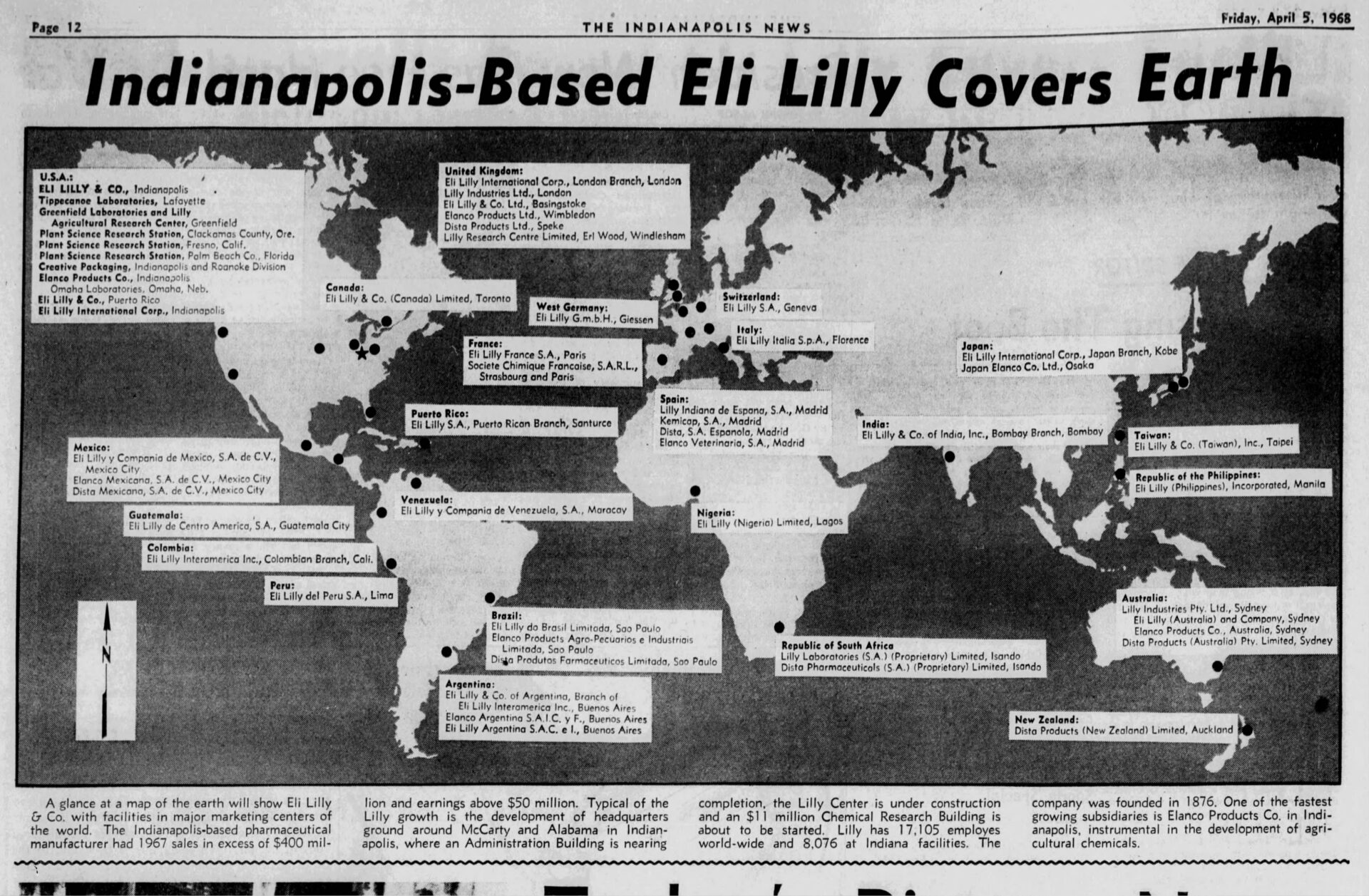
Indianapolis-Based Eli Lilly Covers Earth, April 5, 1968
The Indianapolis News
The first and only foreign brick and mortar consulate in Indiana was established in Indianapolis in 2002. The consulate opened its first office in Union Station on South Meridian Street. Before this, in 1999 and 2000, Indiana was one of Mexico’s largest trade partners. Per the mayor of Indianapolis’ report, this partnership supported 44,000 Hoosier jobs. Also, during those years, exports from Indiana to Mexico increased over 170%, totaling $2.2 billion in revenue for the State of Indiana. What caused this economic growth? It was in large part due to a trilateral trade agreement between Canada, the United States, and Mexico, called the North American Free-Trade Agreement (NAFTA), introduced during the Clinton administration. Indiana, otherwise known as the “Crossroads of America” benefited, namely in the development of the southern I-69 corridor which would continuously link a freight route from Indianapolis to the border of Mexico. Agreements like NAFTA and other previous labor related binational agreements, as early as 1918, have historically aided in the migration of Mexicans to the United States and Indiana.
Cubans and Puerto Ricans
In 1959, there was a mass exodus of Cuban nationals due to the revolution. They settled in Florida and later expanded to other areas of the U.S. In the 1960s the Migration and Refugee Assistant Act and the Immigration and Nationality Act, helped set the framework for the Cuban Adjustment Act of 1966. This act allowed individuals and their families to apply for legal permanent status after one year in the United States. Before this, in 1962, the Indianapolis News reported that 110 Cuban refugees were living in the city. This same year, the Cuban Association of Indiana was established with Orencio Diaz, Frank Rodriquez, and Rene Veliz, who were the organization’s first officers. In 1984, Orencio Diaz served as a translator and cultural advisor for the city of Indianapolis at the Pan American Sports Organization Congress in Mexico City, helping Indianapolis earn the bid for the 1987 Pan American games.
Puerto Rico has been a United States territory since 1898, following the Spanish-American War. As a population demographic, they were integrated on the U.S. decennial census since 1910. They are the only continuously reported Latino demographic on the U.S. census. After being granted U.S. citizenship in 1917 due to the Jones-Shafroth Act, they were ideal candidates for labor recruitment in mainland United States. From 1945-1960, many left the island to work on the mainland in agricultural jobs and factories. This period was called the Great Puerto Rican migration.
Indiana companies also invested in the island. In 1961, Stokely-Van Camp, Inc. leased a factory to operate a pineapple canning plant in Barceloneta, Puerto Rico. The factory was previously built and operated by the Puerto Rican government. Eli Lilly and Company had a plant in Puerto Rico by the mid-1960s. The draw for corporations to have additional locations in Puerto Rico was a tax exemption and tariff free access of goods and manufacturing. These types of investments raised the cost of living on the island after the establishment of Operation Bootstrap in 1947, which hit its peak in the 1950s.
Cubans were a noted foreign born population demographic, alongside with Mexicans, in the U.S. census state report. American born Latinos, except for Puerto Ricans, were statistically invisible until the 1980 census.
Central and South Americans
In the early 20th century, a few Latin Americans would leave their mark of contribution to the city of Indianapolis and beyond. Peruvian native, Louis Yolando Mazzini, after graduating from Indiana University, became a professor of serology at the Indiana University School of Medicine in 1924. He developed the Mazzini cardiolipin test for syphilis, which was faster and less costly than the commonly used Wasserman test.
An Ecuadorian priest, Mauro Rodas, served as a visiting priest at St. Mary’s Catholic church in downtown Indianapolis in the late 1960s. By 1967 St. Mary’s Catholic Church began to offer mass in Spanish, a first of Indianapolis. After becoming the official priest at St. Mary’s, his congregation would be described as Colombian, Costa Rican, Cuban and mostly Mexican and Mexican American. During his career he was influential in the formation of the Archdiocese’s Hispanic Apostolate. By 1995 the Archdiocese of Indianapolis would instruct all churches to offer a bilingual or Spanish language mass.
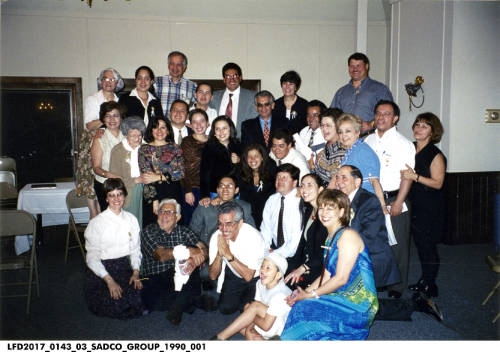
The late 1970s and early 1980s Indianapolis saw university students enrolling and young professionals coming from countries like Venezuela and Colombia. In 1981 the Sociedad Amigos de Colombia de Indiana (SADCO) formed, reflecting a growing presence. However, they were not a defined demographic reported on the census, rather combined in the “other” category. They both saw an increase in population in the 21st century.
Sociedad Amigos de Colombia de Indiana (SADCO), 1990s
Carmen DeRusha, IHS
The Immigration Act of 1990 created the Temporary Protected Status (TPS) program for countries to provide legal residency, work authorization permits, and protection from deportation for those who came from countries that had armed civil conflict, extreme environmental disasters, or other temporary crises. Though this did not provide a pathway to a green card or citizenship. After its creation, the first Latin American countries to be given TPS status were El Salvador, Honduras, Nicaragua, and Haiti. In 1995 there was a revision of the Cuban Adjustment Act of 1966. The Dry Foot/Wet Foot clause was amended, ending the “wet foot” provision for Cubans found in U.S. territorial waters, causing a surge in immigration before it was enacted.
The Central American Free Tade Agreement (CAFTA) was passed into law in 2005. This included Costa Rica, El Salvador, Guatemala, Honduras, Nicaragua, and later added the Dominican Republic. With the combination of TPS and CAFTA, of the 2000s saw a higher percentage of Hondurans, Guatemalans, El Salvadorians, Nicaraguans, and Dominicans in the United States and Indiana. To serve the growing diversity of Latinos in Indianapolis, the Indiana Latino Expo was established. The first Expo was held in 2012 at the Indiana State Fairgrounds where critical community needs such as mobile on-site consular services for different Latin American countries were provided.
Latinos in Indiana and Indianapolis come from a rich diverse cultural backgrounds, language, culture, and history. Who knows what the Latino population of Indiana will look like in another 100 years?