

I’ve written a lot about American’s former hubs in recent posts of this series, but none of them can say they were dehubbed by American twice. Only San Jose holds that… uh… well, let’s call it an honor. Within a span of 10 years, American took its hub away from the airport on two occasions, and that has certainly made an impact on the airport’s development over the years.
The first real terminal at SJC was built in 1965 at a bend in the airport road. It was made for ground-level boarding, and it wasn’t very large. But in later years it expanded to the northwest with more gate space. This would eventually become what in the end was known as Terminal C.

Unlike American’s Nashville and Raleigh/Durham hubs which were conjured from scratch, the San Jose hub came after buying AirCal in 1986. American liked what it saw in San Jose, and a new terminal A was planned to support this with 16 gates.
Terminal A was not connected to the existing terminal building, but American didn’t really care about that anyway. It just need to be able to connect to itself.

This hub stuck around until 1993 when American walked away. As often happens, another airline saw the vacuum left by American and decided to set up shop. In this case, it was Reno Air that stepped in. Reno Air started in 1992 from its, well, it’s Reno hub. But in 1993 it jumped at the chance to turn San Jose into a hub as well.
I had the chance to see this up close when I flew the airline down to LAX in 1997, but it wouldn’t last for long. American ended up buying Reno Air in 1999, and so once again, American found itself with a San Jose hub.
In 1999, of course, the economic climate was very different. Silicon Valley was in the heat of the .com boom, and American decided not only to keep the reacquired hub but grow it further with nonstops to places like Paris and Taipei. That required building new international arrival facilities just to the southeast of the existing gates in Terminal A, highlighted in red below.

But then, the bubble burst, 9/11 happened, and American walked away from the hub yet again. What an uncomfortably familiar place to be.
San Jose was left with an underutilized Terminal A and an old Terminal C in desperate need of modernization. I say that, but this is the time when I moved up to the area for grad school, and man did I love how easy it was to fly through Terminal C. I have many happy memories on America West going in and out over the years.
But, the airport went to work. The original plan was to build a giant, brand new terminal to replace everything, but that was scaled back to keep and expand the landside of Terminal A to better deal with local traveler demand. It would also create a big, new, Terminal B to replace Terminal C.
The northern part of Terminal C was shut down to make room for the Terminal B build. Terminal B was opened in 2010, and that’s when Terminal C was shut down for good. With Terminal C demolished, demand slowly increased to the point where the airport built eight extra gates at the southeastern end in an interim terminal extension between 2017 and 2019.

That’s where the airport is today, having 36 gates in total. All airlines are in Terminal A except for the airport’s largest tenant Southwest, Alaska/Hawaiian, and Zipair in Terminal B. So, what comes next?
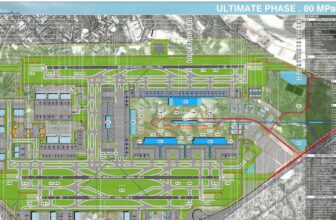
San Jose has a plan to basically create a mirror image of the existing Terminal B and paste it further to the southeast. The eight gates in the interim terminal will be demolished and replaced. There will then be an additional six gates built for a total of 42 at the airport.

That’s what the Environmental Assessment proposes, and it has been shown to have no impact. I don’t think timing has been set for this project, nor has funding been completed. But it will be necessary eventually. And since this is a largely local market where connections are minimal, it must not be overly concerning to SJC that they just keep building in a straight line along the runways.