


Public sector event teams face a problem private sector planners rarely do: every registration page is bound by accessibility law, procurement rules, and public accountability. So if you run federal, state, or municipal events, how do you choose event registration software for government events that clears those hurdles before your first attendee signs up? This guide walks through the challenges unique to government organizations, what to look for in a platform, and the questions that matter most before you commit.
A federal agency hosting a policy briefing, a city running a public consultation, a regulatory body organizing a stakeholder forum, and a public sector association managing its annual conference all share one reality. Each registration flow is shaped by procurement approval, accessibility obligations, records requirements, and the expectation that every attendee interaction is handled correctly.
The Unique Registration Challenges Government Organizations Face
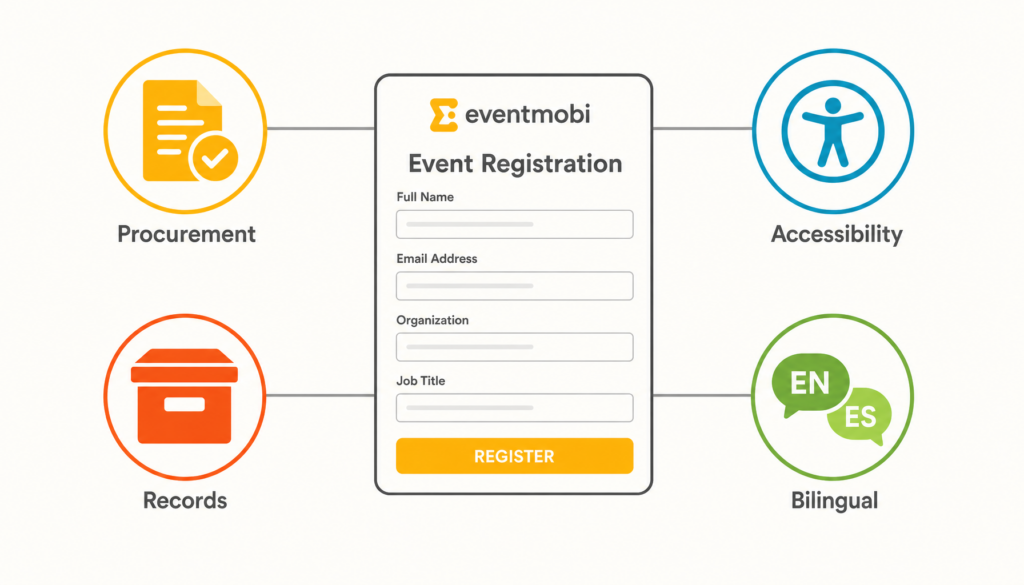
Four constraints shape government event registration, and generic event registration software wasn’t built to handle them: formal procurement, accessibility law, public record-keeping, and often bilingual service requirements. Understanding each one up front helps you scope a realistic evaluation and avoid a platform that fails a public sector test later.
Procurement Requirements and Vendor Approval
Government organizations typically buy software through formal procurement: Requests for Proposal (RFPs), vendor pre-qualification, security assessments, and contract approval processes. That process takes time. Euna Solutions’ 2026 State of Public Procurement report found that 46% of public sector procurement teams still manage procurement primarily through spreadsheets, email, or paper, so approvals stay slow and manual.
For event teams, the practical takeaways are clear:
- Start vendor evaluation earlier than a private sector timeline would suggest
- Favor platforms with transparent pricing and standard contract terms
- Confirm the vendor can supply security and compliance documentation quickly
Accessibility Compliance
Public-facing government events must comply with accessibility law, and the standard depends on your level of government. Getting this distinction right protects you from choosing a platform that meets the wrong benchmark.
- Federal agencies: Section 508 of the Rehabilitation Act requires federal agencies to make electronic and information technology accessible, using the current technical standard of Web Content Accessibility Guidelines (WCAG) 2.0 AA, per Section508.gov
- State and local governments: The Department of Justice (DOJ) April 2024 final rule under Americans with Disabilities Act (ADA) Title II requires WCAG 2.1 AA for websites, mobile apps, online forms, and third-party platforms used to deliver services, per ADA.gov
ADA Title II compliance is phased. State and local governments serving populations of 50,000 or more must comply by April 26, 2027, while smaller entities and special districts have until April 26, 2028, according to ADA.gov. Using a third-party registration platform does not transfer the obligation: the agency remains responsible for that platform’s WCAG 2.1 AA conformance.
The compliance gap is real. Only 23% of federal agencies’ top-viewed public internet pages are fully conformant with Section 508, according to the General Services Administration (GSA) FY24 Governmentwide Section 508 Assessment (December 2024, 245 federal reporting entities).
Public vs. Private Event Registration
Most public sector calendars mix two kinds of events: open ones (consultations, town halls, public forums) and restricted ones (staff training, internal briefings, stakeholder working groups). A single platform should handle both, with access controls configured per event. Open events may need barrier-free registration. Restricted events may need invitation-only gating, RSVP flows for curated lists, or access limited to a specific group. Managing both in one system cuts operational overhead and keeps attendee data in one place.
Transparency and Record-Keeping
Public accountability doesn’t stop at the event page. Registration data can end up in a freedom-of-information request, an audit, or an internal report, so exporting it in formats your records management system accepts is a practical requirement, not an afterthought.
Bilingual and Multilingual Requirements
Service in more than one language is standard for many public agencies, and registration is no exception. In practice, that means bilingual field labels, bilingual confirmation emails, and multilingual website content. Two practical approaches work well:
- Inline bilingual text in field labels and page content, for example, “Name / Nombre”
- An artificial intelligence (AI) concierge that detects a visitor’s language and responds in kind, reducing the burden on the registration site itself
Budget Constraints and Value Justification
Procurement teams scrutinize software costs, and event teams often have to justify a platform against the alternative of managing registration manually. Subscription pricing that covers all your events is more cost-effective for departments running several events per year. The value case is stronger still when one platform replaces multiple disconnected tools. You can review EventMobi’s pricing to model the per-year approach against your event volume.
What to Look for in Event Registration Software for Government
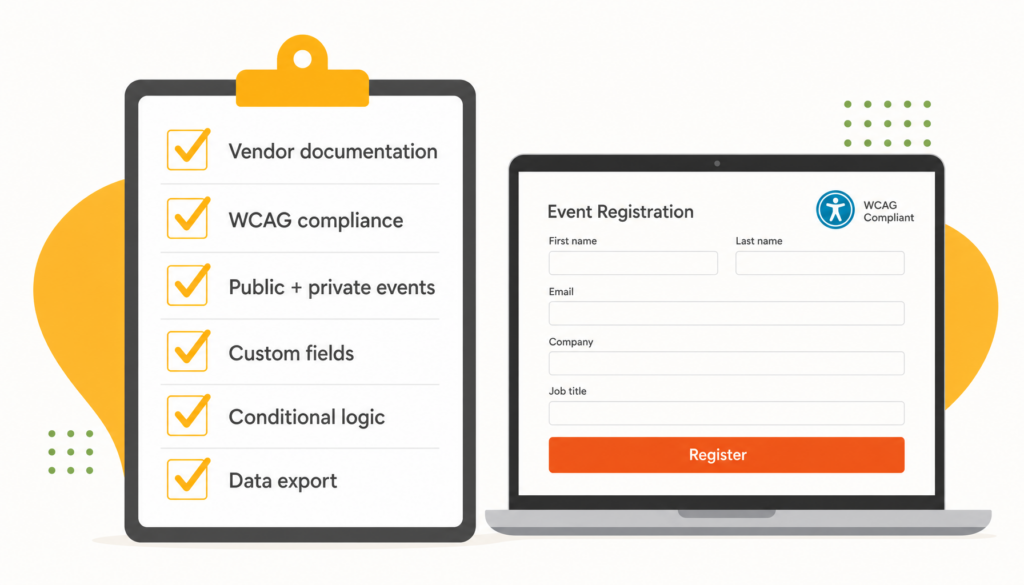
The right event registration software for government proves it meets public sector needs before you buy. That means procurement-friendly documentation on hand, accessibility conformance to the standard you actually need, support for both public and private events, and structured data export, not a sales pitch asking you to take it on faith. Use the checklist below to evaluate platforms against those needs, and treat each item as a question to confirm rather than an assumption.
Procurement-Friendly Vendor Documentation. Ask each vendor for clear pricing, standard contract terms, a data processing agreement, an accessible privacy policy, and any security attestations they hold, such as SOC 2 or ISO 27001 reports. Treat these as questions to confirm, not assumptions. The faster a vendor supplies this documentation, the smoother your procurement process runs.
Accessibility Standards Compliance. The platform’s website builder and registration forms need to produce output that meets the standard your level of government requires: WCAG 2.0 AA for federal agencies, WCAG 2.1 AA for state and local governments. Push on the specifics, keyboard navigation, screen reader compatibility, color contrast, accessible form field labeling, and run a sample output through an accessibility checker before you commit.
Public and Private Registration in a Single Platform. The platform should support open public registration and restricted, access-controlled registration in the same system, configured per event. EventMobi’s event registration software handles this with public and private form gating, RSVP with acceptance tracking, and Promo Codes that reveal hidden ticket tiers to specific groups only. Government teams should not need separate tools for public consultations and internal staff events.
Custom Form Fields for Government-Specific Data. Government events often need fields that generic forms omit: department or ministry affiliation, employee identifier, clearance level for restricted events, and language preference. A form builder with custom, event-specific fields handles this without workarounds.
Conditional Logic for Multiple Audience Types. When public attendees, government staff, elected officials, and media all register through one form, conditional logic keeps each experience relevant. EventMobi’s Form Conditions apply if/then logic that shows or hides fields based on a registrant’s selections, so you serve every audience type without fragmenting your data.
Bilingual and Multilingual Support. Organizations with official language obligations need to settle two things early: whether the platform supports bilingual labels and page content inline, and whether an AI concierge responds in the visitor’s language automatically. EventMobi’s MobiAI Reg Concierge covers both. Get this decided before your site is built, not after.
Integrated Email Communications. Government event emails often carry logistics, accessibility information, language options, and policy disclaimers. An email tool that reads directly from registration data lets you target by registration status, attendee type, and language preference without manual list management. EventMobi’s Communications Hub segments email by registration status from within the same platform.
Data Export and Records Management. The platform needs to export structured data in formats your records management systems accept. Registration data for government events often carries retention policies and access-to-information obligations that demand clean records, and EventMobi’s registration analytics support that export.
Common Government Event Registration Patterns

Common government events fall into a handful of registration patterns, from open public consultations to invitation-only stakeholder forums and internal staff briefings. Each one calls for a different mix of platform features, laid out below.
Public Consultation or Town Hall
- Open registration with no access barriers
- Basic attendee fields, plus optional location, primary language, and topics of interest
- High-volume registration management and straightforward communications
Stakeholder Forum or Working Group
- Invitation-only event for a curated list across industry, civil society, and other departments
- RSVP flow with acceptance tracking and private access controls
- Communications tailored to the stakeholder audience, often with bilingual requirements
Internal Policy Briefing or Staff Training
- Employee-only registration via access gating or invitation-only setup
- Simple form, free registration, logistics-focused communications, kept internal within the same platform you use for external events
Professional Association Conference (Public Sector)
For public sector associations such as municipal administrators, public works professionals, and government finance officers, registration mirrors the broader association model:
- Member and non-member pricing
- Multiple attendee categories
- Early bird tiers
- Multi-event subscription value
Annual Departmental or Interagency Conference
- Multi-day event spanning government staff, external partners, and sometimes the public
- Multiple ticket types with different access conditions
- A content-rich event website with agenda and speaker details
- Communications segmented by attendee type
Questions to Ask When Evaluating Platforms
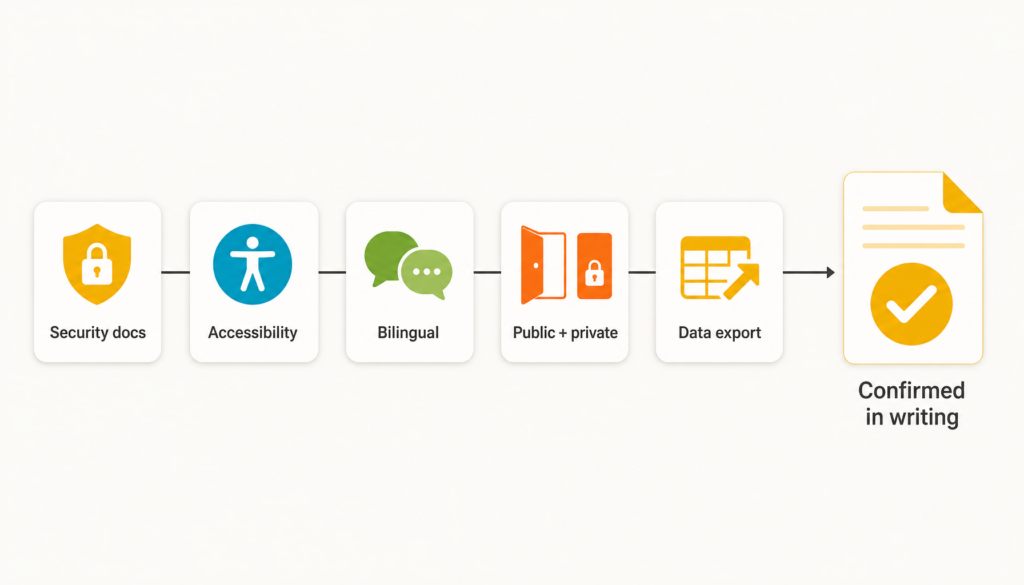
Five questions separate a procurement-ready government event platform from one that will stall your evaluation: security documentation, accessibility conformance, bilingual support, combined public and private registration, and data export for records management. Bring all five to every vendor conversation, and get the answers in writing.
Can the vendor supply the security documentation your procurement process needs? Ask for security attestations such as SOC 2 or ISO 27001 reports, a data processing agreement, and privacy policy documentation at the start of the evaluation. Do not assume this documentation exists until you have confirmed it.
Does the website builder produce output that meets your required accessibility standard? Ask for written confirmation, and test a sample output with an accessibility checker before committing. Match the answer to your level of government: WCAG 2.0 AA for federal, WCAG 2.1 AA for state and local. Accessibility is non-negotiable, not a nice-to-have.
Does the platform support bilingual or multilingual registration without separate setups? For organizations with official language obligations, get the specific approach in writing and test it before committing.
Does the platform support both public and private registration within a single subscription? Government departments run a mix of public-facing and restricted-access events, and both need to live in the same platform and the same subscription. Make sure that’s actually true before you sign.
What data export capabilities does the platform provide for records management? Ask about export formats, available data fields, and whether historical registration data stays accessible for records management and audit purposes.
Frequently Asked Questions
The Bottom Line
Government event registration comes down to four things: accessibility law, procurement rules, running public and private events in one system, and data governance that holds up to an audit. The platforms worth shortlisting handle all four without forcing you into a workaround.
When you evaluate platforms, accessibility compliance and security documentation should knock out anyone who can’t produce them fast. From there it comes down to bilingual support and whether one system actually covers the full range of events your department runs. Get those right, and the rest of the procurement process gets a lot smoother.
See how EventMobi’s event registration software supports public sector teams


